
Lord Padmanabha
पद्मनाभ
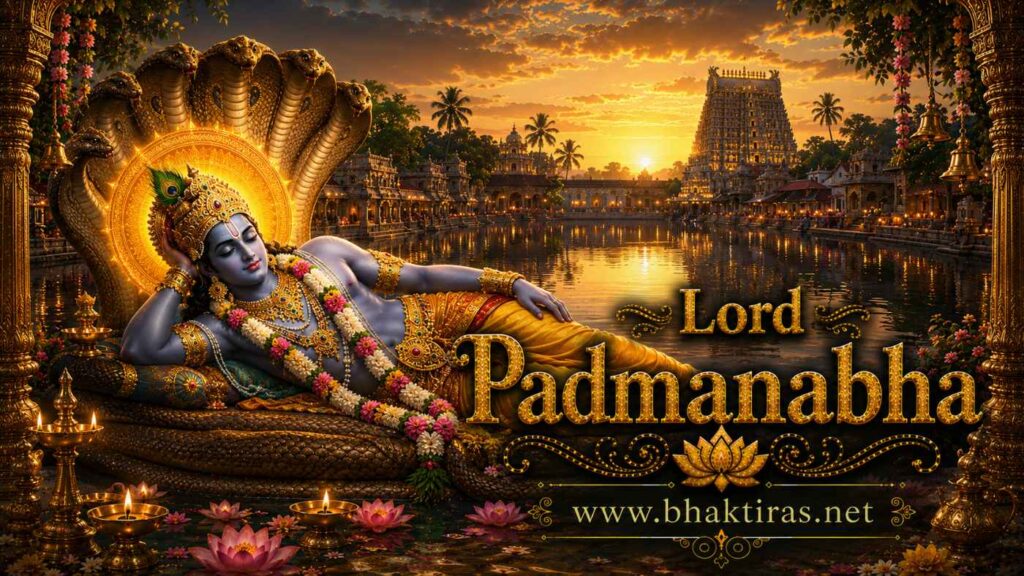
Lord Padmanabha is the form of Vishnu reclining in cosmic sleep upon the great serpent Anantha, with a lotus rising from his navel bearing Brahma the creator. He is the presiding deity of the Sree Padmanabhaswamy Temple in Thiruvananthapuram, Kerala, one of the 108 Divya Desams and among the wealthiest temples in the world.
Who Is Lord Padmanabha?
Lord Padmanabha is Vishnu at rest. Where many images of the Lord show him standing tall with conch and discus, or striding across the worlds, Padmanabha shows the other truth about the Supreme: that between the great ages of the universe he withdraws into a serene, oceanic sleep. The name itself carries the whole vision. Padma is the lotus, nabha is the navel. Padmanabha is the Lord from whose navel a lotus rises, and upon that lotus sits Brahma, the four-faced creator, ready to shape the next world.
His home is the Sree Padmanabhaswamy Temple in Thiruvananthapuram, the capital of Kerala. The very name of the city means the town of Anantha, the endless serpent, so the deity and the place share a single identity. For centuries pilgrims have come to the golden coast of Kerala to see this one great murti lying in yoga-nidra, the yogic sleep, and to feel that the Lord is not far away in some distant heaven but resting close at hand, breathing quietly at the heart of things.
Padmanabha belongs to the deep current of Vaishnava devotion in the south. He is counted among the 108 Divya Desams, the sacred abodes of Vishnu sung by the Alvar saints, and his temple is one of the oldest and most storied in the country. In modern times the world came to know his name for another reason: the sealed underground vaults of his temple, holding gold, gems, and offerings gathered over a thousand years, making it one of the wealthiest shrines on earth. Yet for the devotee the treasure was never the point. The treasure is the Lord himself, lying in peace, with a lotus growing from his navel and the whole of creation folded quietly inside him.
To meet Padmanabha is to meet a gentler face of the infinite: majesty at rest, power sleeping, the ocean calm before the next dawn of worlds.
The Lotus, the Serpent and the Cosmic Sleep
The form of Padmanabha is a single image that carries an entire cosmology. He lies stretched upon a giant serpent named Anantha, which means the Endless One, also called Adi Shesha, the primordial remainder. This serpent has a thousand hoods spread above the Lord like a living canopy, and its coils float upon the causal ocean, the shoreless waters that exist between one creation and the next. When a universe has run its course and dissolves back into its source, this is where the Lord rests: on Anantha, on the ocean, in a sleep that is not weariness but the calm withdrawal of a yogi.
This sleep has a name of its own, yoga-nidra, the yogic slumber. It is not unconsciousness. The Lord sleeps and yet remains awake within, holding the whole of existence in a kind of luminous dreaming. Nothing is lost in that sleep. Every world that was, and every seed of the worlds to come, is kept safe in him as a tree is kept safe in its seed.
Then comes the miracle at the center of the name. From the navel of the sleeping Lord a lotus rises on a long slender stalk, and seated upon its open petals is Brahma, the four-faced creator. Brahma does not make the world out of nothing; he is himself born from Vishnu, drawn up out of the resting Lord like a flower out of still water. So the image tells the deepest order of things. First the Supreme at rest, then the lotus of possibility, then the creator upon it, and only then the countless worlds. Creation is not a rupture in the peace of God. It blossoms out of that peace, like a lotus opening from a navel, and returns to it again when the long day is done.
The Temple of Thiruvananthapuram
The Sree Padmanabhaswamy Temple rises in the old heart of Thiruvananthapuram, its tall gopuram a landmark visible across the city. Built and rebuilt over long centuries in the Kerala and Dravidian styles, its granite corridors and carved wooden ceilings have sheltered the reclining Lord for as far back as tradition can reach. The Alvar saint Nammalvar sang of this shrine more than a thousand years ago, which places it firmly among the 108 Divya Desams, the abodes of Vishnu most beloved to the Tamil devotees.
What makes the darshan here unlike any other is the sheer size of the deity. The murti of Padmanabha, made in the ancient kadu-sharkara-yogam method from a mixture of many sacred materials, is so long that no single doorway can hold him in one view. The devotee sees the Lord through three separate doors. Through the first opens the face and the crowned head, with the serpent above and the right hand resting over a small Shiva linga. Through the second appears the lotus rising from the navel with Brahma seated upon it. Through the third are the divine feet, which devotees revere last of all. To take in the whole Lord one must move, and pray, and look again, so that the darshan itself becomes a slow pilgrimage from his head to his feet.
In the twenty-first century the temple drew the eyes of the world for its hidden wealth. Beneath the sanctum lie sealed vaults, known by the letters given to them, kept shut for generations. When some were opened under the order of the courts, they revealed staggering quantities of gold, precious stones, ceremonial objects, and offerings laid up by kings and pilgrims across the ages. By many reckonings this made Padmanabha’s shrine one of the richest temples anywhere on earth. Yet the vaults were never a bank. They were the accumulated love of countless devotees, given to the Lord and left in his keeping, and the temple has always insisted that what lies there belongs to Padmanabha alone.
Padmanabha Dasa – the Lord as King
No account of Padmanabha is complete without the extraordinary bond between the Lord and the royal house of Travancore. In the eighteenth century the great king Anizham Thirunal Marthanda Varma, who welded many small principalities into the kingdom of Travancore, made a decision that would define the dynasty forever. In a solemn ceremony known as the Thrippadidanam, he surrendered his entire kingdom, its lands, its wealth, and its people, at the feet of Lord Padmanabha.
From that day the king no longer ruled as sovereign in his own name. He and every ruler after him governed only as Padmanabha Dasa, the servant of Padmanabha, and the queens as Padmanabha Sevini. The true and eternal king of Travancore was the reclining Lord in the temple. The human ruler was merely his steward, holding the land in trust and answering to him. Every act of state, in a sense, was carried out in the Lord’s name and for his sake.
This was not empty ceremony. It shaped how the dynasty saw itself and its duty for two hundred years. To rule as a servant, to hold power as a trust rather than a possession, is a rare and humbling idea, and Travancore lived by it. Even today the head of the former royal family bears the title Padmanabha Dasa and performs devoted service at the shrine. The kingdom is gone, but the surrender remains, a reminder that the highest crown a ruler can wear is the willingness to lay his crown at the feet of God.
The Meaning of the Reclining Lord
Why does the Supreme lie down? Of all the questions the image of Padmanabha raises, this is the one that opens the heart. We are used to picturing God as active, watchful, ceaselessly at work. The reclining Lord answers with a quieter truth. Before there is any doing, there is being. Before creation stirs, there is the deep, unhurried rest of the divine, and it is out of that rest that everything comes.
The lotus rising from the navel says it plainly. Creation is not forced or laborious for the Lord. It unfolds from him as naturally and beautifully as a flower opens from water. Brahma, the busy maker of worlds, is himself a blossom on that stalk, dependent every moment on the sleeping Lord beneath him. The lesson for the devotee is a kind of peace. If the whole universe grows from the calm of God, then the anxious striving we so often mistake for life is not the deepest thing. Underneath our restlessness lies the same still ocean on which the Lord reclines.
There is also comfort in this rest. Anantha, the serpent, is endlessness itself, and the Lord who sleeps upon it is untouched by the ending of worlds. Ages rise and dissolve, kingdoms are built and forgotten, but Padmanabha lies serene through all of it, holding creation safe in his sleep. To bow before him is to remember that whatever passes away, the ground of things does not; that at the center of all change there is one who rests in perfect, unbroken peace, and that we too belong to that peace.
Iconography and Symbols
Every element of the Padmanabha murti carries meaning. The image below unfolds the symbols the devotee sees in the great reclining form.
Anantha, the endless serpent
The Lord reclines on Adi Shesha, the thousand-hooded serpent whose name means the Endless One. Its coils are the causal ocean between the ages, and its raised hoods form a living canopy of shelter over the resting Lord.
The lotus and Brahma
From the navel of Padmanabha a lotus rises on a slender stalk, bearing Brahma the four-faced creator. It shows that the maker of worlds is himself born from Vishnu, and that creation blossoms gently out of the Lord’s rest.
Yoga-nidra, the cosmic sleep
The half-closed eyes and serene face show the yogic slumber, a sleep that is inward wakefulness. The Lord is not weary; he holds all worlds within him like seeds, dreaming the universe into being and out of it again.
The hand over the Shiva linga
The right hand of Padmanabha extends gracefully over a small Shiva linga placed beneath it. Devotees read this as the harmony of the great gods, Vishnu honouring Shiva, the two faces of the one Supreme in loving accord.
Sridevi and Bhudevi
Near the reclining Lord stand or attend his consorts, Sri or Lakshmi, goddess of fortune, and Bhudevi, the earth. They are his inseparable powers, grace and abundance seated close beside cosmic rest.
Darshan through three doors
Because the murti is so vast, it is revealed through three openings: the head and serpent, the lotus-navel with Brahma, and the sacred feet. The devotee moves from door to door, making the very act of seeing a small pilgrimage.
How Lord Padmanabha Is Worshipped
Worship of Padmanabha follows the rich temple traditions of Kerala, with daily rituals, festival seasons, and the quiet personal devotion of the pilgrim who has travelled far for a single darshan. Here are some of the ways devotees turn toward the reclining Lord.
- Darshan through the three doors: The heart of worship here is simply to see the Lord, moving between the three openings to behold his head, his lotus-navel, and his feet, and to bow at each.
- Chanting his name and mantra: Repeating Om Namo Bhagavate Padmanabhaya or singing the Vishnu Sahasranama, the thousand names of Vishnu, is a beloved way to invoke his presence.
- Observing Ekadashi: The eleventh day of the lunar fortnight is kept as a day of fasting and remembrance of Vishnu, especially dear to devotees of Padmanabha.
- Following the temple dress code: Traditional attire is required for entry, men in a mundu and bare-chested, women in sari or set-mundu, a discipline that itself becomes an act of reverence.
- Joining the great festivals: The twice-yearly Painkuni and Alpashy festivals, ending in the grand Aarat procession to the sea, draw devotees into the deepest celebration of the Lord.
- Offering service in humility: In the spirit of the Travancore kings, many devotees offer themselves as servants of Padmanabha, giving what they can and leaving the rest in his keeping.
Temples and Sacred Sites
Thiruvananthapuram is the supreme abode of Padmanabha, but the reclining form of Vishnu, Ananthashayana, is honoured at sacred sites across India. These are some of the places where the Lord is worshipped in his cosmic rest.
- Sree Padmanabhaswamy Temple, Thiruvananthapuram: The great abode of Padmanabha, a Divya Desam and the tutelary shrine of the Travancore royal house, where the Lord is seen through three doors.
- Ananthapura Lake Temple, Kasaragod: A serene shrine in northern Kerala set in the middle of a lake, revered as the original seat, the moola sthanam, of Padmanabha before Thiruvananthapuram.
- Ranganathaswamy Temple, Srirangam: The foremost of the Divya Desams, where Vishnu reclines as Ranganatha on Anantha, a close kin in form and spirit to Padmanabha.
- Padmanabhapuram, Tamil Nadu: The old capital of Travancore, whose very name honours the Lord, home to the historic wooden palace of the Padmanabha Dasa kings.
- Ananta Padmanabha temples of Karnataka: Several shrines in coastal Karnataka and the Konkan enshrine Ananta Padmanabha, carrying the devotion to the reclining Lord along the western coast.
Prayers and Mantras
The simplest and most cherished prayer to the reclining Lord is his root mantra, a call upon his name that carries the whole devotion of the Divya Desam within it. Chant it softly, morning or evening, and let the mind rest as the Lord rests.
Devanagari: ॐ नमो भगवते पद्मनाभाय
Transliteration: Om Namo Bhagavate Padmanabhaya
Meaning: I bow to the Divine Lord Padmanabha, the Supreme who reclines in cosmic sleep with the lotus of creation rising from his navel. In uttering his name the devotee surrenders, as the kings of Travancore once surrendered, at the feet of the endless Lord.
Frequently Asked Questions about Lord Padmanabha
Who is Lord Padmanabha?
Lord Padmanabha is the form of Vishnu reclining in yogic cosmic sleep upon the great serpent Anantha, with a lotus rising from his navel bearing Brahma the creator. He is the presiding deity of the Sree Padmanabhaswamy Temple in Thiruvananthapuram, Kerala, and one of the abodes of Vishnu sung as the 108 Divya Desams.
Why is Padmanabha shown reclining on a serpent?
The reclining pose is yoga-nidra, the cosmic sleep the Lord enters between the ages of the universe. He rests on Anantha, the endless serpent floating on the causal ocean, holding all worlds safely within him. Creation then blossoms from his navel like a lotus, showing that the universe unfolds gently out of the divine rest.
Where is the Padmanabhaswamy temple?
The Sree Padmanabhaswamy Temple stands in Thiruvananthapuram, also called Trivandrum, the capital of Kerala in South India. The city's name itself means the town of Anantha, the serpent on which the Lord reclines, so the deity and his city share a single sacred identity.
What does the name Padmanabha mean?
Padmanabha means the lotus-naveled Lord, from padma, lotus, and nabha, navel. It refers to the lotus that rises from Vishnu's navel bearing Brahma the creator. The name captures the entire vision of the deity: the Supreme at rest, from whom the flower of creation and its maker are born.
Why is the murti viewed through three doors?
The reclining image of Padmanabha is so vast that no single doorway can show it whole. Devotees see the Lord through three separate openings: the first reveals his head and the serpent, the second the lotus-navel with Brahma, and the third his sacred feet. Seeing the full Lord thus becomes a small pilgrimage in itself.
Why are the Travancore kings called Padmanabha Dasa?
In the eighteenth century King Marthanda Varma surrendered his entire kingdom to Lord Padmanabha in the Thrippadidanam ceremony. From then on the rulers of Travancore governed not as sovereigns but as Padmanabha Dasa, servants of Padmanabha, holding the land in trust for the Lord who was the true and eternal king.
Why is the temple called one of the wealthiest in the world?
Beneath the sanctum lie sealed vaults holding gold, gems, and offerings gathered over a thousand years by kings and devotees. When some were opened under court order, they revealed treasures of extraordinary value, making the shrine among the richest anywhere. For devotees this wealth is simply love laid at the Lord's feet and left in his keeping.
What is the mantra of Lord Padmanabha?
The root mantra is Om Namo Bhagavate Padmanabhaya, meaning I bow to the Divine Lord Padmanabha. Chanted softly morning or evening, it invokes the reclining Lord and expresses surrender to him, echoing the surrender of the Travancore kings at his feet.
May the reclining Lord who rests on the endless serpent hold you in his quiet peace, and may the lotus of his grace unfold gently in your heart.