
Lord Ranganatha
रंगनाथ
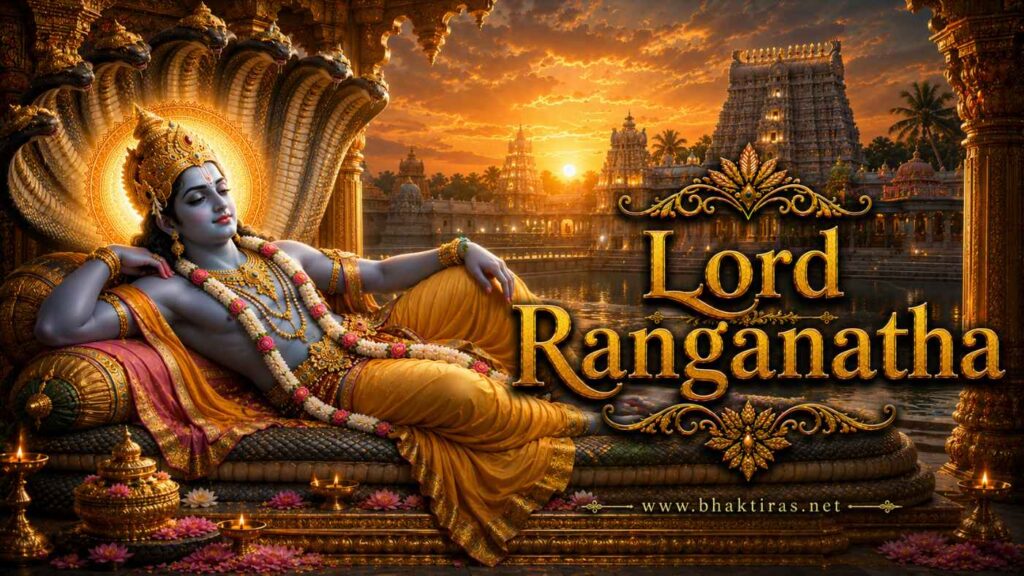
Lord Ranganatha is the reclining form of Vishnu, resting upon the coils of the serpent Adi Shesha on the milk ocean. He is the presiding deity of the Ranganathaswamy Temple at Srirangam, first and largest of the 108 Divya Desams. His consort is Ranganayaki, a form of Lakshmi.
Who Is Lord Ranganatha
Lord Ranganatha is Vishnu at rest. Where many images of the Lord show him upright, discus and conch in hand, ready to act, Ranganatha lies at ease, stretched along the coils of the great serpent Adi Shesha, his eyes half-open and endlessly kind. This is the Lord who has finished nothing and abandoned nothing; his rest is not sleep but a watchful calm, holding the whole of creation in his gaze even as he seems to slumber on the milk ocean.
He is the presiding deity of the Ranganathaswamy Temple at Srirangam, an island town cradled between two arms of the Kaveri river in Tamil Nadu. To the people who love him, he is simply Perumal, ‘the great one’, and the festival image who moves among the crowds is Namperumal, ‘our own Perumal’. They also call him Azhagiya Manavalan, the beautiful bridegroom, a name warm with affection rather than distance.
Srirangam is counted as the first and foremost of the 108 Divya Desams, the sacred abodes of Vishnu that the Alwar saints sang into memory. Of all those hundred and eight, this is the one the tradition places at the head, the temple the poets returned to again and again. Its walls enclose a whole living town, and generations have been born, married, and carried to the river within sight of its gopurams.
To worship Ranganatha is to draw near to a Lord who is majestic and yet completely approachable, a king who reclines like a friend resting in his own home and invites you to come and sit beside him.
The Lord Who Reclines on the Serpent
The heart of Ranganatha’s form is his posture. He lies upon Adi Shesha, the primeval serpent whose thousand hoods spread above him like a canopy. Shesha means ‘the remainder’, that which is left when all else has dissolved, and so the Lord rests on the one thing that endures beyond every cycle of creation and dissolution. The serpent is his bed, his shade, and his devoted servant all at once.
Beneath them both spreads the Kshira Sagara, the ocean of milk. This is not idleness. In the old teaching, the reclining Vishnu is the still centre from which the worlds unfold; the lotus rises from his navel, and upon it Brahma sits to begin the work of making. So Ranganatha’s rest is fertile and alive, a stillness pregnant with everything that will come. When devotees stand before the reclining image in the innermost shrine, they are looking at the source, the quiet place from which the moving world pours out.
There is tenderness in the posture too. A Lord who reclines is a Lord at home, unguarded, close. He does not tower over the worshipper from a throne; he lies at eye level, one hand resting near his crowned head, face turned gently toward whoever comes. The Sri Vaishnava poets loved this intimacy and returned to it constantly, singing of the sleeping-yet-waking Lord who keeps watch through the night over the ones who cannot sleep for love of him.
The Temple of Srirangam
The temple that holds Ranganatha is one of the great works of the human spirit. It is built as seven concentric enclosures, called prakaras, wrapped one inside the next like the rings of a shell, with the shrine of the reclining Lord at the very core. To walk inward from the outer wall to the sanctum is to pass through streets, gateways, pillared halls, and courtyards, moving step by step from the everyday world toward the still heart where the Lord lies.
Rising above the enclosures are the gopurams, the tall gateway towers that make Srirangam visible from far across the river plain. The southern Rajagopuram climbs to a great height and is among the tallest temple towers in Asia, a pale ridge of sculpture catching the first light of morning. Older gopurams, carved over many centuries by many hands, ring the inner prakaras, so that the whole complex reads like a history of Tamil temple building written in stone.
Because those seven enclosures wrap a living town within them, Srirangam is often described as the largest functioning Hindu temple in the world. Families live in the outer streets; shops, homes, and the daily business of a community share the same walls that guard the sanctum. The temple is not a monument set apart but the beating centre of an inhabited place, and the Lord at its core is a neighbour as much as a king.
This is why the tradition names Srirangam bhuloka Vaikuntha, ‘heaven upon the earth’. It is the first of the Divya Desams not only in rank but in the imagination of the devout, the place where the distance between the worshipper and the Lord grows thinnest.
The Heart of Sri Vaishnavism
Srirangam is the spiritual home of Sri Vaishnavism, the great southern tradition of devotion to Vishnu and his consort Sri, or Lakshmi. Its most beloved teacher, the acharya Ramanuja, spent the long central years of his life here, ordering the temple’s worship, teaching, and drawing the scattered strands of devotion and philosophy into one clear path. His presence still lingers in the enclosures; a shrine within the temple honours him, and his teaching shaped the way generations have understood the reclining Lord.
Long before the acharyas came the Alwars, the twelve poet-saints whose Tamil hymns are gathered as the Nalayira Divya Prabandham, the four thousand verses. They wandered the sacred places singing of Vishnu in a voice thick with longing, and Srirangam drew their deepest songs. Thondaradippodi Alwar tended the Lord’s garden and strung his garlands; others poured out verses of separation and reunion, of a soul aching for a Lord who lies so near and yet just out of reach.
Dearest of all is Andal, the girl-saint who loved Ranganatha as a bride loves her groom. She wove garlands and, in her love, wore them herself before offering them, until the Lord accepted the flowers her body had touched as the sweetest gift of all. The tradition tells that she was at last united with Ranganatha at Srirangam, carried into the sanctum as his bride. Her Tiruppavai and her fierce, tender verses are sung there to this day, and through her the temple became a place where love for the Lord is spoken in the frank language of the heart.
Vaikuntha Ekadashi and the Gate of Heaven
Of all the days in the Srirangam year, none draws the crowds like Vaikuntha Ekadashi, which falls in the bright fortnight of the month of Margazhi, around December or January. On this day the temple opens a doorway it keeps shut through the rest of the year: the Paramapada Vasal, the gate of the supreme abode, the very threshold of Vaikuntha.
In the deep dark before dawn the festival image of Namperumal is carried in procession toward this northern gateway, and the doors are thrown open. Then, in an unbroken stream that lasts through the day, hundreds of thousands of devotees pass through the Paramapada Vasal behind the Lord. To walk through that gate in his company is understood as a passage toward liberation itself, a rehearsal of the soul’s final journey home, made in the flesh while still alive.
The belief is old and simple: that whoever passes through the gate of heaven on this sacred day, following the reclining Lord, is drawn toward the shore of moksha. Whole families come, the elderly leaning on the young, all of them moving with the crowd through that single opening. For one day the ordinary distance between earth and Vaikuntha is set aside, and the temple becomes, quite literally, a doorway. It is the most intimate promise Ranganatha makes to those who love him, and the day the whole Sri Vaishnava world turns its face toward Srirangam.
Iconography and Symbols
The Reclining Posture
Ranganatha lies full length on his side, the pose called Ananta Shayana, ‘rest on the endless one’. His right hand curves gently near his crowned head; the whole figure speaks of ease and majesty together. This is Vishnu as the still source of the worlds, resting yet awake.
Adi Shesha the Serpent
The many-hooded serpent Adi Shesha forms both his couch and his canopy. Shesha is ‘the remainder’, that which survives every dissolution, and by resting on him the Lord shows that he abides beyond all cycles of time. The spread hoods shelter the sleeping Lord like a living crown.
The Milk Ocean
Beneath the Lord spreads the Kshira Sagara, the ocean of milk, the primal waters from which creation arises. From Vishnu’s navel a lotus unfolds, and on it Brahma begins to shape the worlds. The still Lord is thus the fountain of all that moves.
Conch and Discus
As Vishnu, Ranganatha is known by the conch Panchajanya and the discus Sudarshana, his signs of sovereignty over sound and time. At Srirangam the Sudarshana chakra is honoured in its own shrine, worshipped as a fierce, protecting presence beside the gentle reclining Lord.
Ranganayaki, the Consort
Sri Ranganayaki, a form of Lakshmi, has her own shrine within the complex and her own following of devotees. She is grace and abundance, the compassionate side of the Lord that intercedes for the soul. In Sri Vaishnavism the two are never truly parted; to reach him you first turn to her.
The Vaishnava Marks
The Lord and his devotees wear the tilaka of the Sri Vaishnavas, two upright white lines meeting at the brow with a stroke of red between them, the namam. It marks the feet of the Lord and the presence of Sri, worn on the forehead as a sign of belonging to him.
How Lord Ranganatha Is Worshipped
Worship of Ranganatha is warm, unhurried, and woven through with song. Devotees come to sit before the reclining Lord, to sing the Tamil hymns of the Alwars, and simply to be near him. A few gentle practices carry the heart of that devotion.
- Visiting the sanctum at Srirangam to have darshan of the reclining Lord, and moving slowly inward through the seven prakaras as a walk from the world toward the divine.
- Reciting the Nalayira Divya Prabandham, the four thousand Tamil verses of the Alwars, especially the songs sung for Srirangam.
- Chanting the simple name-mantra Om Shri Ranganathaya Namah, and repeating the Lord’s dear names, Perumal, Namperumal, Azhagiya Manavalan.
- Offering fresh tulsi (holy basil) and flower garlands, remembering Andal who wove garlands for him with her own love.
- Keeping the great festivals, above all Vaikuntha Ekadashi with its passage through the Paramapada Vasal, and the Adhyayana Utsava of hymn-recitation in Margazhi.
- Honouring the acharya Ramanuja and the line of teachers who kept the tradition of Sri Vaishnavism alive at Srirangam.
- Turning first to Sri Ranganayaki, the Lord’s consort, whose grace opens the way to him.
Temples and Sacred Sites
Srirangam is the great centre, but the reclining Lord is worshipped at many of the Divya Desams and in Vishnu temples across the south. A few places hold him especially close.
- Ranganathaswamy Temple, Srirangam – the first and largest Divya Desam, home of Namperumal, an island temple of seven prakaras between two arms of the Kaveri.
- Adi Ranga, Srirangapatna (Karnataka) – the ‘first Ranga’, the upstream shrine of the reclining Lord on the Kaveri, counted with the island temples of the three Rangas.
- Madhya Ranga, Shivanasamudra – the ‘middle Ranga’ on the Kaveri, the second of the three great island temples of Ranganatha.
- The wider circle of the 108 Divya Desams, the sacred abodes of Vishnu sung by the Alwars, of which Srirangam is held foremost.
- Vishnu temples across Tamil Nadu and the Sri Vaishnava world where the reclining Ananta Shayana form is worshipped and the Prabandham is sung.
Prayers and Mantras
The simplest way to hold Ranganatha in the heart is his name itself, spoken with love. The core mantra places the mind at the feet of the reclining Lord of Srirangam.
Mantra (Devanagari):
ॐ श्री रंगनाथाय नमः
Transliteration:
Om Shri Ranganathaya Namah
Meaning:
‘Om, salutations to the venerable Ranganatha.’ In these few words the devotee bows before the Lord of the sacred stage of Srirangam, the reclining Vishnu, offering the whole self at his feet. Repeated softly, it becomes a companion for the heart, a way of staying near the Lord long after leaving the temple gates.
Frequently Asked Questions about Lord Ranganatha
Who is Lord Ranganatha?
Lord Ranganatha is the reclining form of Vishnu, resting on the coils of the serpent Adi Shesha upon the ocean of milk. He is the presiding deity of the Ranganathaswamy Temple at Srirangam and is lovingly called Perumal and Namperumal. His consort is Ranganayaki, a form of Lakshmi.
Where is the Ranganatha temple?
The great Ranganathaswamy Temple stands at Srirangam, an island town held between two branches of the Kaveri river near Tiruchirappalli in Tamil Nadu. Built as seven concentric enclosures ringed by towering gopurams, it is counted the first and largest of the 108 Divya Desams.
What is Vaikuntha Ekadashi at Srirangam?
Vaikuntha Ekadashi, in the month of Margazhi, is Srirangam's greatest day. The temple opens the Paramapada Vasal, its 'gate of heaven', shut the rest of the year. Behind the festival image of Namperumal, hundreds of thousands of devotees pass through the gate, a passage understood to draw the soul toward liberation.
Why does Lord Ranganatha recline?
The reclining posture, called Ananta Shayana, shows Vishnu as the still source of the worlds, resting on the endless serpent upon the milk ocean. His rest is not sleep but a watchful calm from which creation unfolds. The pose also expresses tenderness: a Lord at home, close and unguarded, lying at the level of those who come to him.
What does the name Ranganatha mean?
Ranganatha means 'Lord of the ranga', the master of the sacred stage or arena, which is understood as Srirangam itself. Devotees also call him Perumal ('the great one'), Namperumal ('our own Perumal'), and Azhagiya Manavalan, 'the beautiful bridegroom', names full of affection for a Lord felt to be near.
Who was Andal and how is she linked to Ranganatha?
Andal is the girl-saint and Alwar who loved Ranganatha as a bride loves her groom. She wove garlands for him and, in her love, wore them before offering them, which he received as the sweetest gift. The tradition tells that she was united with Ranganatha at Srirangam as his bride, and her Tamil verses are sung there still.
What is Ranganatha's connection with Sri Vaishnavism and Ramanuja?
Srirangam is the spiritual heart of Sri Vaishnavism, the southern tradition of devotion to Vishnu and Lakshmi. The great acharya Ramanuja lived and taught here for many years, ordering its worship and teaching, and a shrine within the temple honours him. The hymns of the twelve Alwars, gathered as the Divya Prabandham, are central to its worship.
May the gracious Lord of Srirangam, who reclines in endless calm upon the serpent of eternity, turn his gentle gaze toward you and draw your heart toward his feet.