
Lord Indra
इन्द्र
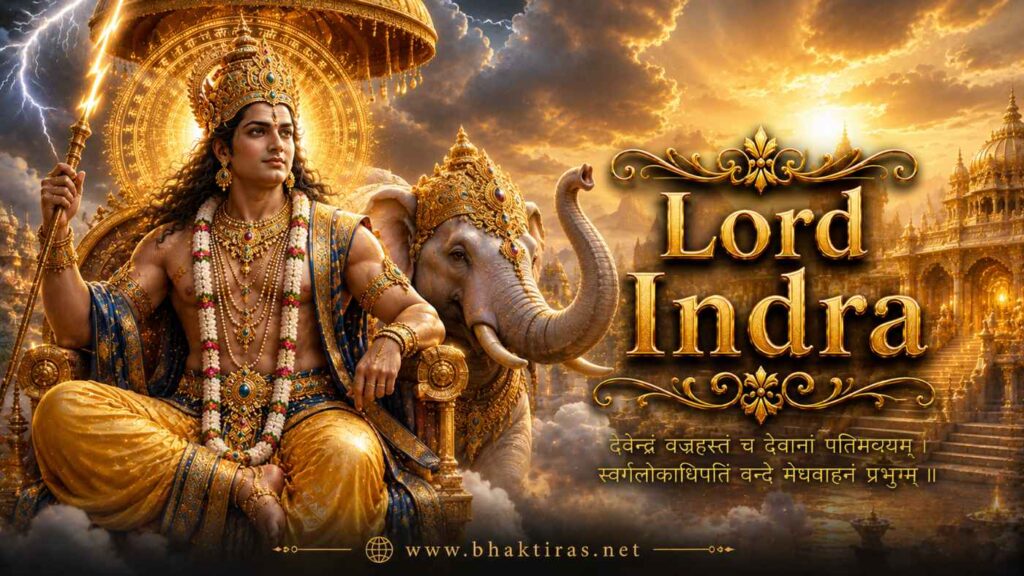
Indra is the Vedic king of the devas, the god of rain, thunder, storms and war. He rules the heavenly city of Amaravati, rides the white elephant Airavata, and wields the vajra, a thunderbolt forged from the bones of sage Dadhichi. In the Rigveda he receives more hymns than any other god.
Who Is Lord Indra
Indra is the old king of the gods, the deity who reigns over the visible heavens where clouds gather and lightning splits the sky. To the poets of the Rigveda he was the first god they turned to for help: he brings the rain that feeds the harvest, he leads the devas into battle against the demons, and he holds the vajra, the thunderbolt no enemy can withstand. No other deity is praised in as many Vedic hymns.
His character is drawn in bold, human strokes. He is powerful and generous, but also fond of the sacred soma drink, quick to pride, and sometimes reckless. The Vedic seers loved him for exactly this vigour – he is a warrior-king, not a distant abstraction, a god you could imagine roaring across the storm-clouds on his chariot.
Indra rules from Amaravati, a city of gold set within the paradise of Svarga. There the apsaras dance, the gandharvas sing, and the wish-granting tree Kalpavriksha stands beside him. His consort is Shachi, also called Indrani, and his mount is the great white elephant Airavata.
Over the long span of Hindu tradition his standing shifted. The supreme storm-lord of the Vedas gradually became, in the Puranas, a more limited figure – a king who can be humbled, tested, and taught. That change is part of what makes his story so rich, and this page follows it honestly.
The King of the Devas & His Court
As देवेन्द्र Devendra, king of the devas, Indra presides over the heavenly realm the way an earthly monarch presides over a kingdom. His seat is Amaravati, a city whose walls and towers are said to shine with gold and gems, ringed by the pleasure-gardens of Nandana where fragrant flowers never wither.
In his assembly hall, the Sudharma, gather the many beings of the celestial world. Apsaras such as Urvashi, Menaka and Rambha dance for the court; gandharvas provide the music; sages and lesser gods attend upon him. The wish-fulfilling tree Kalpavriksha grows here, one of the treasures churned from the cosmic ocean, and so does the divine cow Kamadhenu in some tellings.
Indra’s mount, the four-tusked white elephant Airavata, rose from the same churning of the ocean (the Samudra Manthan), as did the seven-headed white horse Uchchaihshravas. His throne is the seat of cosmic order in the sky, and his position as Indra is one he must defend – for in Hindu cosmology, being Indra is less a fixed identity than an office that different beings hold across the vast ages of time.
Iconography & Symbols
Indra is usually shown as a golden, richly ornamented king, seated on Airavata or on his war-chariot, weapon in hand. Each of his emblems carries meaning drawn from his role as storm-god and ruler of the heavens.
The Vajra
His thunderbolt, forged from the bones of the sage Dadhichi, who gave up his body so the gods could make a weapon powerful enough to defeat their enemies. Hard as diamond and irresistible as lightning, the vajra is the emblem of Indra’s authority.
Airavata
The great white elephant, milk-pale and often shown with several tusks or heads. As Indra’s vahana, Airavata links him to the rain-bearing clouds, which old poets pictured as a herd of celestial elephants.
The Thousand Eyes
Indra is called Sahasraksha, ‘the thousand-eyed’. The name comes from a story of a curse later softened into eyes, and it also marks him as the all-seeing watcher of the sky and its weather.
The Golden Chariot
Drawn by tawny horses, Indra’s chariot carries him across the heavens into battle. It is the vehicle of the warrior-king, thundering at the head of the deva armies.
The Rainbow
The rainbow is called Indradhanush, ‘Indra’s bow’. When the storm-god sets down his weapon of war, its arc across the cleared sky becomes a sign of the rain he has given and the peace that follows.
The Slaying of Vritra
Releasing the Waters
The greatest of Indra’s Vedic deeds is his battle with Vritra, a vast serpent-demon who coiled around the mountains and held back the waters of the world, leaving the rivers dry and the earth parched. Vritra was a formidable foe, and the gods were helpless before him. To arm Indra, the sage Dadhichi willingly surrendered his own body so that his indestructible bones could be forged into the vajra. Strengthened by soma, Indra rode out and struck Vritra with the thunderbolt, splitting open the demon and freeing the pent-up rivers. The waters rushed down to the sea, and life returned to the land. For the Vedic poets this was not just a myth but the story of every monsoon – the moment the withheld rain finally breaks free. The deed earned Indra one of his proudest titles, Vritrahan, ‘the slayer of Vritra’, and it stands at the very centre of his worship in the Rigveda.
Indra in the Vedas vs the Puranas
Few Hindu gods have travelled so far in reputation. In the Vedas Indra is close to supreme – the champion of the devas, the friend of the singers, the god who fills the sacrifice with strength. Roughly a quarter of the Rigveda’s hymns are addressed to him, more than to any other deity.
By the age of the Puranas the picture had changed. Vishnu and Shiva had risen to the highest place, and Indra became a lesser king – still ruler of the heavens, but one whose flaws are freely told. He grows proud of his throne, fears anyone whose austerities might threaten it, and is repeatedly humbled. His moral failings, including the well-known episode with the sage Gautama’s wife Ahalya, are recounted plainly.
The famous lesson comes in the story of Govardhan. When the cowherds of Vrindavan, at young Krishna’s word, stopped their yearly offering to Indra, the affronted king sent a punishing deluge. Krishna lifted the whole Govardhan hill on one finger as an umbrella, sheltering the village until Indra’s pride broke and he bowed in apology. The message is gentle but clear: even the king of the gods must set aside vanity before the divine.
Read together, the two portraits are not a contradiction so much as a long conversation within the tradition about power and humility – and about how the object of worship can shift while the older reverence still echoes underneath.
Guardian of the East
Indra keeps an enduring place in ritual as one of the Dikpalas, the guardians of the eight directions. His station is the East, the quarter of the rising sun, and in temple design and ceremony his corner is honoured whenever the directions are invoked.
As lord of rain he is naturally called upon in rites for good weather and a full harvest. Older texts describe the Indra Dhwaja or Indra Puja, a festival in which a tall pole or banner was raised in his honour to seek rain and protection for the kingdom – a rite once observed by kings and still surviving in regional forms. Some hill and eastern communities keep versions of an Indra festival to this day.
So even as his mythological standing softened, Indra never left the working religious calendar. Wherever the sky, the rains, or the eastern direction matter, his name is spoken with respect.
How Indra Is Remembered & Worshipped
Indra rarely has grand independent temples the way Shiva or Vishnu do, but he remains woven through Hindu practice in several living ways:
- As a Dikpala, honoured in temple rituals and direction-based ceremonies as guardian of the East.
- In rain and harvest rites, where his blessing is sought for timely monsoons and fertile fields.
- In the recitation of Vedic hymns, where his many Rigvedic verses are still chanted by traditional priests.
- In regional festivals such as Indra Puja and Indra Jatra, celebrated in parts of the eastern subcontinent and the Himalayas.
- In the many stories told in the epics and Puranas, which keep his character alive as king, tester of sages, and cautionary example of pride.
A Story Every Devotee Knows
The Lifting of Govardhan
In Vrindavan the cowherds prepared their yearly worship of Indra, praying for rain. The boy Krishna asked them instead to honour Govardhan hill and their cattle, the real source of their sustenance. When the offerings stopped, Indra’s pride flared and he loosed a storm meant to drown the village. Krishna calmly lifted the entire hill on the little finger of his left hand, and for seven days and nights the people and their herds sheltered beneath it, dry and unharmed. His fury spent and his power outmatched, Indra descended, laid down his anger, and paid homage to Krishna. The tale is remembered every year at Govardhan Puja – a reminder that no throne, however high, stands above the divine.
The Testing of Sages
Again and again the Puranas show Indra anxious for his seat. Whenever a sage’s penance grows powerful enough to threaten the heavens, Indra sends an apsara – Menaka to Vishwamitra, others to other ascetics – to break their concentration. These episodes are told with a certain irony: the king of the gods, for all his splendour, is undone by his own insecurity, while the tested sages often emerge the greater for it. It is one of the ways tradition uses Indra to teach about the difference between position and true mastery.
Prayers & Mantras
Devotees invoke Indra with simple Vedic-style salutations, seeking rain, strength and protection. The most direct of these is the seed salutation to the king of the gods:
ॐ इन्द्राय नमः
Om Indraya Namah
‘Salutations to Lord Indra.’
This short mantra offers reverence to Indra as ruler of the heavens and lord of the rains, and it can be repeated in daily prayer or before rites that call on his blessing for good weather and courage.
Frequently Asked Questions about Lord Indra
Who is Lord Indra?
Indra is the Vedic king of the devas and the god of rain, thunder, storms and war. He rules the heavenly city of Amaravati, rides the white elephant Airavata, and carries the vajra thunderbolt. In the Rigveda he is the most frequently invoked of all the gods.
What is Indra the god of?
Indra is chiefly the god of rain, thunder and storms, and by extension of the monsoon and the fertility of the fields. He is also a war-god, the leader of the devas in their battles against the demons, and the ruler of the heavens.
What is Indra's weapon?
Indra wields the vajra, a thunderbolt of irresistible force. It was forged from the bones of the sage Dadhichi, who gave up his own body so the gods could make a weapon strong enough to destroy the demon Vritra. The vajra is Indra's chief emblem.
Why did Indra's importance decline over time?
In the Vedas Indra is close to supreme, but as Vishnu and Shiva rose to the highest place in later Hinduism, Indra became a lesser king. The Puranas freely tell of his pride and moral failings, most famously his humbling when Krishna lifted Govardhan hill against his storm.
What is the story of Indra and Vritra?
Vritra was a serpent-demon who held back the world's waters, drying up the rivers. Armed with the vajra forged from Dadhichi's bones and strengthened by soma, Indra struck him down and released the waters, which flowed to the sea. This deed, celebrated across the Rigveda, earned him the title Vritrahan, 'slayer of Vritra'.
What is Indra's vahana?
Indra's mount is Airavata, a great white elephant that rose from the churning of the cosmic ocean. Often shown with several tusks or heads, Airavata connects Indra to the rain-clouds. He is also linked to Uchchaihshravas, the white horse born from the same churning.
Is Indra a name or a title?
It is both. Indra is the name of the storm-king of the gods, but in Hindu cosmology it is also an office. Across the immense cycles of cosmic time, different beings hold the position of Indra, so the tradition speaks of many Indras succeeding one another rather than a single eternal one.
Which direction does Indra guard?
Indra is the Dikpala, or guardian, of the East, the quarter of the rising sun. His corner is honoured in temple design and in rituals that invoke the eight directions, and as lord of rain he is called upon in rites for good weather and a plentiful harvest.
May Lord Indra send his rains in season and lend his courage to all who call on him. Om Indraya Namah.