
Lord Hayagriva
हयग्रीव
Hayagriva is the horse-headed form of Lord Vishnu, worshipped as the presiding deity of knowledge, wisdom and the Vedas. He recovered the sacred scriptures after they were stolen from the sleeping Brahma and hidden in the cosmic ocean, restoring learning to creation. Students, scholars and teachers pray to him for memory, eloquence and mastery of scripture.
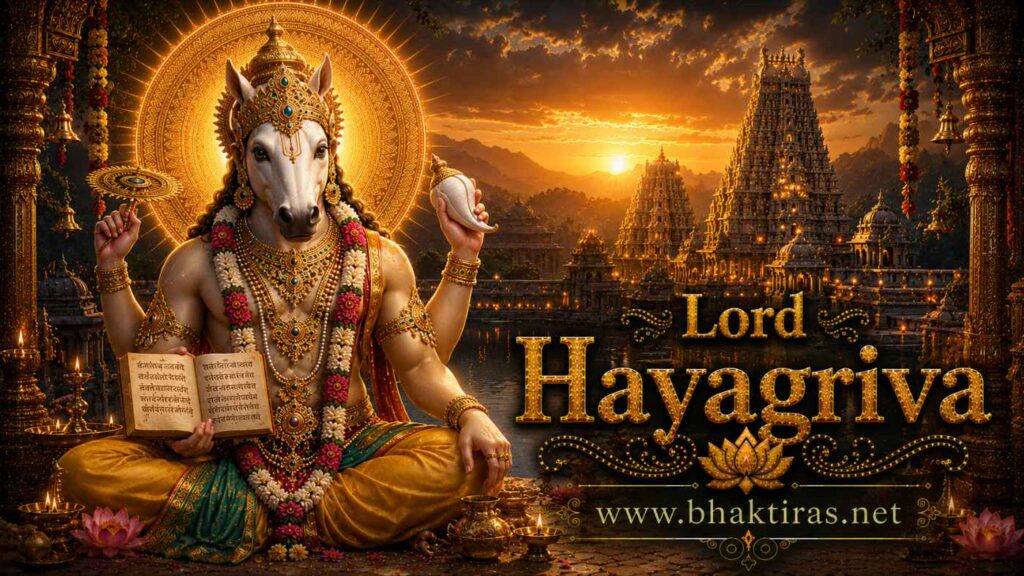
Who Is Lord Hayagriva
Lord Hayagriva is the horse-headed form of Vishnu, worshipped as the very source of knowledge, wisdom and the sacred Vedas. Where other forms of Vishnu are praised for their beauty or their strength, Hayagriva is loved for something quieter and more lasting – the gift of learning itself. His name comes from the Sanskrit haya, a horse, and griva, the neck, and it points at once to the striking image that devotees carry in their hearts: a serene white figure with the head of a horse, seated in stillness, holding the scriptures.
To understand why Vishnu should take such a form, one must remember what the horse meant to the ancient world. The horse was swift, tireless, and associated with the sun and with sacred sound. In the Vedas, sacrifice and speech ride together, and the horse’s neigh was heard as an echo of the primordial mantra. So when Vishnu appears with a horse’s head and a human body, he unites the animal’s untiring energy with the human capacity for thought and word. He becomes the god through whom knowledge is spoken, preserved and passed on.
Hayagriva is not a fierce deity, though the story that gives him his form involves demons and a great cosmic rescue. He is calm, luminous and generous. His worshippers are not warriors or kings but students bent over their books, scholars puzzling over a difficult verse, teachers hoping to explain it clearly, and reciters straining to hold a long text perfectly in memory. To all of them, Hayagriva promises clarity of mind and steadiness of tongue.
He is honoured above all in the Sri Vaishnava tradition of South India, where he is considered the divine guru who first revealed sacred wisdom. There he is worshipped as Vagishvara, the lord of speech, and as the one who removes the darkness of ignorance as surely as the rising sun removes the darkness of night.
The Theft of the Vedas
When the Sacred Knowledge Was Stolen
The story of how Hayagriva came to be told begins in a time of cosmic sleep. At the close of a great age, when creation folds back into rest, Lord Brahma the creator grew drowsy. As he slept, the four Vedas – the sacred hymns and knowledge that hold the pattern of all things – slipped from his care.
Two demons named Madhu and Kaitabha, born of the darkness that gathers when order weakens, seized the scriptures. In some tellings it is a single demon, himself named Hayagriva, who commits the theft; the traditions differ, but the loss is the same. The demons carried the Vedas down into the depths of the cosmic ocean and hid them where no light reached, thinking that by holding the knowledge they might hold power over the whole of creation.
The World Falls Into Ignorance
With the Vedas gone, the world grew dim. The chants that ordered the seasons fell silent. The wisdom that guided the righteous was hidden. Sacrifices could not be performed correctly, truth could not be spoken with certainty, and a heavy ignorance settled over gods and mortals alike. It was not a war of weapons but a famine of knowing – the most dangerous kind of darkness, because those who suffer it may not even know what they have lost.
The gods, distressed, turned to Vishnu, the preserver, who alone could recover what had been taken. For the loss was not of a treasure that could be seized back by force, but of sacred sound and meaning that had to be restored to their rightful place. And so Vishnu prepared to take a form suited to the task.
The Horse-Headed Lord Who Restored Knowledge
To recover the Vedas, Vishnu took a form unlike any other – radiant and white, with the head of a horse. There is a beautiful logic in this. The Vedas are not simply written down; they are chanted, held in living voice, carried on breath and sound. A form crowned with the horse’s head, whose neigh the tradition hears as the echo of the sacred syllable, was fitted to call the scriptures back out of the depths.
Descending into the cosmic ocean, the horse-headed Lord met the demons who had hidden the Vedas. In the tellings where the thieves are Madhu and Kaitabha, Vishnu overcomes them and reclaims the scriptures; in the telling where the demon himself bears the name Hayagriva, the Lord takes on that very form to defeat him and afterwards keeps the name as a mark of victory. Either way, the outcome is the recovery of what was lost. The Vedas were drawn up from the darkness and restored to Brahma, and through him to all creation.
With the scriptures returned, the chants resumed, the sacrifices were made whole, and the light of knowledge spread again across the worlds. This is why Hayagriva is remembered not as a destroyer of demons alone but as the restorer of learning – the one who brought wisdom back when it had vanished from the earth. In his hands he is shown holding the very Vedas he recovered, a reminder that sacred knowledge, once lost, was returned by his grace.
The God of Students and Scholars
Because Hayagriva rescued knowledge itself, he became the natural patron of everyone whose life turns on learning. Students pray to him at the start of their studies and before their examinations. Scholars invoke him when they set out to understand a difficult text. Teachers ask his blessing before they begin to expound, and reciters call on him to hold long scriptures faithfully in memory.
The gifts sought from Hayagriva are precise and practical: a clear mind that grasps meaning quickly, a steady memory that does not falter, and eloquence – the power to speak what one knows with grace and truth. In this he is close in spirit to Saraswati, the goddess of learning and speech, and the two are often worshipped together by those who live by the word.
There is a tenderness in his worship that sets it apart. A young child beginning to learn the alphabet, a nervous student before a test, an old pandit still deepening his knowledge – all approach the same gentle Lord. Hayagriva does not ask for grand offerings. A simple prayer, a lamp, a few grains of soaked chickpeas or a bit of jaggery, and above all a sincere wish to learn, are enough to draw his grace. He is, in the fullest sense, the god of the humble seeker.
Vedanta Desika and the Hayagriva Stotra
No account of Hayagriva is complete without Vedanta Desika, the great acharya of the Sri Vaishnava tradition who lived in the thirteenth and fourteenth centuries. Desika was a scholar of astonishing range – a poet, philosopher, logician and teacher – and he attributed his own brilliance of mind to the grace of Hayagriva, whom he worshipped as his chosen deity.
Tradition holds that Desika composed the beloved Hayagriva Stotra, a hymn of thirty-three verses that praises the horse-headed Lord as the embodiment of pure knowledge, whiter than jasmine and the moon, seated in serene glory. The verses ask not for wealth or power but for wisdom, for the removal of ignorance, and for the flowering of the mind. To this day, students and scholars recite the Stotra before their studies, trusting that the same grace which made Desika a master will steady and sharpen their own understanding.
Through Desika, the worship of Hayagriva became firmly woven into the life of learning in South India. His image was kept in schools and homes of study, and his hymn passed from teacher to student across the generations, so that the Lord who once restored the Vedas continues to guide those who take them up anew.
Iconography & Symbols
The White Horse Head
Hayagriva is shown with the head of a horse on a human body, and he is almost always pure white – the colour of clarity, purity and untainted knowledge. Devotees compare his brightness to jasmine, the moon and a mountain of white crystal. The horse’s head marks him as the Lord of sacred sound, through whom the Vedas are voiced.
The Vedas
In one hand Hayagriva often holds a book or a palm-leaf manuscript, representing the very scriptures he recovered from the ocean. This is his defining symbol as the god of learning – a sign that all true knowledge rests in his keeping and flows from his grace to those who seek it sincerely.
The Rosary (Japamala)
A string of prayer beads in his hand points to meditation, disciplined recitation and the steady repetition of sacred names. It reminds the worshipper that knowledge is not seized in haste but ripened through patience, practice and inner stillness.
The Conch (Shankha)
As a form of Vishnu, Hayagriva carries the conch, whose sound is heard as the primordial vibration from which the universe unfolds. Blown at the start of worship, it is fitting for the Lord of sacred sound, whose horse’s neigh is itself likened to the first mantra.
The Discus (Chakra)
The spinning discus, another of Vishnu’s emblems, represents the wheel of time and the cutting away of ignorance and disorder. In Hayagriva’s hand it signals that the light of knowledge also destroys the darkness of confusion, restoring order to the mind and the world.
How Lord Hayagriva Is Worshipped
Worship of Hayagriva is simple, sincere and centred on learning. It is favoured by anyone setting out on a course of study or facing an examination, and Thursday, the day sacred to Vishnu, is considered especially auspicious for his prayers. Common practices include:
- Before study and examinations – students light a lamp before his image and pray for a clear mind and a steady memory as they begin their lessons or sit their tests.
- Reciting the Hayagriva Stotra – Vedanta Desika’s hymn is chanted at the start of study, especially by those of the Sri Vaishnava tradition, to invite the grace of wisdom.
- Chanting his mantra – the repetition of Om Shri Hayagrivaya Namah, often on a rosary, to calm the mind and sharpen concentration.
- Offering simple foods – soaked chickpeas (chana) and jaggery are traditional offerings to Hayagriva, humble and pure like the knowledge he grants.
- Worship on Thursday – the day of Vishnu is set aside for his special veneration, with a lamp, incense and heartfelt prayer.
- Beginning new learning – families invoke his blessing when a child first takes up the alphabet or begins formal education, seeking his lifelong guidance in learning.
Temples & Sacred Sites
While Hayagriva shrines are found across India, several temples in the south are especially cherished by scholars and pilgrims who come seeking the blessing of learning:
- Thiruvahindrapuram, Tamil Nadu – one of the most revered Hayagriva shrines, closely linked with Vedanta Desika, who is said to have received the Lord’s grace here; a place of pilgrimage for those devoted to knowledge.
- Chettipunyam, Tamil Nadu – an ancient Hayagriva temple near Chennai, long visited by students and scholars praying for success in their studies.
- Hayagriva shrines within Vishnu temples – across South India, many Vaishnava temples house a shrine or image of Hayagriva, where he is worshipped as the guru of sacred wisdom.
- Home and school altars – beyond the great temples, Hayagriva is kept in countless homes and places of study, his image a quiet presence over those who read, write and learn.
Prayers & Mantras
The prayers offered to Hayagriva ask for the one gift he most freely gives – the light of knowledge. Chanting his name is believed to steady the mind, strengthen the memory and loosen the tongue for clear and truthful speech. The most widely recited mantra is short and easily held:
ॐ श्री हयग्रीवाय नमः
Om Shri Hayagrivaya Namah
This simple prayer means ‘I bow to the revered Lord Hayagriva.’ Repeated with attention, especially before study or recitation, it is trusted to clear away confusion and open the mind to understanding. Devotees also chant the fuller Hayagriva Stotra of Vedanta Desika, whose verses praise the white, radiant Lord and beg him to remove ignorance and grant the flowering of wisdom.
Frequently Asked Questions about Lord Hayagriva
Who is Lord Hayagriva?
Hayagriva is the horse-headed form of Lord Vishnu, worshipped as the god of knowledge, wisdom and the Vedas. He recovered the sacred scriptures after they were stolen from the sleeping Brahma and hidden in the cosmic ocean. He is revered above all by students, scholars and teachers who seek learning, memory and eloquence.
Why is Hayagriva worshipped for knowledge?
Hayagriva rescued the Vedas, the source of all sacred learning, when they were stolen and the world fell into ignorance. Because he restored knowledge itself to creation, he is honoured as its guardian and giver. Students and scholars pray to him for a clear mind, a steady memory and success in their studies.
Why does Hayagriva have a horse head?
The horse in ancient tradition was linked to sacred sound and untiring energy, and its neigh was heard as an echo of the primordial mantra. Vishnu took this form to call the stolen Vedas, which are chanted and carried on living voice, back out of the cosmic ocean. The horse head marks him as the Lord of sacred sound and speech.
What does Hayagriva hold in his hands?
Hayagriva is shown holding the Vedas as a book or palm-leaf manuscript, a rosary of prayer beads, and the conch and discus of Vishnu. The scriptures mark him as the god of learning, the rosary as the Lord of meditation and recitation, and the conch and discus as sacred sound and the cutting away of ignorance.
Who was Vedanta Desika and how is he connected to Hayagriva?
Vedanta Desika was a great acharya of the Sri Vaishnava tradition, celebrated as a poet, philosopher and teacher. He worshipped Hayagriva as his chosen deity and attributed his own brilliance to the Lord's grace. He is said to have composed the beloved Hayagriva Stotra, a hymn still recited by students and scholars today.
When and how should one pray to Hayagriva?
Thursday, the day of Vishnu, is considered especially auspicious for Hayagriva. Students light a lamp before his image, chant the mantra Om Shri Hayagrivaya Namah, and recite the Hayagriva Stotra before study or examinations. Simple offerings of soaked chickpeas and jaggery, given with a sincere wish to learn, are enough to draw his grace.
Where are the famous temples of Hayagriva?
Two of the most revered shrines are at Thiruvahindrapuram and Chettipunyam in Tamil Nadu, both long visited by students and scholars seeking success in learning. Thiruvahindrapuram is especially linked with Vedanta Desika. Many Vishnu temples across South India also house a shrine or image of Hayagriva as the guru of sacred wisdom.
May Lord Hayagriva, the white and radiant giver of wisdom, clear the darkness of ignorance from your mind and bless you with clear understanding, steady memory and the joy of learning.