
Goddess Rati
रति
Rati is the Hindu goddess of love, passion, desire and sensual delight, and the devoted consort of Kamadeva, the god of love. Born of Daksha, she is remembered for her grief and penance after Shiva burned Kamadeva to ash, which led to his revival, and for embodying erotic love and marital happiness.
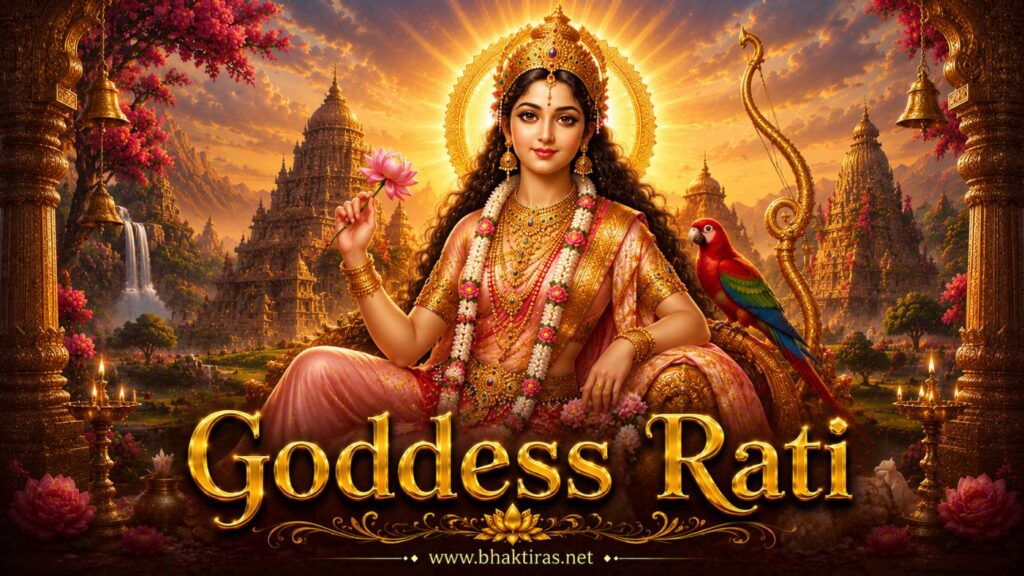
Who Is Goddess Rati?
Rati is the goddess who gives love its warmth and its sweetness. Her name itself means delight, attachment and the pleasure of union, and she presides over desire, passion and the tender joys shared between lovers. Where her husband Kamadeva stirs the first spark of longing, Rati is the abiding affection that keeps two hearts bound together.
She is pictured as a figure of great beauty, graceful and full of feeling, often shown at Kamadeva’s side as he draws his bow of flowers. Together they represent the complete experience of love – attraction and devotion, playfulness and depth. To Hindu tradition she is not a distraction from the spiritual path but a divine acknowledgement that love, honoured rightly, is sacred.
Because of her steadfast devotion to her husband, Rati is also worshipped as a model of loyalty in marriage, invoked by couples for harmony, affection and lasting union.
Rati and Kamadeva
Rati is the eternal consort of Kamadeva, the handsome god of love who carries a bow of sugarcane strung with humming bees and arrows tipped with flowers. The two are inseparable in myth and art, and their marriage is the very image of romantic devotion in Hindu lore.
Born as a daughter of Daksha the Prajapati, Rati was given to Kamadeva as his perfect match, for love and delight belong naturally together. As Kama travels the worlds awakening desire in gods and mortals alike, Rati accompanies him as his strength and his solace. Their bond is so complete that Rati’s identity is woven into her husband’s mission – she is Kamapatni, the wife of Kama, and without her his work of love feels unfinished.
The Burning of Kama and His Revival
The most moving chapter of Rati’s story begins in sorrow. When the gods needed Parvati to win the heart of the meditating Shiva, Kamadeva was sent to loose his flower arrow and kindle desire. Disturbed from his deep austerity, Shiva opened his third eye and burned Kamadeva to ashes in an instant.
Rati was left shattered. Her lament is one of the tenderest passages in the Puranas, as she mourned the loss of her husband and refused to be consoled. Moved by her grief and her unbroken devotion, and by the pleas of the gods, Shiva relented. He promised that Kama would live again, though for a time in a bodiless form known as Ananga, the limbless one, present everywhere as invisible desire.
Rati’s faith was rewarded more fully still. Kamadeva was reborn as Pradyumna, the son of Krishna. Rati herself, taking the form of Mayavati, watched over him, guided him to remember his true self, and was at last reunited with her beloved. Her story became a promise that steadfast love can outlast even death.
Worship, Love and Holi
Rati is honoured wherever love and marriage are celebrated. Newly married couples and those seeking affection remember her alongside Kamadeva, praying for passion tempered by devotion and for a bond that endures. Her presence in temple sculpture and classical poetry reflects a tradition that treats love as a worthy and beautiful part of life.
She is especially associated with the spring season and the festival of Holi. In parts of India the days around Holi recall the burning of Kamadeva and honour Rati and Kama as the divine couple of springtime and desire. The blossoming of flowers, the play of colour and the warmth returning to the earth are all felt as their gift. In this way Rati links the renewal of nature with the renewal of love in the human heart.
Legends and Significance
Rati as Mayavati
After Kamadeva’s rebirth as Pradyumna, an infant was carried away by a demon named Sambara and thrown into the sea, only to be swallowed by a fish. When the fish was caught and cut open, the child was found and raised in Sambara’s own house by Mayavati, who was Rati in disguise. As the boy grew, Mayavati revealed the truth of their past lives and helped him defeat the demon, and the couple were joined once more. The legend is cherished as proof that true love, guided by wisdom, finds its way back across lifetimes.
The lament that softened Shiva
Storytellers often linger on Rati’s grief at the ashes of her husband, for it is her sorrow, not force or argument, that changes the course of the myth. Her devotion moved even Shiva, the great ascetic, to grant Kamadeva’s return. The episode is retold to show that heartfelt love and loyalty carry a power of their own, able to reach where nothing else can.
Frequently Asked Questions
Who is Goddess Rati?
Rati is the Hindu goddess of love, passion, desire and sensual delight. She is the consort of Kamadeva, the god of love, and a daughter of Daksha, and she embodies affection, marital bliss and devotion between lovers.
Who is Rati's husband?
Rati's husband is Kamadeva, the god of love who carries a sugarcane bow and flower-tipped arrows. The two are an inseparable divine couple, and Rati is often called Kamapatni, the wife of Kama.
What happened to Rati when Shiva burned Kamadeva?
When Shiva burned Kamadeva to ashes, Rati was overcome with grief and performed penance. Moved by her devotion, Shiva promised Kama's revival. Kamadeva was later reborn as Pradyumna, and Rati, as Mayavati, was reunited with him.
Why is Rati associated with Holi?
Holi is linked to the burning of Kamadeva by Shiva, and the festival of spring honours Rati and Kama as the divine couple of love and renewal. The colours, flowers and warmth of the season are seen as their blessing on love.
What does Rati symbolise?
Rati symbolises love, desire, passion and marital happiness, along with loyalty and devotion. She represents the sacred and joyful side of love in Hindu tradition, honoured by couples for harmony and lasting affection.
May Goddess Rati bless every devotee with tender love, faithful union and the sweetness of a joyful heart.