
Goddess Prakriti
प्रकृति
Prakriti is the primal Nature of Hindu thought – the active, creative power that becomes matter, energy and the entire visible world. In Samkhya she is the eternal partner of Purusha, the silent witness. Shakta and Puranic teachings recognise her as the living Devi, the Great Mother from whom all creation flows.
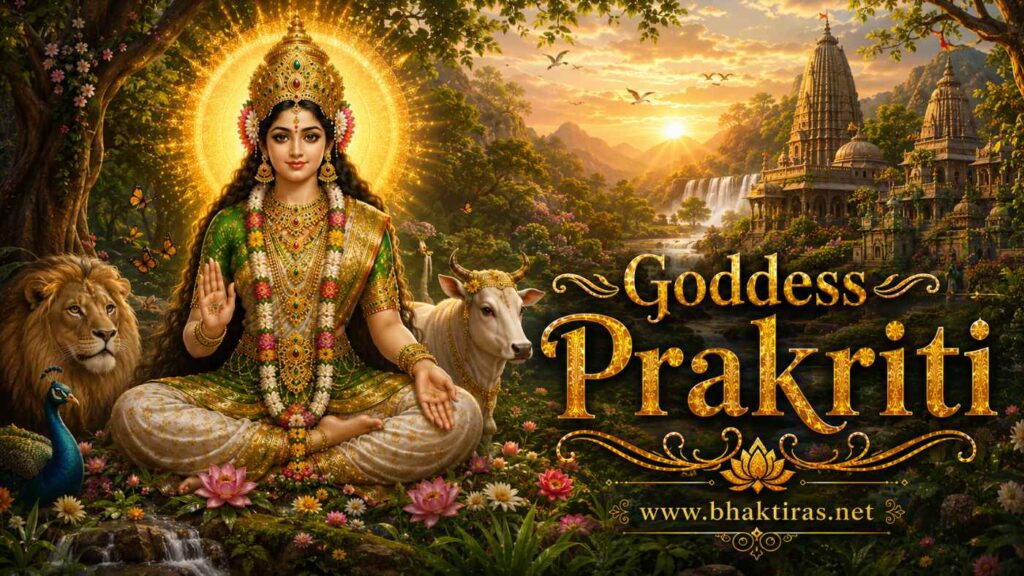
Who Is Goddess Prakriti?
Sit quietly outdoors for a while – watch a leaf turn, a cloud shift, a seed swell into a sprout – and you are watching Prakriti at work. The word means Nature, but not only the green world outside the window. In Hindu thought Prakriti is the creative power itself: the force that takes formless potential and turns it into everything you can see, touch, taste and hear. She is matter and energy woven together, the busy loom on which the universe is endlessly woven.
What makes Prakriti fascinating is that she lives on two levels at once. To a philosopher she is a principle – one of the two great realities that explain how a world can arise at all. To a devotee she is the Mother – a warm, personal presence who gives life, holds it, and takes it back. Both readings are true, and one grows naturally out of the other. The abstract idea and the beloved Goddess are the same reality seen from different distances.
She is called active for a reason. In systems where the highest reality is often described as still and unchanging, Prakriti is the one who moves. She dances, unfolds, brings forth. Nothing appears without her. The sky, the tides, your own breathing body – all of it is her creativity made visible.
To meet Prakriti, then, is to look at the ordinary world and see it freshly: not as dead stuff, but as the ongoing, patient, generous activity of a creative feminine power that has never once stopped making.
Prakriti and Purusha – Nature and Witness
The clearest picture of Prakriti comes from Samkhya, one of the oldest schools of Indian philosophy. Samkhya says that reality rests on two poles. One is Purusha – pure awareness, the silent witness. The other is Prakriti – Nature, the creative substance. Everything you experience is the meeting of these two.
A simple image helps. Imagine a lamp lighting a stage. The lamp does nothing but shine; it does not act in the play, it only makes the play visible. That steady light is Purusha – consciousness that watches without interfering. The whole moving performance – the actors, the scenery, the drama – that is Prakriti. She does all the work. Purusha simply sees.
This is why Prakriti is called the active partner and Purusha the passive one. He observes; she creates and unfolds. Left to himself, Purusha would sit in changeless silence. It is Prakriti who spins out the visible world – the body, the mind, the senses, the endless variety of things. Yet she does it, in a sense, for him: so that awareness can experience, and finally understand its own freedom.
They are not rivals. They are a pair, like a seer and a scene, and the whole cosmos is born in the space where they meet. Understanding this relationship was, for the ancient teachers, the beginning of wisdom – and it places the feminine creative power right at the heart of how the world exists.
The Three Gunas – The Threads of Nature
Prakriti is not a single flat thing. She is woven from three strands called the gunas – three basic qualities whose shifting balance produces every form and every mood in the universe. The word guna can be translated as ‘quality’ or, quite literally, ‘thread’. Reality is what these three threads make when they twist together.
Sattva – harmony and light
Sattva is the quality of balance, clarity and calm. Where it is strong you find peace, understanding, kindness and a mind that sees clearly. It is the bright, steady note in Nature – the quiet of dawn, a clear thought, a moment of genuine contentment.
Rajas – activity and passion
Rajas is movement, drive and desire. It is the quality that pushes, changes, wants and works. Without it nothing would begin; with too much of it, restlessness and craving take over. Rajas is the engine of Nature, the heat that keeps the world turning.
Tamas – inertia and rest
Tamas is heaviness, stillness and darkness. In its shadow side it brings dullness, confusion and delay. But it also gives structure, sleep and rest – the ground that holds things down. Tamas is Nature pausing, the seed sleeping in the soil before it wakes.
No form is ever made of one guna alone. Every person, feeling, season and stone is a particular blend, and that blend keeps changing. A calm mind is sattva rising; a burst of ambition is rajas; a heavy afternoon of sleep is tamas. To understand the gunas is to read the moods of Nature – and of oneself – with a gentler, wiser eye.
From Principle to Goddess – Mula Prakriti and the Devi
So far Prakriti sounds like a beautiful idea. But in the Shakta and Puranic traditions the idea comes alive – it stands up, opens its eyes, and becomes the Mother. This is one of the loveliest movements in Hindu thought: the philosophical principle turning into a living Goddess without ever losing its depth.
Here Prakriti is called Mula Prakriti – the root Nature, the original source before any particular thing has appeared. She is also named Maya, the power that makes the one appear as the many, and simply the Devi, the Goddess. What Samkhya described coolly as the creative substance, these traditions worship warmly as Shakti, the divine energy that is the true mover of the whole cosmos.
The Devi Bhagavata Purana is where this vision sings most fully. It presents Mula Prakriti not as a lesser reality but as the supreme creative power, the ground from which gods, worlds and beings all pour forth. Creation, preservation and dissolution are her rhythms. The still consciousness of Purusha is honoured – but it is she who acts, and so it is she who is adored.
This is why a devotee can look at the same Prakriti that a philosopher analyses and instead fold their hands. The root Nature is not an it but a She – present, responsive, and endlessly giving. The bridge from thought to devotion is short, because the reality on both sides is the same living Mother.
The Five Manifestations of Prakriti
The Devi Bhagavata Purana tells that Mula Prakriti, the root Nature, expresses herself through five great forms. Each carries one face of her endless creativity, and together they cover the whole of what the Mother gives – strength, love, abundance, wisdom and the sustaining light of life.
- Durga – the fierce, protecting Mother, Prakriti as the power that guards creation and defeats what threatens it.
- Radha – the soul of devotion and divine love, Prakriti as the tender longing that draws all beings toward the divine.
- Lakshmi – the giver of abundance and grace, Prakriti as the nourishing wealth and beauty that sustains the world.
- Saraswati – the flow of wisdom, speech and art, Prakriti as knowledge and the creative word.
- Savitri – the radiant, life-giving power linked to the sun and to sacred sound, Prakriti as the light that upholds existence.
These five are not separate goddesses set beside Prakriti; they are Prakriti herself, seen through five windows. When a worshipper honours Lakshmi at harvest or Saraswati at study, they are honouring the one creative Nature wearing that particular face.
Nature as Sacred
Because Prakriti is Nature itself, this whole vision quietly asks something of us: to treat the natural world as holy. If the earth, the rivers, the forests and the seasons are the visible body of the Goddess, then they are not resources to be used up but expressions of the divine to be honoured.
You can feel this thread running all through Hindu life. Rivers are addressed as mothers. Trees are circled and tied with thread. The first food is offered before it is eaten; the soil is asked forgiveness before it is dug. These are not empty customs. They come from a deep sense that the living world is animate, generous, and worthy of gratitude – that Prakriti is present in the grain and the rain as surely as in any temple.
Seen this way, reverence for Prakriti becomes a very practical spirituality. To care for a tree, to waste less, to walk gently on the land – these become small acts of worship. The Goddess is not far off in some other realm; she is the ground under your feet and the air in your chest, asking only to be met with respect.
In an age worried about the fate of the natural world, this ancient view feels strikingly close. Prakriti reminds us that Nature is not a backdrop to human life but its sacred source, and that honouring her and caring for the earth are, in the end, the same act.
How Prakriti Is Honoured
Prakriti is rarely worshipped as a single named idol in her own shrine; instead she is honoured through the many forms of the Devi and through the living world itself. Devotion to her tends to be woven into daily life rather than confined to one festival.
- Worshipping the Goddess in her forms – especially during Navaratri, when the Devi as creative Nature is adored across nine nights.
- Reverence for rivers, mountains, trees and the earth as sacred embodiments of Prakriti.
- Offering the first fruits, grain and flowers back to Nature in gratitude before use.
- Simple gestures of respect toward the soil, water and plants in everyday household ritual.
- Contemplation and study of the Samkhya and Vedanta teachings on Prakriti and Purusha.
- Living in harmony with the seasons and the rhythms of the natural world as a form of devotion.
Prayers and Mantras
A short mantra can turn the mind toward Prakriti and toward the sacredness of the living world. Repeated with attention, it becomes a small daily act of reverence for Nature as the Mother.
ॐ प्रकृत्यै नमः
Om Prakrityai Namah
‘Om, salutations to Prakriti, the primal Nature.’ This simple bow honours the creative feminine power present in all things – a gentle way to greet the Goddess in the earth, the sky and one’s own breath.
Frequently Asked Questions about Goddess Prakriti
What is Prakriti?
Prakriti is the primal Nature of Hindu philosophy – the active, creative power that becomes matter, energy and the entire visible world. She is the source of all forms and change. In devotional traditions she is also worshipped as the living Goddess, the Great Mother from whom all creation flows.
What is the difference between Prakriti and Purusha?
In Samkhya philosophy, Purusha is pure consciousness – the silent witness who only observes. Prakriti is Nature – the active power that creates and unfolds the world. Purusha sees; Prakriti does. The two are eternal partners, and the whole cosmos arises where these two poles meet.
What are the three gunas?
The gunas are the three qualities that make up Prakriti: sattva (harmony, clarity and light), rajas (activity, passion and movement) and tamas (inertia, heaviness and rest). Every form and mood in the universe is a particular, ever-shifting blend of these three threads of Nature.
Is Prakriti a goddess or a philosophical idea?
She is both, and one grows from the other. To a philosopher Prakriti is the creative principle behind the world. To a devotee she is the living Devi, the Great Mother. Shakta and Puranic thought identify the principle with the Goddess, so the abstract Nature and the beloved Mother are one reality.
What are the five manifestations of Prakriti?
The Devi Bhagavata Purana describes Mula Prakriti expressing herself as five great goddesses: Durga, Radha, Lakshmi, Saraswati and Savitri. Each carries one face of her creativity – protection, love, abundance, wisdom and life-giving light – while all remain the one root Nature.
Why is Prakriti linked to caring for Nature?
Because Prakriti is Nature itself, the earth, rivers, forests and seasons are seen as her living body. Honouring her means treating the natural world as sacred rather than as mere material. This gives Hindu reverence for rivers, trees and soil a deep spiritual root and a very practical meaning today.
Which texts describe Prakriti?
Prakriti is central to Samkhya philosophy, especially the Samkhya Karika, and appears in the Bhagavad Gita and Vedanta. Her devotional identity as Mula Prakriti and the Great Mother is developed most fully in the Devi Bhagavata Purana and other Shakta scriptures.
May the primal Mother, present in every leaf and every breath, awaken in you a quiet reverence for the living world.