
Goddess Narmada
नर्मदा
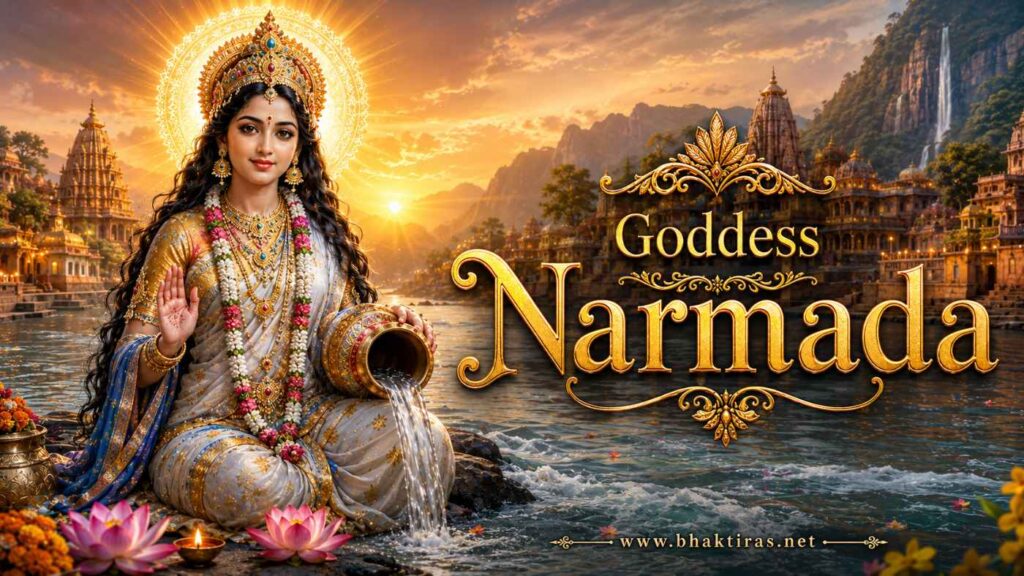
Narmada is the river goddess of central India, revered as one of the holiest rivers in the Hindu tradition. Born from the penance of Lord Shiva, she flows east to west into the Arabian Sea, and her worshippers hold that the mere sight of her waters purifies the soul. Every pebble of her bed is honoured as a natural Shivalinga.
Who Is Goddess Narmada?
Narmada is the presiding goddess of the river that shares her name, a broad and quiet flow that crosses the heart of India from the Maikal hills to the sea. Among Hindus she is counted with the Ganga and the Yamuna as one of the country’s most venerable waters, and in central India her name is spoken with a tenderness reserved for a mother who has never left her children. Villagers along her banks greet her simply as Narmada Maiya.
What sets her apart is the belief that she purifies not by touch alone but by sight. The tradition holds that a bath in the Ganga cleanses, a bath in the Saraswati cleanses, yet the Narmada purifies at a single glance – darshanad narmada. To look upon her waters, the old sages taught, is already to be made lighter of one’s burdens.
Her story is bound to Lord Shiva. She is said to have taken form from his body during a long austerity, which is why she carries the names Shankari and Shambhavi, the daughter of Shiva. Because of this origin she is honoured as a maiden goddess, ever-virgin, free and unattached, moving through the land on her own terms.
The Revakhanda of the Skanda Purana and other Puranic passages gather her legends, her hymns, and the merits of visiting her ghats. For the pilgrim, though, Narmada is less a subject of scripture than a living presence, felt in the cool air off the water and the round stones that rest in her bed.
Born of Shiva, the River That Flows West
Most of India’s great rivers run toward the east, toward the rising sun and the Bay of Bengal. Narmada does the opposite. She sets out from Amarkantak in the Maikal range and travels steadily west, cutting through Madhya Pradesh and Gujarat before she reaches the Arabian Sea near Bharuch. This westward course is unusual enough that it became part of her sacred identity, a river that keeps her own direction.
The Puranas trace her beginning to Lord Shiva. In one telling, as Shiva sat absorbed in deep meditation, a stream of perspiration gathered and took the shape of a girl of surpassing grace; from that drop, born of his tapas, came Narmada. Because she rose from Shiva she is called Shankari and Somodbhavini, and she is regarded as his daughter rather than any god’s bride.
She asked, the stories say, for two boons: that she would never run dry even at the end of the age, and that her waters and stones would carry Shiva’s own sanctity. Both were granted. So she flows on, unmarried and undiminished, and every part of her is treated as an extension of Shiva himself.
The River That Purifies at a Glance
The most quoted saying about Narmada draws a contrast among the sacred rivers. One is cleansed by bathing in the Ganga after some days, by the Yamuna in a week, by the Saraswati at once – but the Narmada purifies the very moment she is seen. The eye alone completes the pilgrimage. This is why so many pilgrims travel simply to sit on her banks and take darshan of the water.
The idea reflects how central India relates to her. She is not approached as a distant deity to be petitioned but as a mother whose presence is enough. People pour her water at weddings and funerals, carry it home in copper vessels, and mark the year by her festivals. Her cool, unhurried flow through gorges and plains has fed farms and settlements for as long as memory reaches.
On Narmada Jayanti, the day held to be her descent to earth, the ghats at Amarkantak, Maheshwar and Bhedaghat fill with lamps set adrift on the current. Rows of small clay diyas drift downstream after dusk, and the whole river seems to answer the light.
The Narmada Parikrama
The greatest act of devotion to Narmada is to walk around her. The Narmada Parikrama is a circumambulation of the entire river, on foot, down one bank to the sea and back up the other to the source – a journey of roughly 2,600 kilometres that traditionally takes about three years and three months and thirteen days to complete.
Pilgrims, called parikramavasis, keep to a strict discipline. They walk with the river always on their right, never crossing her main channel, living on what villages offer, carrying little more than a water pot and a change of cloth. Many go barefoot. Along the way lie hundreds of shrines, ashrams and ghats, and the countryside itself becomes the map. When the walker reaches the mouth of the river near the sea, she or he turns and begins the long return on the far bank.
Few other pilgrimages in the Hindu world ask so much or last so long. Those who finish speak less of merit gained than of the river becoming a companion – a presence walked beside for years, learned turn by turn. The Parikrama is Narmada’s own devotion made into a road.
Every Stone a Shivalinga
Because Narmada carries Shiva’s sanctity, the smooth stones worn round by her current are held to be self-formed Shivalingas. Known as the Banalinga or Narmadeshwar, these dark, egg-shaped pebbles are the only lingas that need no ritual consecration before worship. The river herself has made them, and that is consecration enough.
This belief gives her bed a rare status. A pilgrim who lifts a stone from the Narmada lifts, in the tradition’s eyes, a shrine. Narmadeshwar lingas are carried to homes and temples across India, installed on altars, and honoured with the same rites offered to any Shiva shrine. Some are polished and set in metal; others are kept just as the water shaped them.
The teaching behind it is simple and generous: divinity here is not confined to a single sanctum but scattered through the whole riverbed, a temple stretching from Amarkantak to the sea. To worship the Narmada is, in a sense, to worship Shiva in ten thousand forms at once.
Sacred Sites Along Her Course
From her source to the sea, Narmada passes places that have drawn worshippers for centuries. A few of the most loved:
- Amarkantak – her source high in the Maikal hills, where the first trickle of the river emerges from a temple tank, ringed by ancient shrines.
- Omkareshwar – one of the twelve Jyotirlingas of Shiva, set on a river island shaped like the sacred syllable Om, encircled by Narmada’s two arms.
- Maheshwar – the old capital of Rani Ahilyabai Holkar, its long stone ghats and riverfront temples rising straight from the water.
- Bhedaghat – the Marble Rocks, where the Narmada narrows into a gorge of pale cliffs, and the Dhuandhar falls throw up a haze of spray.
Each of these draws its own festivals and its own crowds, yet all share a single river. To move along her banks is to pass from shrine to shrine without ever leaving the goddess.
Iconography and Symbols
When Narmada is shown in human form, her imagery gathers the meanings the river carries:
The Makara Mount
Narmada rides the makara, the crocodile of Indian sacred art, the same creature that carries the Ganga. It marks her as a river goddess and a mistress of the waters, at home in the deep current.
The Water Pot
In her hands she often holds a kalasha or overflowing pot, the sign of endless, life-giving water and of the boon that she would never run dry.
Serene, Maidenly Grace
She is pictured calm and youthful, an ever-virgin goddess. Her stillness reflects the river’s own unhurried flow and her freedom from any consort.
Fair, Cool Waters
Painters give her a pale, luminous complexion, echoing the clear waters and the white marble gorges of Bhedaghat through which she passes.
How Goddess Narmada Is Worshipped
Devotion to Narmada runs through daily life along her banks and reaches far beyond them. Common practices include:
- Darshan and snan – simply beholding the river, and where possible bathing in her, especially at Amarkantak, Omkareshwar and Maheshwar.
- Deep-daan – floating lit clay lamps on the current at dusk, most of all on Narmada Jayanti.
- Aarti at the ghats – evening lamp offerings sung to the river, with priests circling flame and conch before the water.
- Worship of Narmadeshwar lingas – installing and honouring the river’s natural Shivalingas on home and temple altars.
- Carrying Narmada jal – taking her water home in copper vessels for rituals, blessings and sacraments.
- The Parikrama – for the most devoted, the years-long barefoot circuit of the whole river.
Whether it is a lamp set adrift or a lifetime’s pilgrimage, the spirit is the same – a return to the mother who purifies with a look.
Prayers and Mantras
Devotees invoke Narmada with short mantras and with the traditional Narmada Ashtakam attributed to Adi Shankaracharya. The simplest and most widely used salutation is:
ॐ नर्मदायै नमः
Om Narmadayai Namah
“Om, salutations to Goddess Narmada.”
A fuller prayer of reverence runs:
त्वदीय पाद पङ्कजं नमामि देवि नर्मदे
Tvadiya pada pankajam namami devi Narmade
“O Goddess Narmada, I bow to your lotus feet.”
Recited at the water’s edge, with a lamp or a handful of flowers, these lines ask for the purity the river is believed to grant at a glance.
Frequently Asked Questions about Goddess Narmada
Who is Goddess Narmada?
Narmada is the river goddess of central India and one of Hinduism's holiest rivers. Born from the penance of Lord Shiva, she is worshipped as a purifying mother whose mere sight is said to cleanse. Her river runs from Amarkantak in Madhya Pradesh to the Arabian Sea in Gujarat.
Why does the Narmada flow west?
Unlike most Indian rivers, which run east to the Bay of Bengal, the Narmada flows west into the Arabian Sea. Geographically she follows a rift valley between two hill ranges. In sacred tradition this westward course is part of her distinct identity as a river that keeps her own independent path.
What is the Narmada Parikrama?
The Narmada Parikrama is a circumambulation of the entire river on foot, down one bank to the sea and back up the other to the source. It covers about 2,600 kilometres and traditionally takes over three years. Pilgrims walk with the river on their right and never cross her main channel.
Why is the Narmada said to purify at a glance?
A well-known verse teaches that while the Ganga purifies by bathing over time, the Narmada purifies the instant she is seen. This darshan-based purity is central to her worship, and many pilgrims travel simply to sit on her banks and behold her water rather than to bathe.
What is a Narmadeshwar or Banalinga?
The smooth stones from the Narmada's bed are held to be self-formed Shivalingas called Banalinga or Narmadeshwar. Because the river herself shaped them, they need no ritual consecration before worship. Devotees install these natural lingas on home and temple altars across India.
Where does the Narmada river begin?
The Narmada rises at Amarkantak in the Maikal hills of Madhya Pradesh, where the first stream emerges from a temple tank surrounded by ancient shrines. From there she flows west through central India, passing Omkareshwar, Maheshwar and Bhedaghat, before reaching the Arabian Sea near Bharuch in Gujarat.
How is Goddess Narmada connected to Lord Shiva?
The Puranas say Narmada took form from Lord Shiva during his penance, which is why she is called Shankari and Shambhavi, the daughter of Shiva. She carries his sanctity so fully that every stone in her bed becomes a natural Shivalinga, making the whole riverbed a shrine to Shiva.
May Narmada Maiya bless you with her clear and gentle waters, and may a single glance at her flow lighten every burden you carry.