
Goddess Ganga
गंगा
Ganga is the sacred river of India worshipped as a mother goddess. Hindus believe her waters wash away sin and grant liberation of the soul. Daughter of the mountain king Himavan and sister of Parvati, she descended from heaven to earth through King Bhagiratha's penance, her fall broken by Shiva's matted hair.
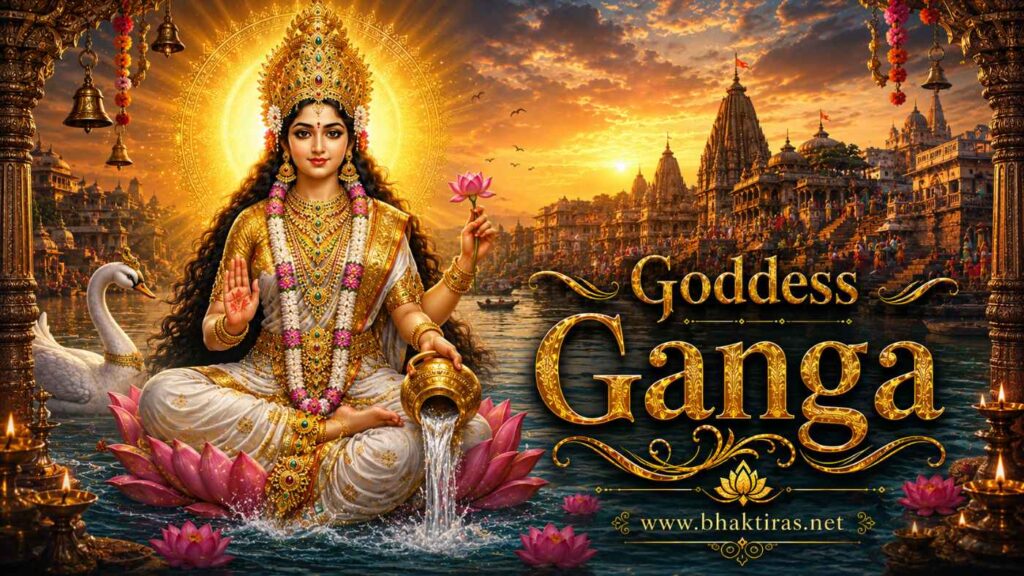
Who Is Goddess Ganga?
Ganga is the holiest river of India, and to Hindus she is far more than water moving toward the sea. She is a living mother, a goddess who flows through the plains of the north carrying the prayers, the ashes, and the hopes of millions of people. Along her banks cities were born, kingdoms rose and fell, and countless generations have come to bathe at dawn, to fold their hands, and to whisper the name of Ganga Maiya.
Her name means the swift one, she who is always moving forward. In her personified form she appears as a fair and gentle goddess, seated upon a crocodile, holding a pot brimming with sacred water and a lotus in her hand. Her expression is calm and giving, for she asks nothing and pours out everything. Where other deities are approached with fear or awe, Ganga is approached the way a child approaches its mother.
Hindus believe that her water is pure in a way no other water can be. A single drop is said to cleanse the heart, and to bathe in her current is to let the weight of one’s wrongs be carried away by the stream. This is why she is called the purifier, the one who washes away papa, sin, and opens the door to moksha, the release of the soul from the endless round of rebirth.
She belongs to no single sect. Shaivites revere her because she rests upon Shiva’s head. Vaishnavas honour her as one who sprang from the feet of Vishnu. Devotees of the Goddess count her among the great mothers. From the Vedas through the Puranas, the Ramayana, and the Mahabharata, her story is woven into the very memory of the land.
The Descent of the Ganga
The most beloved of all Ganga’s stories tells how she came from heaven to earth. It is a tale of stubborn devotion and of a god’s mercy, and it explains why she flows among us at all.
Bhagiratha's Long Penance
Long ago the sons of King Sagara, sixty thousand of them, were reduced to ash by the anger of the sage Kapila after they wrongly accused him of stealing their father’s sacrifical horse. Their souls could find no rest, for they had died without the proper rites, and no ordinary water could purify them. Only the heavenly Ganga, who flowed then across the sky and among the gods, could release them.
Generations passed, and none could bring her down. At last King Bhagiratha, a descendant of that cursed line, gave up his throne and went to the mountains to perform tapas, austerity of the fiercest kind. He stood on one leg through summer heat and winter cold, eating nothing, asking only that Ganga descend to redeem his ancestors. His penance lasted years upon years, until the heavens themselves could no longer ignore him.
Shiva Catches Her Fall
Ganga agreed to descend, but there was a danger no one had spoken of. Her flow from the heavens was so vast and so powerful that, falling straight to the ground, it would have shattered the earth and swept everything away. Bhagiratha turned then to Lord Shiva and begged him to break her fall.
Shiva stood beneath the descending river and let her land upon his head. Ganga poured down in her full fury, certain she would carry even the great god away, but Shiva simply caught her in the coils of his matted hair, his jata, and there she was lost, wandering for a time among his locks until her pride was gentled. He released her at last in a slender, calm stream that the earth could receive. For this act Shiva is called Gangadhara, the bearer of Ganga, and to this day she is shown resting on his head, a thin crescent of water beside the crescent moon.
The Ancestors Set Free
Softened and tamed, Ganga followed Bhagiratha as he led her across the plains toward the sea, her waters running wherever his chariot went. Along the way she flooded the hermitage of the sage Jahnu, who in irritation drank her whole, and only released her from his ear when the gods pleaded with him. Because she was reborn from him she is also called Jahnavi, daughter of Jahnu.
At last Bhagiratha brought her to the place where the sons of Sagara lay in ash. Her touch redeemed their souls, and they rose to the higher worlds at peace. Because it was he who brought her, Ganga carries his name too, Bhagirathi, and his devotion became the very image of what patient effort can achieve.
Daughter of the Mountains, Sister of Parvati
Before she was a river on earth, Ganga was a daughter of the high peaks. Her father is Himavan, the king of the Himalayas himself, the great mountain range personified, and her mother is Mena. Being born of the mountains gives her a special kinship, for the same household gave the world another of its most loved goddesses.
Parvati, the consort of Shiva, is Ganga’s sister. Both are daughters of Himavan, and their bond runs through many of the old tales. There is a gentle tension in it as well. Ganga rests upon Shiva’s head, and it is said that Parvati was not always easy about the closeness of another woman so near her husband. Yet the sisters share a single origin in the snows, and both, in their way, are bound to the same lord, one as his wife and one as the river he carries.
This mountain birth also explains her earthly beginning. She emerges into the world at Gaumukh, the mouth of a great glacier, where the ice of the Himalayas melts and gathers into the first thread of the stream. From that cold and silent place high above the plains, the daughter of Himavan begins her long journey to the sea.
Ganga in the Mahabharata – Mother of Bhishma
Ganga’s presence in the epics is not only that of a sacred stream. In the Mahabharata she takes human form and enters the royal house of Hastinapura, and from her comes one of the greatest figures of that story.
King Shantanu of the Kuru line met Ganga on the riverbank and was captivated by her beauty. She agreed to marry him on one strange condition: he must never question anything she did, and if he ever did, she would leave him at once. Bound by his word, Shantanu watched in silent horror as, one after another, Ganga carried each of their newborn sons to the river and let the water take them. These children were the Vasus, celestial beings under a curse, and by returning them to her stream she was freeing them from a mortal life of suffering.
When the eighth child was born, Shantanu could bear it no longer and cried out, breaking his promise. Ganga stopped, and this time she spared the boy. She revealed who she was and why she had acted, then departed, taking the child with her to raise. That son was Devavrata, who would grow into Bhishma, the grandsire of the Mahabharata, famed for a vow of celibacy so terrible it shook the heavens. He is remembered as Gangaputra, the son of Ganga, and even in the vast sweep of that epic his mother’s name is joined forever to his.
Her Sacred Course – Gangotri to Ganga Sagar
From her icy birth in the mountains to her meeting with the ocean, Ganga passes through a chain of holy places, each one a pilgrimage in its own right. Her journey is a thread of sacred geography strung across the whole of northern India.
- Gangotri and Gaumukh – High in the Himalayas, the river begins as meltwater from the Gaumukh glacier. The temple town of Gangotri marks where pilgrims first offer worship to her at her source.
- Rishikesh and Haridwar – Here she leaves the mountains and enters the plains. Haridwar, whose name means the gateway of God, is one of the four sites of the Kumbh Mela and hosts the famous evening Ganga aarti at Har Ki Pauri.
- Prayagraj (Triveni Sangam) – At Prayagraj she meets the Yamuna and the unseen, mythical Saraswati. This meeting of three rivers, the Triveni Sangam, is among the holiest bathing spots on earth and the grandest stage of the Kumbh Mela.
- Kashi (Varanasi) – The eternal city of Shiva stands along her western bank, its ghats crowded with pilgrims at dawn. To die in Kashi beside the Ganga is believed to grant liberation from rebirth.
- Ganga Sagar – Far to the east she finally reaches the Bay of Bengal, spreading into the delta and meeting the sea. It was here, by tradition, that the ashes of Sagara’s sons were redeemed, and here that great crowds gather each year on Makar Sankranti.
Along this course she gathers a hundred names and a thousand shrines, but she remains one river and one mother, giving herself to everyone who reaches her bank.
The Purifier – Sin, Salvation and the Departed
At the heart of Ganga’s worship lies a single, simple faith: her water purifies. To step into her current, to sip a little from cupped palms, to pour a few drops over one’s head, is to be washed clean of wrongdoing. Where human effort at repentance falls short, the mother’s touch completes it.
This power reaches beyond the living. For Hindus, the final gift a family can offer a loved one is to carry their ashes to the Ganga and release them into her flow. It is believed that when the remains of the dead mingle with her water, the soul is helped on its way, freed from lingering attachment and drawn toward moksha, the release from the cycle of birth and death. Families travel great distances for this, from Haridwar and Kashi to Prayagraj, so that their departed may rest in her keeping.
She is also called upon in life’s ordinary moments. A little Ganga jal, water of the Ganga, is kept in many homes and used to bless newborns, to sanctify rituals, and to touch the lips of the dying. In this way she flows not only across the land but through the whole span of a life, from first breath to last. Her compassion is understood to be without limit and without judgement, offered equally to the saint and the sinner who comes to her bank in need.
Ganga Aarti and the Festivals
Wherever Ganga flows, the days are marked by her worship, and the year turns around the festivals that honour her descent and her presence.
The Ganga aarti is the most breathtaking of these daily rites. At dusk, at the ghats of Haridwar and Varanasi, priests take up great brass lamps stacked with rows of flame and swing them in slow arcs over the water while bells ring and voices rise in song. Little leaf boats carrying flowers and a single lit diya are set adrift, thousands of them, drifting downstream like stars set loose on the current. To stand among the crowd as the lamps circle and the smoke lifts is to feel the whole gathering breathe as one.
Ganga Dussehra celebrates the day she descended to earth, the day Bhagiratha’s penance was answered. Falling in the month of Jyeshtha, it is observed with bathing in her waters, offerings, and the belief that worship on this day dissolves ten kinds of sin. Close to it comes Ganga Saptami, held to mark her rebirth from the sage Jahnu, another day of bathing and devotion.
Greatest of all is the Kumbh Mela, the vast gathering that rotates among Prayagraj, Haridwar, Nashik, and Ujjain. Drawing tens of millions of pilgrims to bathe at the sacred confluence, it is the largest peaceful gathering of human beings anywhere on earth, and at its centre, always, is Ganga.
How Goddess Ganga Is Worshipped
Devotion to Ganga is woven into daily life, and there are many simple ways in which people honour her, whether standing on her bank or far from any river.
- Bathing in her waters at dawn, especially at Haridwar, Prayagraj, or Kashi, while reciting her name and praying for purification.
- Offering flowers, milk, and lit diyas floated on the current in small leaf boats, particularly at the evening aarti.
- Keeping Ganga jal at home in a copper or brass vessel and using it to sanctify rituals, bless the household, and touch the lips of the dying.
- Chanting the Ganga mantra or singing her aarti and stotras during morning and evening prayers.
- Carrying the ashes of departed family members to immerse in her flow, so that their souls may be helped toward liberation.
- Undertaking pilgrimage to her source at Gangotri or to the great bathing festivals of Ganga Dussehra and the Kumbh Mela.
Prayers and Mantras to Goddess Ganga
To call on Ganga is to ask for cleansing of the heart and peace for the soul. Her mantras are spoken while bathing, while offering water, and during the daily worship of the river. The simplest and most cherished invocation greets her as the universal mother whose form pervades all things.
Devanagari: ॐ नमो गंगायै विश्वरूपिणि नारायणि नमो नमः
Transliteration: Om Namo Gangayai Vishwarupini Narayani Namo Namah
Meaning: I bow to Goddess Ganga, whose form pervades the whole universe, who is one with the divine mother Narayani. Again and again I bow to you. Spoken with a still heart, this prayer is an offering of surrender to her endless purity and compassion.
Frequently Asked Questions about Goddess Ganga
Who is Goddess Ganga?
Ganga is the sacred river of India worshipped as a mother goddess. Hindus believe her waters wash away sin and help the soul toward liberation. She is the daughter of the mountain king Himavan, the sister of Parvati, and the mother of Bhishma in the Mahabharata.
Why did Ganga come down to earth?
She descended to redeem the souls of the sixty thousand sons of King Sagara, who had been reduced to ash and could find no rest. King Bhagiratha performed generations of severe penance to bring the heavenly Ganga down so her purifying waters could set his ancestors free.
Why is Ganga on Shiva's head?
Ganga's fall from heaven was so powerful it would have destroyed the earth. At Bhagiratha's request, Shiva caught her in his matted hair and released her as a gentle stream the earth could receive. For this he is called Gangadhara, and she is shown resting on his head.
What does the name Ganga mean?
Ganga means the swift one, she who is always moving forward. She carries many other names too, such as Bhagirathi after King Bhagiratha, Jahnavi after the sage Jahnu, and Tripathaga, the one who travels the three worlds of heaven, earth, and the underworld.
Who are Ganga's family?
Her father is Himavan, the king of the Himalayas, and her sister is Parvati, the wife of Shiva. In the Mahabharata she married King Shantanu of Hastinapura and became the mother of Bhishma, who is remembered as Gangaputra, the son of Ganga.
What is Ganga's vahana or mount?
Ganga's vahana is the makara, a crocodile, on which she is shown seated in her personified form. She usually holds a water pot brimming with her sacred water and a lotus, her calm expression reflecting her role as a giver and purifier.
Why do Hindus immerse ashes in the Ganga?
Hindus believe that when the ashes of the dead mingle with Ganga's waters, the soul is helped toward moksha, release from the cycle of birth and death. Families carry the remains of loved ones to Haridwar, Kashi, or Prayagraj so the departed may rest in her keeping.
What are the main festivals of Ganga?
Ganga Dussehra marks the day she descended to earth and dissolves ten kinds of sin for those who bathe in her. Ganga Saptami celebrates her rebirth from the sage Jahnu. The vast Kumbh Mela, held at her sacred bathing sites, gathers tens of millions of pilgrims in her honour.
May Ganga Maiya carry your cares gently downstream and keep you always in her boundless, purifying grace.