
Goddess Meenakshi
मीनाक्षी
Meenakshi is the presiding goddess of Madurai in Tamil Nadu and a form of Parvati. Her name means the goddess with eyes shaped like a fish. Born from a sacred fire to a Pandya king, she grew into a warrior queen who married Shiva in the form of Sundareswarar, and their wedding is the heart of the Chithirai festival.
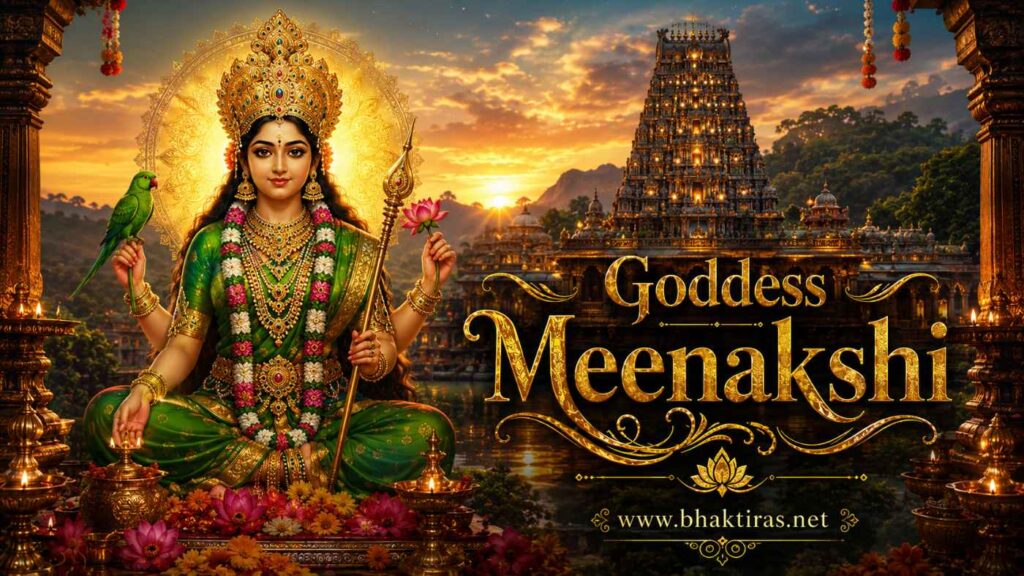
Who Is Goddess Meenakshi
Meenakshi is the goddess of Madurai, the old temple city on the banks of the Vaigai in Tamil Nadu. To the people who pray to her, she is not a distant figure in the sky but the queen of their city, seated in her own great shrine, with Shiva beside her as her husband. Her name comes from two Tamil and Sanskrit words – meen, a fish, and akshi, the eye. She is the goddess with long, curved eyes shaped like a fish, and this single image has followed her name for centuries.In the wider family of Hindu goddesses, Meenakshi is understood as a form of Parvati, the consort of Shiva and the gentle-fierce Mother of the world. Yet at Madurai she keeps a personality all her own. She is a Tamil princess, a crowned ruler, a bride, and a mother goddess folded into one. Tamil devotees call her Angayarkanni, the one with beautiful fish eyes, and Thadaathagai, the name of the little princess who once walked the halls of the Pandya palace. Her worship carries the warmth of a family relationship – she is spoken to as amman, mother, and her yearly wedding is celebrated as a joy shared by the whole city.Born of Fire – Her Miraculous Birth
The story of Meenakshi begins with a king who longed for a child.A king's prayer and a sacred fire
The Pandya king Malayadwaja and his queen Kanchanamala ruled at Madurai, but their palace held one grief – they had no child to follow them. To ask the gods for a son, the king performed a great yajna, a fire sacrifice, pouring offerings into the flames with prayer and hope. When the fire rose at its brightest, a girl of about three years stepped out of it. She was no ordinary child. She had three breasts, and the surprised king felt his wish for a son slip away. As he stood uncertain, a voice from the sky spoke to him.
The prophecy of the third breast
The heavenly voice told the king to raise the girl as he would a son, to teach her the arts of a ruler and a warrior, and to fear nothing about her strange form. The third breast, it said, would simply vanish on the day she met the man she was meant to marry. Until then it would remain, a quiet sign that her story was not yet complete. Comforted, Malayadwaja named her Thadaathagai and crowned her heir to the throne, and Kanchanamala raised her as her own dear daughter.
A daughter raised as heir
So the child of the fire grew up in the Pandya court, learning the sword, the bow, statecraft, and the ways of kingship. She was trained not to sit quietly beside a throne but to sit upon it. When Malayadwaja passed on, she was crowned queen of Madurai. From the beginning, then, Meenakshi was set apart – a goddess who was first a warrior and a ruler, born to lead rather than to wait.
The Warrior Queen Who Met Her Lord
Crowned young and fearless, Meenakshi set out to do what great rulers of her age did – to extend her reign across the world.Conqueror of the eight directions
As queen, Meenakshi led her armies out from Madurai and turned toward the horizons. Story after story tells of her marching in every direction, meeting the kings and even the gods of the world, and prevailing. She is said to have conquered the eight directions, one by one, until there was hardly a corner of the earth she had not brought under her sway. She was a goddess in the full flush of her strength, sword in hand, undefeated and unafraid.
The meeting at Mount Kailash
At last her campaign carried her north, to the icy slopes of Mount Kailash, the home of Shiva himself. There the great god of destruction and grace came before her. The moment Meenakshi looked upon him, something shifted that no battle had ever caused. Her third breast quietly vanished, exactly as the sky-voice had promised at her birth. Her heart, so long armored, softened. The unbeatable queen stood still, recognizing in Shiva the one for whom the prophecy had waited.
The queen becomes the bride
In that instant her fury fell away and a deep calm came over her. The warrior who had conquered the eight directions now bowed her head to her destined lord. Shiva told her to return to Madurai and prepare, promising that he would come to her city and take her hand there, before her people, as a proper king weds a queen. And so Meenakshi turned homeward, no longer only a conqueror but a bride awaiting her wedding.
The Divine Wedding and the Chithirai Festival
True to his word, Shiva came down to Madurai to marry Meenakshi, and their wedding became the most joyful event in the city’s sacred year.At Madurai, Shiva took the form of Sundareswarar, the beautiful lord, and their marriage was celebrated with all the splendor of a royal Tamil wedding. Gods, sages, and kings are said to have gathered to witness it. Vishnu, honored in the tradition as Meenakshi’s brother, gave the bride away. This wedding, the Thirukalyanam, is re-enacted every year during the Chithirai festival in the Tamil month of Chithirai, around April and May. For ten days the whole of Madurai turns into a celebration. Temple cars roll through the streets, the goddess and her lord are carried in procession, and the marriage is performed again with music, fire, and crowds pressing close to catch a glimpse. Pilgrims come from across the state to attend the wedding of their mother goddess, and the story of the fish-eyed queen who won and wed Shiva is renewed in the heart of the city that loves her.The Meenakshi Amman Temple
Meenakshi’s home is one of the largest and most storied temple complexes in southern India – the Meenakshi Amman Temple at the center of Madurai.The temple is built around two main shrines, one for Meenakshi and one for Sundareswarar, ringed by courtyards, corridors, and halls. Its skyline is defined by tall gopurams, the towering gateway towers crowded with thousands of brightly painted figures of gods, guardians, and heavenly beings; the southern tower rises high above the city and can be seen from far off. Inside, pilgrims walk through the famous thousand-pillar hall, where each carved stone column tells its own story and a few pillars ring with musical notes when struck. At the heart of the complex lies the golden lotus tank, the Porthamarai Kulam, a still square pool with a golden lotus at its center, where devotees pause before entering the sanctum. The layout of Madurai itself is said to spread outward from this temple in ordered streets, so that the city is arranged like a lotus around its goddess. To walk these corridors is to move through centuries of Tamil devotion, art, and daily prayer.A Goddess Who Rules, with Shiva as Consort
One thing sets Madurai apart from most great Shiva temples of the south.In the majority of shrines where Shiva and his consort are worshipped together, Shiva is the chief deity and the goddess stands beside him. At Madurai the order is reversed. Meenakshi is the primary deity of the temple and the city, and Sundareswarar, though fully honored, is understood as her consort. The city carries her name, the great festival is her wedding, and the daily rhythm of worship centers on her. This makes Meenakshi one of the clearest expressions in Hindu tradition of the goddess as sovereign – Shakti not as a companion to power but as power itself. For her devotees this is deeply meaningful: the Mother is the ruler here, and the divine husband himself came to her city and her throne. It is a vision of the feminine as complete, royal, and self-possessed, gentle to those who love her and unshaken in her authority.Iconography and Symbols
Every part of how Meenakshi is shown carries meaning drawn from her story.Fish-shaped eyes
Her defining feature is her long, curved eyes, shaped like a fish. In Tamil poetry, fish eyes are a mark of great beauty, and there is an old belief that the fish nourishes its young simply by looking at them. So Meenakshi’s gaze is understood as loving and life-giving – her eyes feed and protect her devotees the way a fish is said to watch over its eggs.
Emerald-green body
Meenakshi is almost always depicted with a deep green, emerald complexion, the color of fresh leaves and the unripe mango. Green links her to fertility, growth, and the flourishing life of the land, and marks her out clearly from other goddesses. It is the color of a young world in full bloom, fitting for a mother who sustains her city.
The parrot
A green parrot often sits at her right hand or shoulder. The parrot is a companion of love and speech, a bird linked to Kamadeva and to sweet, auspicious words. Perched beside the goddess, it softens her royal figure with tenderness and charm, and echoes her own green form.
The sword and royal bearing
In many images Meenakshi holds a sword, a reminder that she was a conqueror before she was a bride. She stands crowned and adorned like a queen, jewels at her throat and a lotus in bloom near her. The sword and the crown together say plainly what her legend teaches – that she is a ruler in her own right, warrior and goddess at once.
How Goddess Meenakshi Is Worshipped
Worship of Meenakshi runs through the daily life of Madurai and the wider Tamil country. Devotees honor her at home and at her great temple in ways that are simple, warm, and full of feeling.- Visiting the Meenakshi Amman Temple in Madurai for darshan, walking through the corridors to see the goddess and her lord in the inner shrines.
- Attending the ten-day Chithirai festival in April or May to witness the re-enacted divine wedding, the Thirukalyanam, and the grand temple-car processions.
- Observing Fridays and Tuesdays as special days for the goddess, with prayers, lamps, and offerings at home or in the temple.
- Offering fresh flowers, especially fragrant blooms and lotuses, along with fruit, and lighting oil lamps before her image.
- Chanting her mantra Om Meenakshyai Namah and reciting hymns and Tamil devotional songs that praise her fish eyes and her grace.
- Circling the golden lotus tank and pausing at its edge before entering the sanctum, following the old temple custom.
- Praying to her as amman, the Mother, for marriage, family harmony, courage, and protection, in the trusting tone of a child speaking to a parent.
Prayers and Mantras
Simple mantras help devotees hold the goddess in mind and call on her presence. They can be spoken softly at a home shrine, during a temple visit, or through the day as a quiet remembrance.The heart of daily practice is her name-mantra, ॐ मीनाक्ष्यै नमः, Om Meenakshyai Namah, which simply means salutations to Meenakshi, the fish-eyed goddess. Repeating it is a way of bowing again and again to her loving gaze and her royal grace. Many devotees also chant hymns to her alongside prayers to Sundareswarar, honoring the divine couple together. Whatever words are used, the spirit of Meenakshi worship is the same – to turn toward the Mother of Madurai with trust, and to rest under the watchful, tender eyes for which she is named.Frequently Asked Questions about Goddess Meenakshi
Who is Goddess Meenakshi?
Meenakshi is the presiding goddess of Madurai in Tamil Nadu and a form of Parvati. Born from a sacred fire to a Pandya king and queen, she grew into a warrior queen and later married Shiva in the form of Sundareswarar. She is worshipped as the mother goddess and ruler of her city.
Why is Meenakshi called the fish-eyed goddess?
Her name joins meen, meaning fish, and akshi, meaning eye, so it describes a goddess whose eyes are shaped like a fish. In Tamil tradition, fish eyes are a sign of beauty, and the fish is believed to nourish its young by looking at them, so her gaze is seen as loving and protective.
Who is Meenakshi's husband?
Her husband is Shiva, worshipped at Madurai in the form of Sundareswarar, the beautiful lord. According to her legend, Shiva came to Madurai to marry her, and their wedding, the Thirukalyanam, is re-enacted every year during the Chithirai festival.
How was Meenakshi born?
The Pandya king Malayadwaja and queen Kanchanamala performed a yajna, a fire sacrifice, asking for a child. From the flames rose a three-year-old girl with three breasts. A heavenly voice foretold that the third breast would vanish when she met her destined husband, and it did when she met Shiva at Mount Kailash.
What is special about the Meenakshi Amman Temple?
The temple in Madurai is one of southern India's largest temple complexes. It is famous for its tall gopuram towers covered in thousands of painted figures, its thousand-pillar hall of carved stone columns, and the golden lotus tank at its heart. The whole city is laid out around the shrine.
Why is Meenakshi the main deity and not Shiva?
Madurai is one of the rare places where the goddess is the chief deity and Shiva is honored as her consort. The temple and city carry her name and the great festival is her wedding. This makes her a powerful symbol of the goddess as sovereign, Shakti as power in her own right.
What is the Chithirai festival?
The Chithirai festival is a ten-day celebration in the Tamil month of Chithirai, around April and May. Its center is the Thirukalyanam, the re-enacted wedding of Meenakshi and Sundareswarar, along with grand temple-car processions through the streets of Madurai that draw pilgrims from across Tamil Nadu.
What is Meenakshi's mantra?
Her simple name-mantra is Om Meenakshyai Namah, written in Devanagari as ॐ मीनाक्ष्यै नमः. It means salutations to Meenakshi and is chanted by devotees at home and in the temple as a way of bowing to her loving gaze and royal grace.
May the fish-eyed goddess of Madurai keep her tender gaze upon you, and may her grace bring courage, love, and peace to your home.