
Goddess Kaveri
कावेरी
Kaveri is the sacred river goddess of the south, worshipped as the Ganga of the peninsula and called Ponni, the golden one, in Tamil. Rising at Talakaveri in Kodagu, she waters the rice country of Karnataka and Tamil Nadu, and legend says sage Agastya carried her south in his water pot before she flowed out to bless a thirsty land.
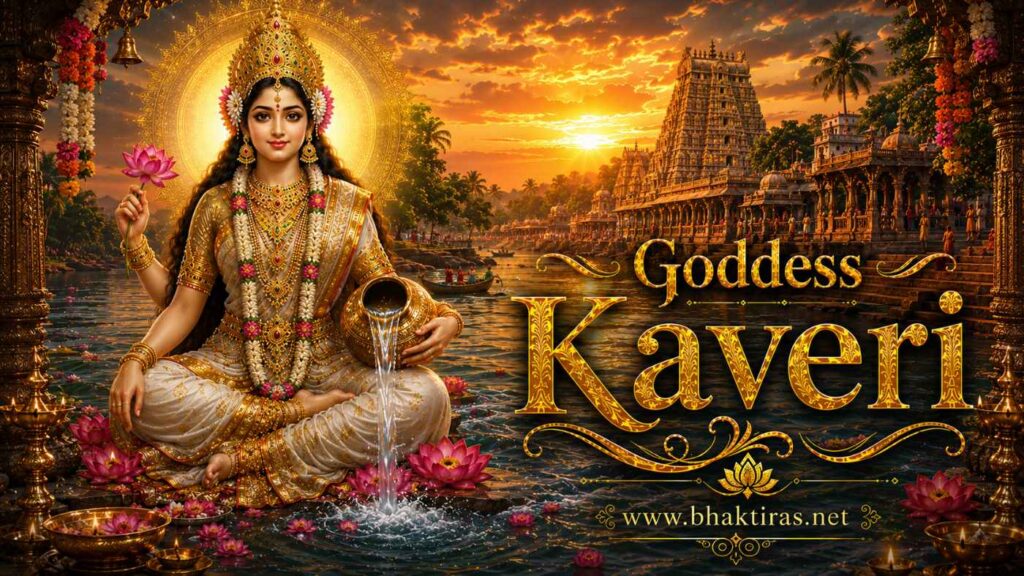
Who Is Goddess Kaveri
Kaveri is the river the south prays to. Where northern devotion turns to the Ganga, the peninsula turns to this water that rises in the Coorg hills and runs east through Karnataka and Tamil Nadu until it reaches the sea. People do not treat her as a stream that happens to pass their fields. They treat her as a mother who arrived, chose to stay, and has fed their families for as long as anyone can remember.Two names sit close to her heart. In Sanskrit she is Dakshina Ganga, the Ganga of the south, a sister of the great northern river carrying the same power to cleanse. In Tamil she is Ponni, the golden one, named for the pale gold silt she lays down across the delta each season, the silt that turns flooded fields into green paddy. Both names say the same thing in different tongues – that this water is holy, and that it gives life. She is worshipped as a goddess in her own right, not merely as the symbol of a river. Farmers greet her at the season’s first flood. Pilgrims bathe in her at Srirangam and count the touch of her water a blessing. Priests offer her lamps and flowers at Talakaveri, where she first appears. To love the Kaveri is, in the southern heart, to love a living presence and not a line on a map.Ponni, the Golden River of the South
The Tamil name Ponni tells you what she does for the land. Pon means gold, and as the river slows across the flat delta country she drops her load of fine silt, a soft golden brown mud that renews the soil year after year. Nobody has to buy it or carry it. The river brings it, spreads it, and the rice grows.This is why the delta districts are called the rice bowl of the south. The old Chola kings built their power on Kaveri water, cutting channels and raising the Grand Anaicut, an ancient dam across her that still guides her flow after nearly two thousand years. Village life along her banks is timed to her moods – the first freshes of the season, the steady flow that fills the channels, the lean months when she runs low and people watch the sky. Because she gives so plainly and so faithfully, the affection people feel for her is warm and household in tone. She is not a distant deity of thunder. She is the mother who keeps the pot full. Songs call her sweet-watered and generous, and old women still fold their hands to her when they cross a bridge over her back.The Legend of Agastya's Pot
The best loved story of how the Kaveri came to the south joins two great figures – the sage Agastya, who carried southern learning across the Vindhyas, and the goddess herself, willing to become water for the sake of a dry land.The Goddess in the Kamandalu
In one telling, Kaveri is the daughter of Brahma, given into the care of a hill sage named Kavera, and it is from him that she takes her name. When she came of age she wished for one thing above all – to bless the earth as a river so that people could drink, bathe, and grow their food. The sage Agastya, who had settled in the south, asked her to travel with him. She agreed on a condition. She would ride inside his kamandalu, his small water pot, but if he ever set the pot down carelessly and left it, she would take that as leave to flow, and she would not be forced back.
The Drought and the Crow
Agastya carried her south and settled among the Coorg hills. Then a hard drought fell on the land. The rivers thinned, the fields cracked, and the people suffered. The gods, watching, knew that the goddess sitting patiently in Agastya’s pot could end the misery if only she were freed. Lord Ganesha took the shape of a crow. While Agastya was at his prayers, the crow settled on the rim of the kamandalu and tipped it over. The sage rushed to save it, but the goddess had already begun to flow. When Agastya tried to gather her back, she rose in her own form for a moment, reminded him of the promise, and then poured out across the parched country as the river Kaveri, green fields following wherever she ran.
Talakaveri and the Sacred Welling-Up
Her birthplace has a name and a shrine. Talakaveri sits high on Brahmagiri hill in Kodagu, the district the British called Coorg, among cool green ridges of coffee and cardamom. Here a small stone tank marks the spot where the river first appears. For most of the year the water lies quiet, and pilgrims bathe and pray at the tank before climbing the steps to the little temple above.Once a year the place comes alive. On Tula Sankramana, the day the sun enters the sign of Tula in the middle of October, the goddess is believed to well up in the tank at a fixed, foretold moment. This welling-up is called Theerthodbhava, the rising of the sacred water. Priests announce the hour in advance, and huge crowds gather in the dark to watch a sudden upsurge break the still surface of the tank. People rush to collect a little of that first holy water in small vessels, keeping it through the year for blessings and for the last rites of the dying. The festival, Kaveri Sankranti, is one of the great days of Kodagu. Families clean their homes, decorate a symbolic figure of the goddess, and honour the river that made their hills and valleys fertile. To have stood by the tank at the moment of the rising is, for a Kodava devotee, a memory carried for life.Her Sacred Course – Srirangam and the Delta
From Talakaveri the Kaveri runs east and south, gathering tributaries, dropping over the falls at Sivasamudram, filling great reservoirs, and passing shrine after shrine. Along her whole length her banks are lined with temples, bathing steps, and towns whose names are tied to hers.Her holiest island is Srirangam, near Tiruchirapalli, where two arms of the river wrap around a long stretch of land to make one of the largest temple complexes in the world. Here Lord Ranganatha reclines in his shrine, and the river that cradles the island is counted part of the sanctity of the place. Pilgrims bathe in her water before entering the god’s presence. Farther on she spreads into the delta, splitting into many channels around Thanjavur and Kumbakonam, the old Chola heartland thick with temples. At last she reaches the Bay of Bengal near Poompuhar, the ancient port city of Tamil song, where her long journey ends in the sea. Every stretch of this course – the falls, the island temple, the branching delta, the sea-mouth – is held sacred, so that the whole river reads like a single flowing pilgrimage from hill to ocean.Iconography and Symbols
As a river goddess, Kaveri is shown with the signs of flowing water and quiet abundance.The Makara Mount
Like Ganga and other river goddesses, Kaveri is often pictured seated or standing upon a makara, a graceful water creature part crocodile and part fish. The makara marks her as a goddess of living water, at home in the current she embodies.
The Water Pot
She frequently holds a kamandalu or pot, a direct echo of Agastya’s vessel from which she flowed. The pot is both her origin and her gift – the container of endless, life-giving water poured out over the land.
The Golden Flow
Her image and her praises are coloured gold, for the silt that names her Ponni. Ornaments, a serene crowned face, and a posture of blessing show her as a giving mother rather than a fierce power.
Lotus and Abundance
Lotuses, sheaves of grain, and full-flowing water attend her, signs of the fertility she carries to the fields. Where she is honoured at Talakaveri and in the delta, the tank and the river themselves stand as her living form.
How Goddess Kaveri Is Worshipped
Devotion to the Kaveri is woven into daily life along her banks and rises to a peak on her great festival day. It blends the reverence given to a goddess with the gratitude a farming people feel for the water that feeds them.- Celebrating Kaveri Sankranti (Tula Sankramana) at Talakaveri, gathering to witness the Theerthodbhava, the sacred welling-up of the water in the tank.
- Collecting the first holy water of the rising in small vessels, kept through the year for blessings and used at the time of death.
- Bathing in the river at Srirangam, Talakaveri, and the delta towns, treating a dip in her water as a purifying act.
- Offering lamps, flowers, and coconuts to the river at bathing steps, and floating small leaf lamps on her current at dusk.
- Honouring her at the season’s first flood, when farmers thank her for the water that will fill their channels and fields.
- Reciting her name and simple mantras such as Om Kaveryai Namah while crossing or bathing in her waters.
- Keeping her festival in Kodava homes with cleaning, decoration of a symbolic image of the goddess, and family prayers.
Temples and Sacred Sites
The Kaveri’s whole length is a garland of holy places. A few sites stand out as the heart of her worship.- Talakaveri, Brahmagiri hill, Kodagu, Karnataka – her birthplace, with the sacred tank of the Theerthodbhava and a hill-top shrine.
- Srirangam, near Tiruchirapalli, Tamil Nadu – the great island temple of Ranganatha, cradled by two arms of the river.
- Bhagamandala, below Talakaveri – the confluence where the Kaveri meets the Kanika and the hidden Sujyoti, a revered bathing sangam.
- The delta towns around Thanjavur and Kumbakonam – the old Chola country dense with river-side temples and bathing ghats.
- Poompuhar (Kaveripoompattinam) – her ancient sea-mouth on the Bay of Bengal, sung in classical Tamil poetry.
- The bathing ghats at countless villages along her banks, each a small shrine to the river-mother in daily use.
Prayers and Mantras
Devotees call on the Kaveri with short, warm invocations, often spoken while bathing or crossing her waters. The simplest name-mantra carries the whole feeling of the south’s love for her.Kaveri Mantra
ॐ कावेर्यै नमः
Om Kaveryai Namah
Meaning: I bow to Goddess Kaveri. In this one line the devotee greets the river as a divine mother and asks for her purifying, life-giving blessing. Repeated at a bathing ghat or before drinking her water, it turns an everyday act into a moment of worship.
Frequently Asked Questions about Goddess Kaveri
Who is Goddess Kaveri?
Kaveri is the goddess of the sacred river of the same name that flows through Karnataka and Tamil Nadu. Revered as the Ganga of the south and called Ponni in Tamil, she is worshipped as a river-mother who purifies devotees and feeds the fertile delta that forms the rice bowl of the peninsula.
What is the story of Agastya and the Kaveri?
Legend says the goddess became water inside sage Agastya's kamandalu so he could carry her to the dry south. When a drought struck, Lord Ganesha took the form of a crow and tipped the pot, and the goddess flowed out across the parched land, becoming the life-giving river Kaveri.
Where does the Kaveri originate?
The river rises at Talakaveri on Brahmagiri hill in Kodagu, the Coorg district of Karnataka. A small sacred tank there marks the spot where she first appears, and pilgrims bathe and pray at this hill-top shrine before the water runs east toward the sea.
Why is she called Ponni, the golden one?
Pon means gold in Tamil. As the river slows across the flat delta she deposits fine golden brown silt that renews the soil and makes it wonderfully fertile. Because this golden mud enriches the fields year after year, Tamil devotees lovingly call her Ponni, the golden river.
What is the Theerthodbhava at Talakaveri?
Theerthodbhava is the sacred welling-up of Kaveri's water in the Talakaveri tank. On Tula Sankramana in mid-October, at a foretold moment, the water is believed to surge up on its own. Huge crowds gather in the dark to witness it and collect the first holy water of the year.
Why is Srirangam important to Kaveri worship?
At Srirangam, two arms of the Kaveri wrap around an island to form one of the largest temple complexes in the world, home to Lord Ranganatha. Pilgrims bathe in the river before entering the shrine, so the water itself is honoured as part of the sanctity of this great southern temple.
Is Kaveri linked to the Ganga?
Yes, in spirit and title. She is called Dakshina Ganga and Ardha Ganga, the Ganga of the south, because devotees credit her with the same power to purify and to grant merit that the Ganga holds in the north. The two rivers are honoured as sister goddesses of holy water.
May the golden waters of Kaveri, mother of the southern land, bless your home with plenty, purity, and peace.