
Goddess Kanyakumari
कन्याकुमारी
Kanyakumari is the ever-virgin form of the Goddess, a manifestation of Parvati and Adi Parashakti, worshipped at the southern tip of India where three seas meet. She stood in penance to marry Lord Shiva, but her destiny to slay the demon Banasura kept her a virgin. She is a Shakti Peetha, honoured for purity, strength and protection.
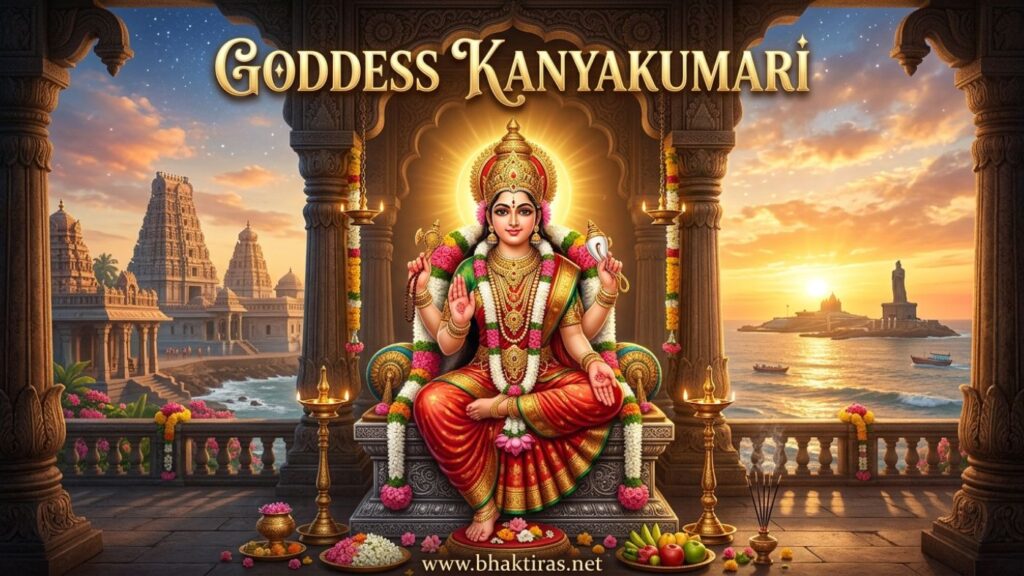
Who Is Goddess Kanyakumari
At the very end of India, where the land narrows to a point and the sea takes over on three sides, sits a goddess who chose never to marry. She is Kanyakumari, the virgin girl, a form of Parvati and of the great Adi Parashakti who holds all of creation within her. Pilgrims come to the southern edge of Tamil Nadu to stand before her, and to watch the sun rise and set over the same wide water.
Her name carries her whole story. Kanya means an unmarried maiden, and Kumari means a young girl. She is the Devi in her youthful, unwed form, full of the strength that comes from restraint and inward fire. Where other forms of the Goddess are wife or mother, this one is the daughter who kept herself apart for a purpose larger than a household.
She is worshipped as Bhagavathy, the divine one, and locally as Kumari Amman, mother Kumari. In her hand she holds a rosary, and her face is turned toward the open sea in what the texts call eternal penance. The bright nose-ring she wears is famous in its own right, a point of light that sailors and poets have spoken of for centuries.
To understand her, you have to know why a goddess so powerful chose the discipline of the single life. The answer lies in a wedding that was arranged, prepared for, and then quietly allowed to slip away.
The Wedding That Never Happened
The maiden's penance for Shiva
As a young goddess, Kanyakumari set her heart on Lord Shiva. To win him, she went to the shore and began a penance so severe that it drew the notice of the heavens. She stood facing the sea, rosary in hand, letting the wind and salt and long silence do their slow work. Her longing was real, and her discipline was greater still, and in time Shiva agreed to marry her.
The rooster's crow
But the young goddess had another destiny. It had been foretold that a demon named Banasura could be killed only by a virgin girl, and so the world quietly needed her to remain unmarried. The sage Narada understood this. When the wedding was arranged for an auspicious hour before dawn, and Shiva set out through the night to reach her, Narada took the form of a rooster and crowed. Hearing the crow, Shiva believed the dawn had already broken and the sacred hour had passed. He turned back. The muhurta, the one exact moment when the marriage could take place, slipped by, and the wedding never happened.
The food that turned to stone
The rice and grains and other foods that had been prepared for the wedding feast were left uncooked and untouched. In the old telling, they turned to stone on the shore. People point to the small, oddly coloured pebbles and grains of sand along the Kanyakumari coast as the remains of that abandoned feast. Whether you take the story as history or as poetry, the coloured sands are real, and they carry the memory of a marriage that was meant to be and was gently set aside.
The Virgin Who Slew Banasura
The wedding was lost so that a greater deed could be done. Banasura had grown proud and cruel, protected by a boon that made him almost impossible to defeat. The one condition written into his death was that only a kanya, a virgin girl, could end his life. This is why the marriage had to fail. Had the goddess become a wife, the demon would have had no one left to stop him.
So she remained Kanya Kumari, and in time she met Banasura in battle. The same fire she had gathered in her long penance now turned outward. She struck the demon down and freed the land from his grip. The people who had suffered under him breathed again, and the goddess returned to her place at the shore, taking up once more the rosary and the long gaze out to sea.
Her story holds two truths together. She is gentle enough to fall in love and to wait for a wedding, and fierce enough to destroy a demon no one else could touch. Devotees see in her the idea that purity is not weakness but a kind of gathered strength, held back until the moment it is needed.
The Goddess at Land's End
There is no place in India quite like the ground she stands on. At Kanyakumari, three great bodies of water come together at a single point: the Bay of Bengal to the east, the Arabian Sea to the west, and the Indian Ocean stretching south with nothing beyond it. On a clear morning you can watch the light change across all three, and it is easy to feel why an ancient people set a goddess here, at the edge of everything.
Her temple sits close to the water, and the goddess inside faces the sea. Pilgrims speak most of all of her diamond nose-ring, which is said to shine so brightly that its light could once be seen far out on the water. An old belief holds that ships were sometimes drawn toward the rocks by that shining point, and so certain doors of the temple are kept closed to hide it from the open sea. True or not, the image has stayed with people: a young goddess at the end of the land, one bright jewel catching the last light.
The meeting of three seas gives the place a feeling of both ending and beginning. Land runs out, water takes over, and in the middle of it stands a maiden in penance, calm at the point where everything meets.
Iconography and Symbols
The rosary (japamala)
She is shown holding a rosary, the mark of a soul in penance. It tells you at once that this is a goddess defined by discipline and inward practice, not by ease. The beads passing through her fingers stand for patience and for prayer repeated without end.
The diamond nose-ring
Her famous nose-ring is more than an ornament. It is the sign of the unmarried maiden and, in her legend, a source of light bright enough to reach far across the sea. Devotees treat it as a small emblem of her whole nature: youthful, radiant and undimmed.
The youthful maiden form
Kanyakumari is always shown young, unwed and standing rather than seated in comfort. Her form is the opposite of the settled mother goddess. It carries the energy of a girl on the edge of a great destiny, poised and unspent.
Facing the sea
Her gaze is turned to the open water in eternal penance. This posture is unusual and deeply local. It ties her to the exact geography of Kanyakumari and makes her, more than almost any other goddess, a deity of a single, unrepeatable place.
The Shakti Peetha of Kanyakumari
Kanyakumari is counted among the Shakti Peethas, the sacred sites tied to the story of Sati. In that older tale, when Sati gave up her body and Shiva carried her in his grief, her form was scattered across the land, and each place where a part fell became a seat of the Goddess. At Kanyakumari, tradition holds that the back or spine of Sati came to rest, marking this shore as one of the great Devi shrines.
This lineage places the virgin goddess inside a much wider web of Shakti worship that stretches across the subcontinent. Pilgrims who travel from Peetha to Peetha know Kanyakumari as the southern anchor of that circuit, the point where the chain of shrines reaches the sea and can go no further. To stand here is to stand at the far end of a devotion that runs the length of India.
The Shakti Peetha status also deepens her identity. She is not only the local maiden of a coastal legend. She is a full form of the supreme Goddess, the same power worshipped as Kali, Durga and Parvati elsewhere, wearing here the face of the eternal virgin.
Kanyakumari and Vivekananda's Rock
Just offshore from the temple rises a rock in the water, and it holds a memory that is more recent but no less loved. In the closing years of the nineteenth century, the young monk Swami Vivekananda came to Kanyakumari, swam out to that rock, and sat there in meditation. Facing the same three seas and the same shore the goddess watches over, he is said to have thought deeply about India and its future.
That meditation is remembered as a turning point in his life. A memorial now stands on the rock, and pilgrims often visit it in the same journey that brings them to the goddess. The two draw meaning from each other: a monk seeking clarity at land’s end, and a goddess who found her strength in penance at the very same edge of the country.
For many who come here, the rock and the temple together make Kanyakumari a place of quiet resolve. It is where the land ends, where a goddess kept her vow, and where a young seeker sat in silence above the meeting of the seas.
How Goddess Kanyakumari Is Worshipped
Worship of the virgin goddess blends daily temple ritual with the seasonal rhythm of festivals and the deep pull of pilgrimage. Here are the ways devotees honour her.
- Temple darshan by the sea – Pilgrims travel to the Bhagavathy Amman Temple at the shore to stand before the goddess, offer their prayers, and see the famous nose-ring for themselves.
- Navaratri celebrations – The nine nights of Navaratri are the high season of Devi worship, when the goddess is adorned, honoured with special rites, and drawn through the town in procession.
- Offerings of flowers and lamps – Devotees bring garlands, oil lamps and simple food offerings, lighting flames before the maiden goddess as an act of surrender and thanks.
- Bathing at the meeting of seas – Many pilgrims take a ritual bath at the point where the three seas meet, treating the confluence as sacred water before entering the temple.
- Prayers for strength and protection – Because she is the slayer of Banasura, people come to her for courage, for the protection of their families, and for the strength to hold to their own vows.
- Chanting her mantra – Repeating the goddess’s mantra, often on a rosary that echoes her own, is a common practice both at the temple and at home.
Prayers and Mantras
The simplest way to call on the virgin goddess is her root mantra, spoken with a still mind and a bowed head. It carries no bargain, only reverence for the maiden who stood in penance at the end of the land.
Devanagari: ॐ कन्याकुमार्यै नमः
Transliteration: Om Kanyakumaryai Namah
Meaning: Om, salutations to Kanyakumari, the virgin goddess. The words offer respect and surrender to the Devi in her youthful, unwed form, seeking her purity, her strength and her protection.
Frequently Asked Questions about Goddess Kanyakumari
Who is Goddess Kanyakumari?
Kanyakumari is the ever-virgin form of the Goddess, worshipped as a manifestation of Parvati and Adi Parashakti. She is enshrined at the southern tip of India, where three seas meet, and is honoured for her penance, purity and the strength that let her slay the demon Banasura.
Why did the goddess remain a virgin?
She wished to marry Lord Shiva and performed severe penance to win him. But her destiny was to kill the demon Banasura, who could only be slain by a virgin girl. The sage Narada caused the wedding's sacred hour to pass, so she stayed Kanya Kumari to fulfil that greater purpose.
Where is the Kanyakumari temple?
The Bhagavathy Amman Temple stands at Kanyakumari, the southernmost point of India in Tamil Nadu. It sits close to the shore where the Bay of Bengal, the Arabian Sea and the Indian Ocean meet, and the goddess inside faces the open water in eternal penance.
What is the story of the food turning to stone?
When the goddess's wedding to Shiva failed to happen, the rice and grains prepared for the feast were left uncooked. In the legend they turned to stone along the coast. Devotees point to the distinctively coloured sands and pebbles of the Kanyakumari shore as the remains of that abandoned wedding feast.
Is Kanyakumari a Shakti Peetha?
Yes. Kanyakumari is counted among the Shakti Peethas, the shrines linked to the story of Sati. Tradition holds that the back or spine of Sati fell here, making this coastal shrine one of the great seats of the Goddess and the southern anchor of the Shakti Peetha circuit.
What is the connection with Swami Vivekananda?
Near the temple, on a rock in the sea, the young monk Swami Vivekananda swam out and meditated in the late nineteenth century, reflecting on India's future. A memorial now marks the spot, and many pilgrims visit both the goddess's temple and Vivekananda's rock in a single journey.
Which festival is most important for Kanyakumari?
Navaratri, the nine nights devoted to the Goddess, is the most important festival at Kanyakumari. During this time the goddess is specially adorned, honoured with elaborate rites, and taken through the town in procession, drawing devotees from across the region.
At the end of the land, where three seas meet and the light turns gold, the virgin goddess keeps her long watch – may her purity and quiet strength stay with you.