
Goddess Kamakhya
कामाख्या
Kamakhya is the great mother goddess of desire, fertility, and creative power, worshipped on Nilachal Hill in Guwahati, Assam. She is the foremost of the Shakti Peethas, the site where the womb of Sati is said to have fallen. Uniquely, she has no idol – the goddess is honoured as a yoni-shaped cleft in the living rock, kept moist by an underground spring.
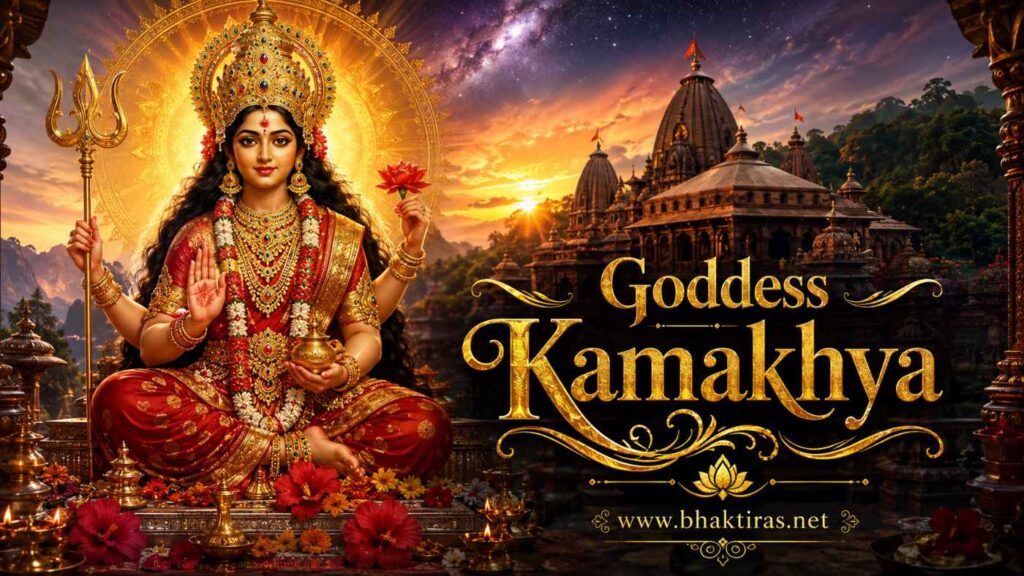
Who Is Goddess Kamakhya?
Kamakhya is the mother goddess of desire and creative power, worshipped on the green rise of Nilachal Hill above the Brahmaputra in Guwahati, Assam. Her name comes from kama, longing or desire, and she is understood as the divine will that brings all things into being – the wish that becomes a world. To her devotees she is Shakti in her most direct and living form: the power that stirs, conceives, and renews.
She belongs to the great tradition of the Devi, the supreme feminine, and yet Kamakhya has a character all her own. She is not a distant queen of heaven but a goddess of the earth itself, of the moist dark ground from which seed rises. Farmers, mothers hoping for children, seekers of every kind climb her hill to ask for fulfilment – of the heart, of the body, of the spirit.
What makes Kamakhya unlike almost every other shrine in the land is that she has no statue. In her innermost chamber there is no carved face, no bronze arms, no painted eyes. There is instead a natural fold in the rock, shaped like a yoni, the emblem of the womb, and over it a spring that keeps the stone forever wet. Here the goddess is worshipped not as an image made by human hands but as the creative power of the feminine itself, present in the earth.
Around her gather the Ten Mahavidyas, the wisdom goddesses of the Tantric path, each with her own small shrine on the same hill. Kamakhya is their mother and their heart, the foremost of the Tantric goddesses, and her sanctuary has drawn saints, yogis, and ordinary pilgrims for well over a thousand years.
The Foremost Shakti Peetha
The grief of Shiva and the falling of Sati
The old story begins with sorrow. Sati, the first wife of Shiva, was the daughter of Daksha. When Daksha held a great fire-sacrifice and pointedly failed to invite Shiva, Sati went uninvited and found her husband dishonoured before the assembly. Unable to bear the insult to the one she loved, she gave up her life in the sacrificial flames.
Shiva’s grief was without limit. He lifted the body of Sati upon his shoulder and wandered the earth, lost in mourning, his sorrow so vast that it began to unsettle the balance of creation itself. To free him from his anguish, Vishnu followed with his discus, the Sudarshana chakra, and let it fall upon the body of Sati, cutting it piece by piece so that it might return to the earth.
Where the womb came to rest
As the pieces fell, each place they touched became a Shakti Peetha, a seat of the goddess, sacred forever after. Fifty-one such places are counted across the subcontinent, and to each one the tradition assigns a part of the divine body.
On Nilachal Hill, so the Kalika Purana tells, fell the womb and generative part of Sati. Because the source of creation itself came to rest here, this Peetha is held to be the foremost of them all – the place where the mother’s power to give life is most fully present. The hill is said to have turned blue at the moment, and so it took the name Nilachal, the blue mountain. What was born of grief became, in time, the most beloved seat of the living goddess.
The Goddess Without an Image
Step into the sanctum of Kamakhya and you will find no idol waiting. The chamber is low and dark, reached by worn stone steps, and the air is close and warm. At the centre, within a small hollow, lies a cleft in the natural rock, shaped like a yoni and draped in silk and flowers. A spring rises within it, and the stone is always damp to the touch. This, and not any carved figure, is the goddess.
It is a form of worship of rare depth. Where most shrines give the divine a face for the eye to rest upon, Kamakhya asks the devotee to honour something more elemental – the creative power of the feminine, the womb of the earth, the quiet source from which every living thing has come. The yoni here is not a matter of embarrassment but of reverence; it is the emblem of generation, the door through which life enters the world, and to bow before it is to bow before the mystery of creation itself.
Priests tend the spring and the stone with great care, offering red flowers, vermilion, and cloth. The moisture is understood as the living presence of the goddess, her fertility flowing unbroken through the rock. Pilgrims touch the wet stone and carry away a little of its sanctity, believing that here, more than anywhere, the mother is not a memory or an image but a presence that can be felt with the hand.
The Ambubachi Mela
Once a year, in the monsoon month when the Brahmaputra runs high and the hill turns deep green, Kamakhya holds her greatest festival – the Ambubachi Mela. It is one of the most remarkable observances in all of Hindu devotion, for it celebrates the annual menstruation of the goddess, understood as the earth’s own season of fertility and renewal.
For a few days the sanctum is closed. The tradition holds that during this time the mother goddess undergoes her yearly cycle, just as the earth rests and readies itself before the seed can grow. In these days no ploughing is done, no worship offered at the shrine; the goddess is left in her privacy, honoured through her stillness. Then the doors open again with great joy, and the reopening becomes a celebration of the goddess renewed, her power returned in full.
Hundreds of thousands of pilgrims, sadhus, and Tantric practitioners gather on the hill for the Mela. What the wider world has often treated as a thing to be hidden away, this tradition lifts up and honours openly: the natural rhythm of the female body is seen here as sacred, a sign of life’s continuance and of the fertile power of Shakti. To the devotee, the festival is a profound affirmation that creation flows through the feminine, and that the same force which turns the seasons and greens the fields is the mother goddess herself, ever renewing the world.
Kamakhya and the Ten Mahavidyas
Kamakhya is the foremost of the Tantric goddesses, and her hill is a whole landscape of Shakti. Encircling the main shrine stand the temples of the Dasha Mahavidyas, the Ten Great Wisdom goddesses of the Tantric path – Kali, Tara, Shodashi, Bhuvaneshwari, Bhairavi, Chinnamasta, Dhumavati, Bagalamukhi, Matangi, and Kamala. Each holds her own form of the one supreme feminine, and each has a place among the sacred groves and rock-cut shrines of Nilachal.
To walk the hill is to move through the many faces of the Devi. Some of the Mahavidyas are gentle and beautiful, some fierce and startling, and together they teach that the goddess is not a single mood but the whole range of power and wisdom – creation and dissolution, tenderness and terror, fullness and emptiness. Kamakhya sits at their heart, the mother from whom they flow, worshipped here as Sodashi, the sixteen-year maiden of perfect beauty and desire.
Because of this, Kamakhya has long been a great centre of Tantric practice. Seekers come to the hill to learn the path of Shakti under the guidance of the mother, treating the whole rise of Nilachal as a mandala, a living diagram of the divine feminine. For the Tantric tradition, no place is more sacred, and no goddess more central, than Kamakhya of the blue mountain.
Iconography and the Sacredness of Shakti
Though her sanctum holds no image, Kamakhya is not without form in the wider imagination of her devotees. In painting and sculpture she is shown as a radiant goddess of deep red or golden hue, seated upon a lotus that itself rests upon the reclining Shiva, a sign that the god of desire and the goddess of creative power are forever joined. She is youthful and lovely, adorned in red, sometimes many-armed, holding lotus, sword, and other emblems of the Devi.
The colour red belongs to her before all others – the red of vermilion, of hibiscus flowers heaped at her feet, of the earth itself. Red is the hue of creation and of the life-force, of blood and birth and desire, and everything in her worship returns to it. Devotees offer red cloth, red blooms, and vermilion, and the goddess is imagined as clothed in that same living colour.
Above all, Kamakhya teaches the sacredness of Shakti – the truth that power, in this vision of the world, is feminine. She is the energy without which even Shiva is still; she is the desire that sets creation in motion and the fertility that carries it forward. To honour Kamakhya is to honour the creative principle of the universe as mother, and to see in the earth, the body, and the seasons the ongoing work of the goddess.
How Goddess Kamakhya Is Worshipped
Worship of Kamakhya ranges from the simple devotion of the pilgrim to the disciplined practice of the Tantric seeker. Some common ways her devotees honour her:
- Climbing Nilachal Hill to have darshan of the sacred yoni-rock in the sanctum, touching the ever-moist stone as the living presence of the mother.
- Offering red flowers – especially hibiscus – along with vermilion, red cloth, and sweets, the red hue that belongs to the goddess of creation.
- Reciting the Kamakhya mantra and the Devi Gayatri, and reading from the Kalika Purana and the Yogini Tantra, the texts that praise her.
- Keeping the Ambubachi Mela, honouring the goddess through the days her sanctum is closed and rejoicing at its reopening.
- Undertaking Tantric sadhana on the hill under the guidance of a teacher, treating Nilachal as a mandala of Shakti.
- Praying to her for children, for the fulfilment of heartfelt desires, and for spiritual strength and protection.
- Visiting the shrines of the Ten Mahavidyas that ring the hill, circling the whole landscape of the goddess.
Above every ritual, the tradition holds that Kamakhya answers a sincere heart. The devotee who comes with reverence and honest longing, whatever form the worship takes, is said to receive her grace.
Temples and Sacred Sites
The heart of Kamakhya’s worship is a single, incomparable place, though her presence is felt across the whole hill and beyond:
- Kamakhya Temple, Nilachal Hill, Guwahati – the foremost Shakti Peetha and the goddess’s chief seat, crowned by its distinctive beehive-shaped tower over the sanctum. (See the dedicated Kamakhya Temple page on Bhaktiras for its history and visitor details.)
- The shrines of the Ten Mahavidyas – the temples of Kali, Tara, Bhuvaneshwari, Bhairavi, Chinnamasta, Dhumavati, Bagalamukhi, Matangi, Kamala, and Sodashi that encircle Nilachal Hill.
- Umananda Temple – on Peacock Island in the Brahmaputra below the hill, sacred to Shiva and closely tied to the pilgrimage circuit of Kamakhya.
- The wider Shakti Peetha network – Kamakhya heads the fifty-one Peethas, and pilgrims often travel between these seats of the goddess across the subcontinent.
Bhaktiras carries a separate, detailed page on the Kamakhya Temple itself; this profile is devoted to the goddess – who she is, and what she means to those who love her.
Prayers and Mantras
Devotees invoke Kamakhya with simple names and with the deeper Devi mantras. Her seed-mantra, Om Kamakhyayai Namah, is repeated as a plain act of surrender to the mother. The Kamakhya Gayatri, given below, is chanted to draw near to her creative grace.
Devanagari: ॐ कामाख्यै च विद्महे कामेश्वर्यै च धीमहि तन्नो देवी प्रचोदयात्
Transliteration: Om Kamakhyai Cha Vidmahe Kameshwaryai Cha Dhimahi Tanno Devi Prachodayat
Meaning: We meditate upon Kamakhya, we contemplate Kameshwari, the goddess of desire; may that Devi awaken and inspire our minds. It is a prayer that the mother of creative power turn her grace toward the one who calls, and quicken the heart with her light.
Frequently Asked Questions about Goddess Kamakhya
Who is Goddess Kamakhya?
Kamakhya is the great mother goddess of desire, fertility, and creative power, worshipped on Nilachal Hill in Guwahati, Assam. She is the foremost of the Shakti Peethas and the central goddess of the Tantric tradition, honoured as the very source of life and the creative energy of the feminine.
Why is there no idol in the Kamakhya temple?
In Kamakhya's sanctum the goddess is worshipped not as a carved image but as a natural yoni-shaped cleft in the rock, kept moist by an underground spring. This honours the creative power of the feminine and the womb of the earth directly, seeing the goddess in the living source of life rather than in a figure made by human hands.
What is the Ambubachi Mela?
The Ambubachi Mela is Kamakhya's greatest festival, held in the monsoon. It celebrates the goddess's annual menstruation, understood as the earth's own season of fertility and renewal. The sanctum closes for a few days while the goddess rests, then reopens with great joy, and hundreds of thousands of pilgrims gather to honour the sacred power of the feminine.
Why is Kamakhya called the foremost Shakti Peetha?
According to the Kalika Purana, the womb of Sati fell on Nilachal Hill when her body was carried by the grieving Shiva and cut by Vishnu's discus. Because the source of creation itself came to rest here, Kamakhya is held to be the most important of the fifty-one Shakti Peethas, the place where the mother's generative power is most fully present.
What does Kamakhya bless her devotees with?
Devotees turn to Kamakhya for fertility and children, for the fulfilment of heartfelt desires, and for spiritual strength. As the goddess of creative power, she is believed to grant new beginnings of every kind – in the body, the heart, and the inner life – to those who come to her with reverence.
How is Kamakhya connected with the Ten Mahavidyas?
The shrines of the Ten Mahavidyas, the great wisdom goddesses of the Tantric path, encircle Nilachal Hill around Kamakhya's temple. She sits at their heart as their mother and source, which makes the whole hill a living landscape of Shakti and one of the most revered centres of Tantric worship in India.
Which texts tell of Goddess Kamakhya?
The chief scriptures devoted to Kamakhya are the Kalika Purana and the Yogini Tantra, which relate the story of the Shakti Peetha, describe her worship on Nilachal Hill, and praise her as the supreme goddess of desire and creative power.
May the mother of Nilachal Hill, Kamakhya of the creative power, bless you with fulfilment, new life, and the quiet strength of the sacred feminine.