
Goddess Godavari
गोदावरी
Godavari is the great river-goddess of the Deccan, revered as the Ganga of the South. Legend says the sage Gautama drew her down from Shiva's matted hair at Trimbakeshwar near Nashik to atone for a sin. She flows across Maharashtra, Telangana and Andhra Pradesh, blessing pilgrims all the way to the Bay of Bengal.
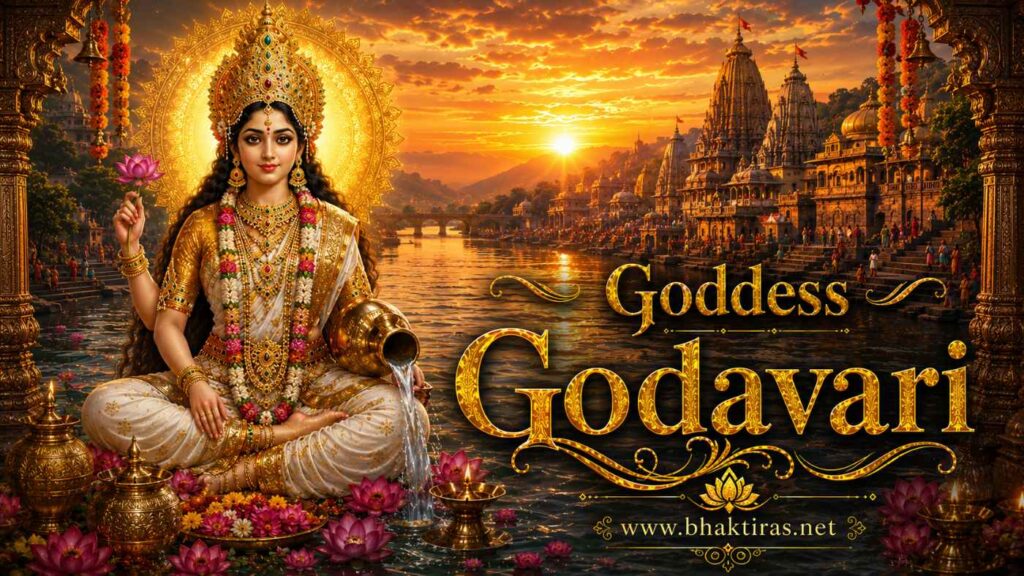
Who Is Goddess Godavari?
Godavari is the living goddess of the great river that carries her name across the heart of southern India. To the villages, ghats and temple towns strung along her course, she is not merely water but a mother – one who cleanses, forgives and carries prayers downstream to the sea.Rising from the misty Brahmagiri hills above Trimbak, she gathers strength as she crosses the Deccan plateau, feeds countless fields, and finally spreads into a wide delta before meeting the Bay of Bengal. Along the way she gives her name to pilgrim towns and shelters some of the most loved temples in the south. Pilgrims bathe in her at dawn, float lamps on her surface at dusk, and speak to her the way children speak to an elder who has watched over generations. Because her story begins in Shiva’s own hair and her waters have washed away the sins of sages, Godavari holds a place in Deccan devotion that is deeply personal and deeply old.The Ganga of the South
Two names follow Godavari wherever she flows: Dakshina Ganga, the Ganga of the South, and Vriddha Ganga, the elder Ganga. Both titles carry a claim of great honour.The people of the Deccan call her Dakshina Ganga because she does for the south what the Ganga does for the north – she purifies, she grants merit, and a single reverent bath in her is believed to lift the weight of long-held sins. The second name, Vriddha Ganga, is even bolder. Some traditions hold that when the northern Ganga hides herself from view, she rises again in the south as Godavari, older and wiser, which is why she is honoured as the elder. Whether she is seen as the Ganga’s southern form or as her senior sister, the meaning is the same to those who love her: bathing in Godavari is spoken of in the same breath as bathing in the Ganga herself, and no lesser reverence is owed to her.How Sage Gautama Brought Her Down
The most cherished origin story of Godavari begins not with the river at all, but with a good man wrongly accused.A famine, a garden, and a grazing cow
In an age of terrible drought, the sage Gautama and his wife Ahalya practised such deep austerity that Shiva granted them an unfailing supply of grain and a garden that stayed green while the world starved. Grateful, Gautama fed and sheltered every hungry rishi who came to him. But jealousy crept in among some of the other sages, who could not bear that his garden alone flourished. They conjured an illusory cow – a phantom made only to deceive – and sent it to graze in his fields.
A false sin and a hard penance
When Gautama gently waved the animal away with a handful of sacred grass, the illusory cow fell dead at his feet, and the plotting sages at once accused him of go-hatya, the grave sin of killing a cow. Though he had struck no blow, Gautama accepted the blame with a heavy heart and asked how he might be cleansed. He was told that only the waters of the heavenly Ganga, brought down to wash the very ground where the cow had fallen, could free him.
Shiva releases the stream at Trimbakeshwar
So Gautama turned to Shiva. On the Brahmagiri hill above Trimbak, near present-day Nashik, he prayed with such devotion that Shiva, moved by his patience, loosened a single strand of the Ganga from his matted hair and let her fall to the earth. She sprang up as a clear stream at that very spot, washed away the illusion and the sin, and flowed onward as a full river. Because a sage of the Gautama line called her down, she is lovingly called Gautami; and because Trimbakeshwar – itself one of the twelve Jyotirlingas – is her cradle, Shiva and Godavari are forever joined in memory.
Her Sacred Course
From her quiet source in the hills, Godavari grows into a broad and generous river, and at certain points along her journey she becomes especially holy. These are the places where pilgrims gather:- Trimbakeshwar – her birthplace on Brahmagiri hill, where a temple tank marks the spot Shiva released her and where the source is worshipped as a Jyotirlinga shrine.
- Nashik (Panchavati) – the first great city on her banks, tied to the Ramayana and to Rama’s forest exile, and one of the four sites of the Kumbh Mela.
- Bhadrachalam – in Telangana, home to the beloved temple of Rama, where the river is honoured as she sweeps past the god she is said to have served.
- Basara – site of the rare Jnana Saraswati temple, where children are brought for their first lessons on the goddess of learning’s riverside shrine.
- Rajahmundry – the great town of the Andhra delta, a chief centre of the Godavari Pushkaram, where enormous crowds bathe from the wide ghats.
The Godavari Pushkaram and Nashik Kumbh
Two of the largest gatherings of faith in southern India belong to Godavari, and both turn on the movement of the heavens.The Godavari Pushkaram, also called Pushkaralu, comes once every twelve years, when Jupiter enters the sign of Leo. For twelve days the entire length of the river is thought to hold a special sanctity, and millions descend on Rajahmundry, Bhadrachalam and other ghats to bathe, offer prayers for their ancestors, and give in charity. The first days are considered the most powerful. Separately, the Nashik Kumbh Mela draws pilgrims to Trimbakeshwar and Nashik in a cycle governed by the sun, Jupiter and moon, filling the ghats of Panchavati with sadhus, akharas and ordinary devotees who come to take the holy dip. Between these two great occasions, the ordinary mornings on Godavari’s banks are quieter but no less devoted, as people slip into her waters with folded hands before the day begins.Iconography and Symbols
When Godavari is given human form in art and worship, every detail points back to her nature as a purifying, life-giving river.The Makara Mount
She is most often shown seated on a makara, the mythical river-crocodile that is the emblem of India’s sacred waters. In some southern depictions she rides a simha, a lion, a sign of her strength and her standing as a great goddess of the land.
The Water Pot
A kalasha or overflowing pot in her hands marks her as the source of endless, nourishing water – the same vessel that appears wherever abundance and auspicious beginnings are invoked.
Lotuses and Flowing Robes
Lotuses at her crown and in her hands speak of purity rising unstained from the water, while her blue-green, rippling garments picture the river itself, calm on the surface and deep beneath.
A Serene, Motherly Face
Her expression is gentle and composed, the face of an elder rather than a warrior – fitting for a goddess whose gift is forgiveness and whose title is the elder Ganga.
How Goddess Godavari Is Worshipped
Devotion to Godavari is woven into daily life along her banks, and most of it happens at the water’s edge rather than inside a temple.- Taking a ritual bath (snana) at dawn from the ghats, especially on Pushkaram, Kumbh and eclipse days, to wash away sin and gain merit.
- Offering flowers, turmeric, kumkum and coconuts to the flowing water, along with a lit lamp set adrift on a leaf.
- Performing tarpana and pind-daan on the banks to honour and free departed ancestors, believed to be especially effective during Pushkaram.
- Chanting her name and the mantra ‘Om Godavaryai Namah’ while cupping her water in the palms and pouring it back as an offering (arghya).
- Filling small vessels with Godavari water to carry home for household rituals and to purify sacred spaces.
- Floating rows of lamps (deepa) at dusk during festival evenings, turning the dark river into a moving field of light.
Temples and Sacred Sites
Because Godavari touches so many holy towns, her worship is closely bound to the great temples that rise beside her.- Trimbakeshwar Jyotirlinga (Maharashtra) – the temple and sacred tank at her very source on Brahmagiri hill.
- Kalaram and the ghats of Panchavati, Nashik (Maharashtra) – the Ramayana town and Kumbh Mela site on her upper reaches.
- Sri Sita Ramachandraswamy Temple, Bhadrachalam (Telangana) – the celebrated Rama temple watched over by the river.
- Sri Jnana Saraswati Temple, Basara (Telangana) – a rare riverside shrine to Saraswati, goddess of learning.
- Kotilingeswara and the Pushkara ghats of Rajahmundry (Andhra Pradesh) – the heart of the delta’s Pushkaram celebrations.
Prayers and Mantras
The simplest way to honour Godavari is to say her name over her water. This short mantra is offered at the ghats as devotees pour a handful of the river back to her:- Devanagari: ॐ गोदावर्यै नमः
- Transliteration: Om Godavaryai Namah
- Meaning: ‘Om, salutations to Goddess Godavari.’ In these few words the devotee greets the river as a living goddess and asks her to accept the offering, cleanse the heart, and grant long life and peace.
Frequently Asked Questions about Goddess Godavari
Who is Goddess Godavari?
Godavari is the goddess of the Godavari river, the longest river of peninsular India. She is revered as a purifying mother who forgives sin and grants long life. Her worship centres on the ghats and temple towns along her course, from her source at Trimbakeshwar down to the delta at Rajahmundry.
Why is Godavari called the Ganga of the South?
She is called Dakshina Ganga, the Ganga of the South, because she is believed to purify pilgrims and grant merit just as the northern Ganga does. Some traditions say the Ganga rises again in the south as Godavari, which is why she is also honoured as Vriddha Ganga, the elder Ganga.
Where does the Godavari originate?
The Godavari rises at Trimbak on the Brahmagiri hill in the Sahyadri range, near Nashik in Maharashtra. A temple tank marks the spot where, in legend, Shiva released her from his matted hair. From there she flows east across the Deccan to the Bay of Bengal.
What is the story of how Godavari came to earth?
The sage Gautama was falsely accused of killing an illusory cow sent by jealous rishis. To atone, he prayed to Shiva at Trimbakeshwar, and Shiva released a strand of the heavenly Ganga from his hair. She fell as a stream, washed away the sin, and flowed on as the Godavari. Because Gautama called her down, she is also named Gautami.
What is the Godavari Pushkaram?
The Godavari Pushkaram, or Pushkaralu, is a great river festival held once every twelve years, when Jupiter enters Leo. For twelve days the whole river is considered specially sacred, and millions gather at ghats such as Rajahmundry and Bhadrachalam to bathe, honour their ancestors, and give in charity.
Which temples are connected with the Godavari?
Key shrines on her banks include the Trimbakeshwar Jyotirlinga at her source, the Ramayana ghats of Nashik, the Rama temple at Bhadrachalam, the Saraswati temple at Basara, and the Pushkara ghats of Rajahmundry. Each honours the river alongside its main deity.
What is the vahana of Goddess Godavari?
Like other river goddesses, she is usually shown riding a makara, the mythical river-crocodile that symbolises sacred water. In some southern images she is depicted on a simha, or lion, a mark of her power and her rank as a great goddess.
How do devotees worship the Godavari?
Devotees bathe at the ghats at dawn, offer flowers, turmeric and lit lamps to the flowing water, perform ancestral rites, and chant 'Om Godavaryai Namah' while pouring water back to the river. Carrying home a small vessel of her water for household rituals is also common.
May the elder Ganga of the south carry your prayers gently downstream, and may a single bath in her waters leave your heart lighter than before.