
Gautama Buddha
गौतम बुद्ध
Gautama Buddha is honoured in the Vaishnava tradition as the ninth avatar of Vishnu, who came to teach compassion, non-violence and gentleness toward all beings. He is also the historical Prince Siddhartha of the Shakya clan, founder of Buddhism, revered by hundreds of millions across the world. He is not the same as Budha, the planet Mercury among the Navagrahas.
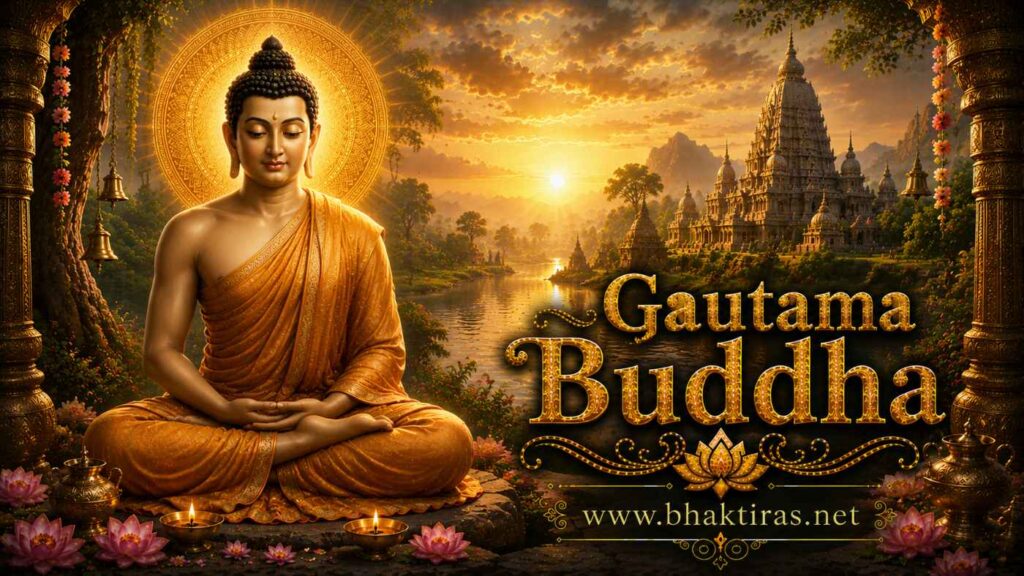
Who Is Gautama Buddha?
Gautama Buddha holds a place of deep reverence in more than one living tradition, and the picture of him grows richer when both are held together with respect. In the Vaishnava reckoning of the Dashavatara, the ten great descents of Vishnu, the Buddha is counted as the ninth avatar – the form the Lord took to teach compassion, gentleness and the way of non-violence, turning hearts away from cruelty and toward kindness for every living creature.
At the same time, Gautama Buddha is a real figure of history: Prince Siddhartha of the Shakya clan, who was born in the sixth or fifth century before the common era, renounced a life of comfort, and after long searching awakened to the truth of suffering and its ending. As the founder of Buddhism he is loved and followed by hundreds of millions of people across Asia and the wider world, and this page speaks of the Hindu view of him with care, never lessening the honour due to him among Buddhists.
One point deserves a clear word, because names can confuse. Gautama Buddha, the Awakened One, is not the same as Budha – the deity of the planet Mercury and one of the nine Navagrahas. The two words sound alike and are sometimes muddled, but they belong to entirely different figures. Budha is a planetary lord linked to intellect and speech; Gautama Buddha is the sage of the Shakyas who taught the Middle Path. Keep them apart, and much becomes clear.
What binds the Vaishnava avatar and the historical teacher is a single, luminous quality: compassion. Whether one approaches him as a form of Vishnu or as the founder of a great path, the Buddha is remembered above all for his tenderness toward suffering beings and his patient work to free them from it.
Prince Siddhartha and the Great Renunciation
The story begins in ease. Siddhartha was born to King Shuddhodana and Queen Maya of the Shakya people, and by tradition his birth took place in a grove at Lumbini, where his mother had paused on a journey. Seers who saw the infant foretold two possible futures – a great king who would rule the world, or a great sage who would renounce it. His father, hoping for the throne, raised the boy inside a sheltered world of gardens and pleasures, keeping every sorrow far from his sight. Siddhartha grew, married the gentle Yashodhara, and had a son named Rahula.
Yet the walls could not hold forever. In the tellings, four sights met him when he ventured beyond the palace. He saw an old man bent with age, and learned that youth does not last. He saw a sick man and understood that the body is fragile. He saw a corpse carried to the burning ground and knew that death waits for all. And then he saw a wandering ascetic, calm-faced and free, who had left the world to seek what lies beyond old age, sickness and death.
These four sights turned him inward. The comforts he had known now seemed thin against the weight of suffering he had glimpsed. One night, in what tradition calls the Great Renunciation, he rose quietly, looked with love upon his sleeping wife and child, and left the palace to become a seeker. It was not a rejection of those he loved but a longing to find an answer that could help them, and all beings, escape the sorrow that no wealth or throne could cure.
The Path to Enlightenment
For years the young seeker wandered the forests of the Ganges plain, learning from teachers of meditation and testing the hardest disciplines. He took up severe austerity, fasting until his body wasted almost to nothing, believing that punishing the flesh might set the spirit free. Companions gathered around him, moved by his effort. Yet the more he starved and strained, the further peace seemed to slip away. He grew weak, and truth grew no nearer.
A simple moment changed his course. Accepting a bowl of milk-rice offered by a village woman named Sujata, he understood that neither indulgence nor self-torture leads to awakening. Between the two extremes lay a gentler way – the Middle Path, balanced and steady, neither drowning in comfort nor breaking the body. His companions, thinking he had given up, left him. Alone, he resolved to sit until he found what he sought.
At a place now called Bodh Gaya he settled beneath a spreading pipal tree, later honoured as the Bodhi tree. Through the long night he sat in deep meditation, facing every fear and temptation that rose within him, until at dawn understanding broke open like light. He saw the roots of suffering and the way to its ending. In that awakening he became the Buddha – ‘the awakened one’ – no longer a prince or an ascetic, but a teacher whose calm would touch the world for ages to come.
The Teaching – Compassion, Ahimsa and the Four Noble Truths
Soon after his awakening the Buddha walked to a deer park at Sarnath, near Varanasi, and there gave his first teaching to the five companions who had once left him. This first sermon set in motion what tradition calls the Wheel of the Dharma. In it he laid out the Four Noble Truths: that suffering is woven through ordinary life; that suffering arises from craving and clinging; that there is an ending to suffering; and that a path leads to that ending.
That path is the Noble Eightfold Path – right understanding, right intention, right speech, right action, right livelihood, right effort, right mindfulness and right concentration. It is a way of living wisely and kindly, a practical map rather than a mere doctrine. Woven through all of it is ahimsa, non-violence, and a boundless compassion (karuna) for every being that breathes.
For forty-five years the Buddha walked from village to village and city to city, teaching kings and beggars alike in plain language anyone could follow. He gathered a community, the Sangha, and welcomed men and women, high-born and low-born, without regard for the barriers of the age. His message was gentle but clear: let go of hatred, harm no living thing, look with kindness upon all, and walk steadily toward freedom from suffering. At last, at Kushinagar, he lay down between two trees and passed into parinirvana, the final peace beyond all sorrow.
The Buddha as an Avatar of Vishnu
In the Puranic scriptures that shaped much of later Hindu devotion, the Buddha appears in the list of Vishnu’s ten avatars, the Dashavatara, standing at the ninth place – after Rama and Krishna and before the awaited Kalki. Several Puranas name him openly, describing the Lord taking the gentle form of the Buddha for the good of the world.
The Vaishnava understanding of why he came is tender and worth stating with care. In an age when ritual had hardened into cruelty and animals were being slaughtered in great numbers in the name of sacrifice, the Lord is said to have descended as the Buddha to teach ahimsa – non-harming – and to turn people away from that cruelty toward compassion. By his quiet example and his teaching, hearts were softened and the excesses of blood-sacrifice were tempered. In this reading the Buddha is a healer of an age gone astray, and his emphasis on kindness to all creatures is seen as the very purpose of the avatar.
Different Hindu teachers have reflected on this in different ways over the centuries, and Buddhists naturally understand the Buddha within their own tradition, on their own terms. Bhaktiras offers the Vaishnava view here without asking anyone to set aside their own. What every telling shares is admiration for a life of gentleness. Whether one bows to him as a form of Vishnu or reveres him as the founder of a great and independent path, the Buddha remains a light of compassion, and honouring him honours the mercy at the heart of both traditions.
The Sacred Sites of the Buddha
Four places above all mark the great turning-points of the Buddha’s life, and pilgrims have travelled to them for more than two thousand years. Together they trace his journey from birth to awakening to teaching to final peace.
- Lumbini – the grove where Prince Siddhartha was born, in the foothills of the Himalaya in present-day Nepal. A quiet, sacred garden that draws pilgrims to the place where his life began.
- Bodh Gaya – in Bihar, where the seeker attained enlightenment beneath the Bodhi tree. A descendant of that very tree still grows beside the great temple here, and it is counted the holiest of all Buddhist sites.
- Sarnath – near Varanasi, the deer park where the Buddha gave his first teaching and set the Wheel of the Dharma turning for the first time.
- Kushinagar – in Uttar Pradesh, where the Buddha entered parinirvana, his final passing. A reclining image of the Buddha marks the spot where he lay down at the end of his earthly life.
Buddha Purnima
Buddha Purnima, also called Vesak in many parts of Asia, is the day set aside to remember the Buddha, and it falls on the full-moon night of the month of Vaishakha, usually in April or May. In the tradition, this single full moon is held to mark three great events in his life – his birth, his enlightenment and his parinirvana – all gathered into one luminous day.
On Buddha Purnima temples and monasteries are cleaned and decorated, lamps are lit, and devotees gather to offer flowers, incense and light before images of the Buddha. Many spend the day in meditation and in listening to his teachings; others give food and gifts to the needy, keeping his spirit of generosity alive. Acts of kindness and non-violence are the truest way to mark the day – releasing captive creatures, sharing meals, speaking gently. Because the full moon of Vaishakha shines the same for all, the festival is a shared moment of stillness and goodwill, remembered by Hindus and Buddhists alike.
How the Buddha Is Honoured
Reverence for the Buddha is expressed less in loud ceremony than in quietness, kindness and inward practice. Some of the ways he is honoured across traditions include:
- Sitting in meditation, following the calm attention he taught, even for a few minutes each day.
- Offering flowers, a lit lamp and incense before an image of the Buddha, as tokens of respect and clarity of mind.
- Taking refuge in the Three Jewels – the Buddha, the Dharma (his teaching) and the Sangha (the community) – by reciting the words of refuge.
- Practising ahimsa in daily life: harming no living creature, and choosing gentleness in speech and action.
- Making pilgrimage to Lumbini, Bodh Gaya, Sarnath or Kushinagar, walking in the footsteps of his life.
- Giving freely to those in need, in the spirit of the generosity (dana) that he praised above almost all virtues.
Prayers & Mantras
The most beloved words associated with the Buddha are the verses of taking refuge, softly repeated by followers across the world. They are simple, humble and steadying – a turning of the heart toward the Awakened One, his teaching and his community.
बुद्धं शरणं गच्छामि
Buddham Sharanam Gachchami
‘I go for refuge to the Buddha.’
धर्मं शरणं गच्छामि
Dharmam Sharanam Gachchami
‘I go for refuge to the Dharma, the teaching.’
सङ्घं शरणं गच्छामि
Sangham Sharanam Gachchami
‘I go for refuge to the Sangha, the community.’
Recited together, these three lines are known as the Three Refuges. Spoken slowly, they settle the mind and place the one who says them under the shelter of compassion, wisdom and good company.
Frequently Asked Questions about Gautama Buddha
Who is Gautama Buddha?
Gautama Buddha was born Prince Siddhartha of the Shakya clan at Lumbini. After renouncing his palace life, he attained enlightenment at Bodh Gaya and became the Buddha, 'the awakened one'. He is the founder of Buddhism and, in the Vaishnava tradition, is honoured as the ninth avatar of Vishnu.
Is the Buddha an avatar of Vishnu?
Yes, in the standard Puranic list of the Dashavatara the Buddha is counted as Vishnu's ninth avatar. The Vaishnava tradition holds that Vishnu took this form to teach compassion and non-violence and to turn people away from cruelty and excessive animal sacrifice. Buddhists understand the Buddha within their own tradition, on their own terms.
Is Buddha the same as Budha (Mercury)?
No. Gautama Buddha, the Awakened One, and Budha, the deity of the planet Mercury among the nine Navagrahas, are entirely different figures. The names sound alike and are often confused, but Budha is a planetary lord linked to intellect and speech, while Gautama Buddha is the historical sage who taught the Middle Path.
What did the Buddha teach?
The Buddha taught the Four Noble Truths – that life holds suffering, that suffering arises from craving, that suffering can end, and that a path leads to its ending. That path is the Noble Eightfold Path. Running through all his teaching is compassion for every being and the practice of ahimsa, non-violence.
Where did the Buddha attain enlightenment?
The Buddha attained enlightenment, or bodhi, at Bodh Gaya in present-day Bihar, seated in deep meditation beneath the Bodhi tree. It is regarded as the holiest of the sites connected with his life, and a descendant of the original tree still grows there beside the great temple.
When is Buddha Purnima celebrated?
Buddha Purnima, also called Vesak, falls on the full-moon night of the month of Vaishakha, usually in April or May. It marks the Buddha's birth, his enlightenment and his final passing, all remembered together. Devotees light lamps, meditate, offer flowers and perform acts of kindness and charity.
What is the meaning of 'Buddham Sharanam Gachchami'?
It means 'I go for refuge to the Buddha'. It is the first of the Three Refuges, followed by taking refuge in the Dharma (the teaching) and the Sangha (the community). Recited together, these words express a turning of the heart toward compassion, wisdom and good company.
May the gentle light of the Awakened One steady your heart, and may his compassion and peace walk with you on every path.