
Ekadasha Rudra – The Eleven Rudras
एकादश रुद्र
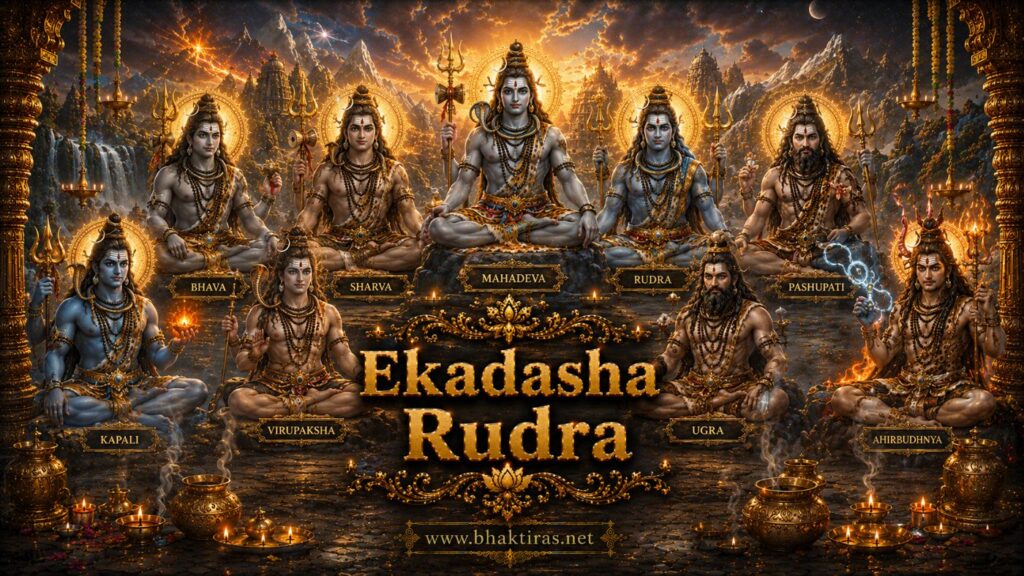
The Ekadasha Rudra are the eleven Rudras, fierce forms and emanations of Lord Shiva who govern the vital breaths of the body and the forces of cosmic dissolution. Their names vary between Puranas, but together they express the powerful, transforming side of Shiva.
Who Are the Ekadasha Rudra?
The Ekadasha Rudra are the eleven Rudras, a group of fierce deities counted among the three great classes of Vedic gods alongside the Adityas and the Vasus. The name Rudra is one of the oldest names of Shiva, and the eleven Rudras are understood as his forms, aspects or emanations, each carrying a portion of his terrible and transforming power.
In one common teaching, the eleven Rudras are linked with the ten pranas or vital breaths of the living body together with the atman or inner self, so that they govern the life force that animates every creature. When that life force withdraws, the Rudras are the forces of ending and dissolution, which is why they are associated with the fierce, world-dissolving side of Shiva rather than his calm, benevolent face.
Their number is fixed at eleven, but their individual names differ from one Purana to another, a sign that the group was always understood more as a collective power than as eleven rigidly separate persons.
Meaning and Symbolism
The eleven Rudras gather the fierce, transforming energy of Shiva into a group that governs life, breath and dissolution.
Forms of Shiva
Each Rudra is an emanation of Lord Shiva, so honouring the eleven is a way of honouring the many faces of his power, from the fierce to the protective.
Lords of the Vital Breaths
The eleven Rudras are linked with the pranas that keep the body alive, making them guardians of the life force within every being.
Agents of Dissolution
As forces of ending, the Rudras carry the world through its cycles of destruction and renewal, clearing the old so the new can arise.
The Eleven Rudras
The names below follow one standard set given in the Puranic tradition. Other texts give slightly different names, since the eleven are aspects of a single fierce power.
- Kapali – The skull-bearer, a form that reflects Shiva’s role as lord over death and the cremation ground.
- Pingala – The tawny or reddish-brown one, radiant with fierce, glowing energy.
- Bhima – The terrible and formidable one, whose very presence inspires awe and fear.
- Virupaksha – The one of odd or many eyes, a name that recalls Shiva’s third eye of insight and destruction.
- Vilohita – The deep red one, coloured with the intensity of fierce power.
- Shasta – The ruler and chastiser, who governs and keeps order among beings.
- Ajapada – The one-footed or goat-footed Rudra, an ancient and mysterious form.
- Ahirbudhnya – The serpent of the deep, guardian of the hidden foundations of the world.
- Shambhu – The source of well-being, the auspicious and benevolent aspect within the fierce group.
- Chanda – The fierce and violent one, embodying raw, unrestrained force.
- Bhava – Existence itself, the Rudra tied to becoming and the unfolding of life.
Vedic Worship and Relevance
The eleven Rudras are honoured together in Vedic and Puranic ritual, most famously through the Rudram, the great hymn to Rudra that is chanted to invoke Shiva in his many forms. Devotees recite the mantra Om Namo Bhagavate Rudraya to salute this fierce yet purifying power. The Rudras are approached not out of dread but for their ability to burn away impurity and to protect the life force, and in this the fierce side of Shiva becomes a source of cleansing and renewal. For a devotee today, the eleven Rudras are a reminder that endings and dissolution are part of the same divine order that also gives and protects life.
Lore and Significance
Born of the Creator's Grief
In one well known Puranic account, when the god Brahma’s mind-born son first appeared he wept and raged until he was given names and stations, and from that fierce weeping being came the Rudras. The very word Rudra is often connected with the sense of one who roars or howls, fitting for a group born in the storm of raw emotion and set to govern the fierce forces of the world.
The Eleven and the Life Breaths
A widely taught idea holds that the eleven Rudras correspond to the ten vital breaths of the body and the inner self that binds them. So long as they remain, a creature lives; when they depart, the Rudras become the agents of that departure. This teaching turns the eleven from distant gods into powers active within every breathing being.
Frequently Asked Questions
Who are the eleven Rudras?
The eleven Rudras, or Ekadasha Rudra, are fierce forms and emanations of Lord Shiva. A standard set names them Kapali, Pingala, Bhima, Virupaksha, Vilohita, Shasta, Ajapada, Ahirbudhnya, Shambhu, Chanda and Bhava, though the names vary by Purana.
Why are they called Rudra?
Rudra is one of the oldest names of Shiva, often linked with the sense of roaring or howling. The eleven Rudras carry the fierce, storm-like and transforming side of Shiva's nature.
What do the eleven Rudras govern?
They are commonly linked with the ten vital breaths of the body and the inner self, so they govern the life force within beings and act as forces of dissolution when that life force withdraws.
Do all texts agree on their names?
No. The number is fixed at eleven, but the individual names differ from one Purana to another, because the Rudras are understood as aspects of a single fierce power rather than rigidly separate persons.
How are the Ekadasha Rudra worshipped?
They are honoured together through the Vedic hymn to Rudra known as the Rudram, and with the mantra Om Namo Bhagavate Rudraya, invoked to burn away impurity and protect the life force.
The eleven Rudras carry the fierce, purifying and renewing power of Lord Shiva.