
Chandra Dev
चन्द्र
Chandra Dev is the Hindu Moon god and one of the nine Navagraha planetary deities. He rules the mind, emotions, night, plant life and the nectar of immortality called soma. His waxing and waning phases come from a curse by Daksha, and Shiva wears the crescent moon on his forehead. Monday is his sacred day.
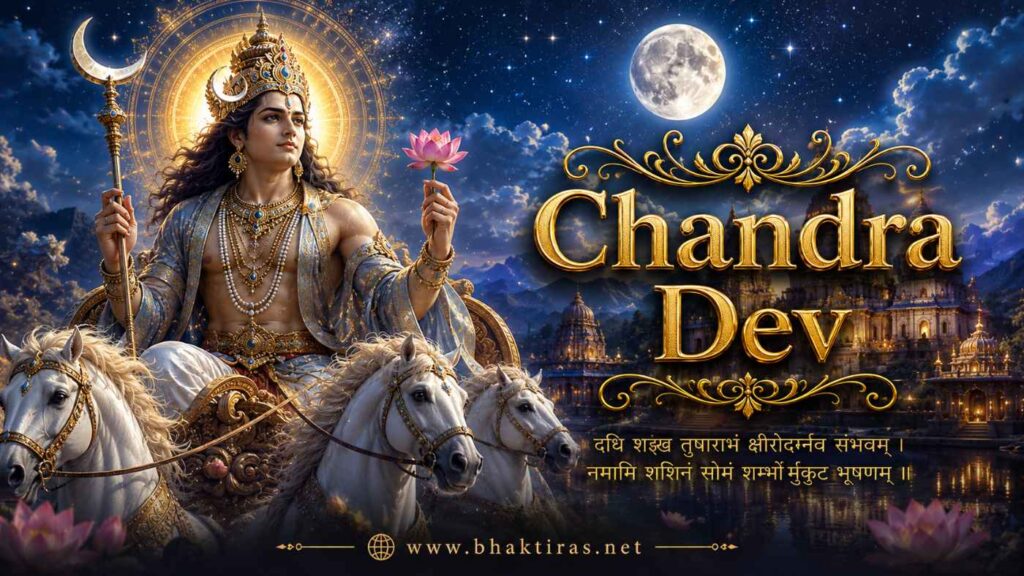
Who Is Chandra Dev?
Chandra Dev is the Hindu god of the moon, worshipped across India as the gentle luminary who softens the darkness of night. His name (चन्द्र) simply means “the shining one” or “moon,” and few deities are named as often in daily life, since the lunar calendar sets the dates of nearly every Hindu festival and vrat.
He belongs to the Navagraha, the nine celestial forces that Hindu astrology holds responsible for shaping human life. Among these nine, Chandra is second only to the Sun in importance. Where Surya governs the soul and vitality, Chandra governs the manas – the mind, moods and feelings. This is why an unsettled or joyful heart is so often compared to the changing phases of the moon.
Old texts also call him Soma, linking him to the sacred drink of the same name that the gods once consumed for immortality. He is described as pale and cool, riding through the sky in a chariot pulled by white horses or a swift antelope, carrying a club in one hand and a lotus in the other.
To devotees, Chandra is approachable and kind. Farmers watch his phases for planting, women observe fasts under his light, and astrologers study his position to understand a person’s emotional nature. He is the deity of the tides within us as much as the tides of the sea.
Lord of the Mind and Emotions
In Hindu thought the moon and the mind are bound together. The Sanskrit phrase chandrama manaso jatah – “the moon was born from the mind” – appears in the Purusha Sukta, and it gives Chandra his most important role: he is the lord of the manas. Just as the moon grows full and then thins away, human emotions rise and fade, and a mind pulled in many directions is likened to moonlight scattered on moving water.
Because of this connection, people troubled by anxiety, restlessness or a wandering mind are often advised to turn to Chandra. His cool, silvery energy is thought to bring peace, patience and emotional balance. Astrologers reading a birth chart look first to the moon’s placement to judge a person’s temperament and inner life.
Chandra’s day is Monday, or Somvar – the very word carries his name Soma. Devotees fast on Mondays, wear white, offer milk and rice, and recite his mantra for a settled heart. Milk, white flowers, camphor and pearls are all linked to him because they share the moon’s cool, luminous quality. Worshipping Chandra is, at its core, a practice of caring for one’s own mind.
Iconography and Symbols
Chandra is shown as a fair, calm figure who carries the softness of moonlight in every detail of his form. Each symbol tells part of his story.
White Body
Chandra is painted pale white or silver, the colour of moonlight itself, signalling coolness, purity and a mind at peace. He is often draped in white garments to match.
Deer Chariot
His chariot glides across the night sky drawn by a swift antelope, or in some accounts by ten white horses, carrying him on his monthly journey through the sky.
Club
In one hand he holds a mace or club (gada), a mark of his authority as a Navagraha and his power to influence the fate of those born under his sway.
Lotus
The lotus in his other hand stands for purity and gentle blessing, echoing the way certain flowers open only under the moon.
Nectar Pot
A kalash of amrita, the nectar of immortality, marks him as Soma – the vessel from which the gods drink the life-giving essence stored in the moon.
Crescent
The crescent is his signature emblem, the same sliver of moon that adorns Shiva’s forehead, tying Chandra forever to the great ascetic god.
Why the Moon Waxes and Wanes
The phases of the moon carry one of the best-loved stories in Hindu tradition. Chandra married the twenty-seven Nakshatras, the lunar constellations, all daughters of the sage Daksha. He was meant to treat every wife equally, but he loved Rohini above all the others and spent his nights only with her, leaving the rest neglected.
When the twenty-six slighted sisters complained to their father, Daksha grew furious. He warned Chandra to change his ways, and when the Moon god ignored him, Daksha laid down a terrible curse: Chandra would waste away and lose his light. Slowly the once-brilliant moon began to shrink until he nearly vanished from the sky, and the whole world dimmed with him.
Desperate, Chandra turned to Shiva. The compassionate lord could not undo Daksha’s curse entirely, but he softened it. He placed the fading crescent on his own forehead, and from that moment the moon would wane and then grow full again in an endless cycle rather than dying outright. This is why Chandra still glows on Shiva’s brow, and why the moon forever passes from new to full and back – a curse turned into rhythm.
Chandra Among the Navagraha
In Jyotisha, Hindu astrology, Chandra is one of the most powerful of the nine grahas because he rules the mind, and the mind colours how a person experiences everything else. He is the lord of the zodiac sign Karka (Cancer), a sign known for its emotional depth, memory and attachment to home and mother.
A strong, well-placed moon in a birth chart is said to grant a calm temperament, good relationships and public affection, while a weak or afflicted moon can bring restlessness, mood swings or emotional strain. Because of this, remedies for Chandra are among the most commonly prescribed.
The classic remedy is the pearl (moti), the gem born of water and moonlight, worn set in silver to strengthen a weak moon. Astrologers also advise fasting on Mondays, offering white items, giving milk or rice in charity, and reciting ॐ चन्द्राय नमः. Nearly all of these remedies share a single aim – to steady and cool the mind, restoring the peace that Chandra rules.
The Moon on Ganesh Chaturthi
There is one night of the year when devotees are told not to look at the moon, and the reason lies in a playful story about Ganesha. One evening Ganesha, having eaten his fill of sweets, was riding home on his little mouse when the mount stumbled and Ganesha tumbled over, his round belly spilling out its contents.
Chandra, watching from above, could not hold back his laughter at the sight. Stung by this mockery, Ganesha cursed the Moon: anyone who gazed upon him would be struck by false blame and undeserved scandal. Realising his mistake, a repentant Chandra begged forgiveness. Ganesha softened the curse so it would apply only on a single day – the Ganesh Chaturthi that marks his own birth.
This is why, to this day, tradition holds that one should avoid viewing the moon on the night of Ganesh Chaturthi, lest one attract false accusations. Even Lord Krishna, the story goes, was once wrongly blamed for a theft after accidentally seeing the moon that night. Those who do glimpse it are advised to recite a short verse or take Ganesha’s name to lift the effect.
Moon Festivals and Vrats
Because the moon sets the Hindu calendar, its worship threads through the whole year. A handful of days are devoted directly to Chandra and his light.
- Sharad Purnima: the autumn full-moon night when the moon is believed to be at its most beautiful and healing, showering nectar (amrita) upon the earth. Devotees leave sweet kheer under the open sky to catch the moonlight before eating it.
- Karva Chauth: the fast kept by married women for the long life of their husbands, broken only after they sight the moon at night and offer water to it through a sieve.
- Kojagari Purnima: the eastern celebration of the same autumn full moon, when Lakshmi and the luminous moon are honoured through the night with lamps and offerings.
- Somvar Vrat: the weekly Monday fast dedicated to Chandra and to Shiva who bears him, kept for peace of mind, marital harmony and emotional steadiness.
Beyond these, every Purnima (full moon) and Amavasya (new moon) is marked with prayer and fasting, keeping Chandra present in devotional life month after month.
A Story Every Devotee Knows
The Birth of Budha and the Waning Moon
Chandra’s most human failing gave the world both a planet and the rhythm of the sky. He fell in love with Tara, the wife of Brihaspati (Jupiter), the teacher of the gods, and carried her away. A great quarrel followed, drawing in gods and asuras, until Brahma intervened and Tara was returned to her husband. From that union a radiant son was born – Budha, who became the planet Mercury and the ancestor of the great Lunar Dynasty of kings. Yet Chandra’s love for Rohini and neglect of his other wives brought Daksha’s curse upon him, and only Shiva’s mercy turned his fading into the endless cycle of waxing and waning we still watch each month.
Soma and the Churning of the Ocean
In the age when gods and demons churned the cosmic ocean for the nectar of immortality, many treasures rose from the waters, and among the first was Chandra himself, gleaming and cool. As Soma, he became the very vessel of amrita, the drink from which the devas draw immortal life. The waxing moon is said to fill again with this nectar, and the waning moon to empty as the gods and ancestors partake of it – so that every phase of Chandra feeds the life of heaven itself.
Prayers and Mantras
Chandra is worshipped for a quiet, steady mind more than for worldly gain. His mantra is short and easy to keep on the tongue, best chanted on Monday mornings, on full-moon nights, or whenever the heart feels unsettled. Offering white flowers, milk and a lit lamp of ghee while reciting it is the simplest way to invite his cool blessing.
Frequently Asked Questions about Chandra Dev
Who is Chandra Dev?
Chandra Dev is the Hindu moon god, one of the nine Navagraha planets and a lord of the mind, emotions and the night. Also called Soma, he rides a chariot pulled by antelopes, holds the pot of nectar that the gods drink, and governs calmness, memory and the tides of feeling within us.
Why does the moon wax and wane?
The Puranas say Chandra married the 27 Nakshatras, daughters of Daksha, but favoured Rohini. The slighted sisters complained, and Daksha cursed Chandra to waste away. After he prayed, Shiva softened the curse into a cycle, so the moon now shrinks and grows again each month rather than dying completely.
Which day is dedicated to Chandra Dev?
Monday, or Somvar, is Chandra's day – the name Soma is another name for the moon. Devotees seeking peace of mind, emotional balance or relief from a weak moon in their horoscope observe a Monday fast, wear white or silver, offer white flowers and rice, and chant the Chandra mantra.
Why do we avoid seeing the moon on Ganesh Chaturthi?
Tradition holds that the moon once laughed at Lord Ganesha after he stumbled, so Ganesha cursed that anyone viewing the moon on Bhadrapada Chaturthi would face false blame. Devotees therefore avoid looking at the moon on Ganesh Chaturthi night, and recite the Syamantaka story to undo any accidental sighting.
What is the Chandra mantra?
The simple beej-style mantra is 'Om Chandraya Namah' – a bow to the moon god. A longer Navagraha verse begins 'Dadhi shankha tushaarabham', praising Chandra as white as curd, conch and frost. Both are chanted on Mondays, often 108 times with a pearl or crystal mala, for a calm and steady mind.
What does Chandra represent in astrology?
Among the Navagraha, Chandra rules the mind, emotions, mother, memory and the sign Karka (Cancer). A strong moon gives peace, intuition and popularity, while a weak or afflicted moon is linked to anxiety and mood swings. The pearl (moti) is his gemstone, and Monday worship is the classic remedy.
Which festivals are connected to the moon?
Sharad Purnima celebrates the full moon whose rays are said to shower nectar, when kheer is left out overnight to absorb them. Karva Chauth ends only when married women sight the moon and offer it water. Kojagari Purnima and every Purnima and Amavasya also mark Chandra's monthly rhythm.
Whenever the mind feels heavy or scattered, a glance at the night sky and a soft “Om Chandraya Namah” is enough to invite Chandra’s calm – may his cool light steady your heart.