
Ardhanarishvara
अर्धनारीश्वर
Ardhanarishvara is the half-male, half-female form of Shiva joined with Parvati in a single body, Shiva on the right and Parvati on the left. The form teaches that the masculine and feminine, spirit and matter, are inseparable parts of one whole divine.
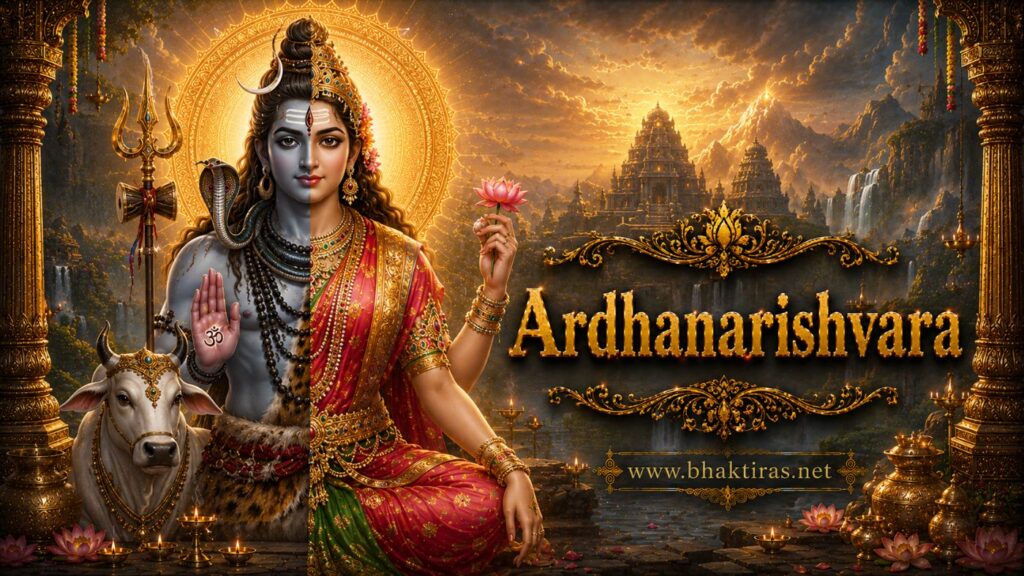
Who Is Ardhanarishvara?
Ardhanarishvara is Shiva and Parvati shown as one body divided down the middle. The right half is Shiva, the great ascetic, and the left half is Parvati, the mother goddess. The name says exactly what the image shows – ardha means half, nari means woman, ishvara means lord, so together it reads as the lord who is half woman.
The form is not a curiosity or a trick of the sculptor. It is a statement about the nature of the divine and of reality itself. Shiva without his Shakti, the tradition says, is inert; it is her energy that lets him act. By fusing them into a single figure, the image insists that god is neither only male nor only female, but the living union of both.
Devotees also call this form Ardhanari or Ardhanarinateshvara. Under every name the point stays the same: the masculine and the feminine belong together at the very heart of the sacred, and neither is complete without the other.
The Two Halves – Iconography
An Ardhanarishvara image is read across a central line, with Shiva keeping the right and Parvati the left. Every detail on each side stays true to that god.
Shiva Half (Right)
The right side is Shiva the ascetic. The hair is matted into a high jata with a crescent moon, the body is smeared with ash, and a serpent may coil at the shoulder. This half holds a trident and often shows a flat, masculine chest. A tiger skin wraps the waist, and the bull Nandi waits nearby. Everything here speaks of stillness, renunciation and pure consciousness.
Parvati Half (Left)
The left side is Parvati in full grace. The hair is dressed and adorned, the eye is lengthened with kohl, and a rounded breast marks the feminine form. This half wears a red or coloured saree, anklets and rich jewellery, and the hand may hold a mirror or a curved lotus. Where present a lion serves as her mount. The whole side glows with beauty, fertility and creative energy.
One Body, Two Natures
The two halves share one waist, one navel and one steady stance, ascetic on the right and adorned goddess on the left, meeting without a seam. The figure never looks split – it reads as a single being who simply carries both natures at once. That undivided centre is the teaching: consciousness and energy, stillness and creation, are one.
The Meaning of the Union
Ardhanarishvara puts a whole philosophy into a single body. In this tradition Shiva is Purusha, pure awareness that watches without moving, and Parvati is Prakriti, the active energy that shapes everything we see. Awareness alone cannot create; energy alone has nothing to illumine it. Joined, they bring the world into being. The half-and-half form makes that dependence impossible to miss – remove either side and the figure, like reality, would collapse.
The image also speaks to human life in a very direct way. It honours the feminine as equal to the masculine, set right at the centre of the divine rather than off to one side. And it hints that wholeness is not found by favouring one nature over the other but by holding both – strength and tenderness, discipline and creativity, stillness and movement – in a single balanced self. For the seeker, Ardhanarishvara is a picture of the completeness that spiritual life is meant to recover.
Worship, Temples and Mantra
The best known shrine to this form is the Ardhanareeswarar temple at Tiruchengode in Tamil Nadu, set on a hill where the deity is worshipped in the half-male, half-female form. Tamil Nadu holds several such temples, and the form appears in Chola bronzes and stone panels across South India, where the balance of the two sides is worked with great care. Beyond the south, Ardhanarishvara is honoured widely across India in Shaiva temples, often as a subsidiary image that carries the deeper teaching of union.
Worship follows the wider Shaiva calendar – Mondays sacred to Shiva and the twilight Pradosham hours are especially favoured, and Maha Shivaratri draws large crowds. Devotees offer bilva leaves along with flowers and red cloth, honouring both the ascetic and the goddess in one act. Married couples in particular turn to this form, praying for harmony and lasting union, since the deity is the very picture of two becoming one. The chanting of the composite name and hymns such as the Ardhanarishvara Stotra completes the offering.
Stories and Legends
The sage who forgot the goddess
A story tells of the sage Bhringi, whose devotion to Shiva was so single-minded that he refused to honour Parvati at all. When he circled the divine couple, he tried to pass between them so that he could go around Shiva alone. To teach him that the two could not be divided, Shiva drew Parvati into his own body and appeared as Ardhanarishvara, half himself and half the goddess. Bhringi, still stubborn, took the form of a beetle and tried to bore through the middle – but the lesson stood: there is no Shiva that is not also Shakti, and no honouring one while ignoring the other.
The creation that needed both
Another account from the Puranas places the form at the very start of creation. When the first beings brought forth by the creator could not multiply, it was seen that a purely male principle was not enough to fill the world. The Supreme then appeared as Ardhanarishvara and separated the feminine half from the body, releasing the goddess so that the pairing of male and female could carry creation forward. The form thus stands at the root of life itself, the moment the one divided into two so that the many could arise.
Frequently Asked Questions
Who is Ardhanarishvara?
Ardhanarishvara is the half-male, half-female form of Shiva united with Parvati in a single body, with Shiva on the right and Parvati on the left. The form symbolises the inseparable union of the masculine and feminine, or Purusha and Prakriti, at the heart of the divine.
What does the name Ardhanarishvara mean?
The name breaks into ardha (half), nari (woman) and ishvara (lord), so it means the lord who is half woman. It describes exactly what the image shows – a single deity that is half Shiva and half Parvati.
How is Ardhanarishvara different from Harihara?
Both are half-and-half forms, but they join different gods. Ardhanarishvara unites Shiva with his consort Parvati to show the union of masculine and feminine. Harihara unites two male gods, Vishnu and Shiva. The two should not be confused with each other.
Which side is Shiva and which is Parvati?
The right half is Shiva: matted hair with a crescent moon, ash, a trident and the bull Nandi. The left half is Parvati: adorned hair, a red saree, jewellery, a mirror or lotus, and sometimes a lion. The two meet along a line down the centre of the body.
What does Ardhanarishvara teach?
The form teaches that consciousness and energy, Purusha and Prakriti, are inseparable and that creation depends on both. It honours the feminine as equal to the masculine and presents wholeness as the balance of both natures within one being.
Ardhanarishvara shows that the divine is whole only when masculine and feminine are one.