
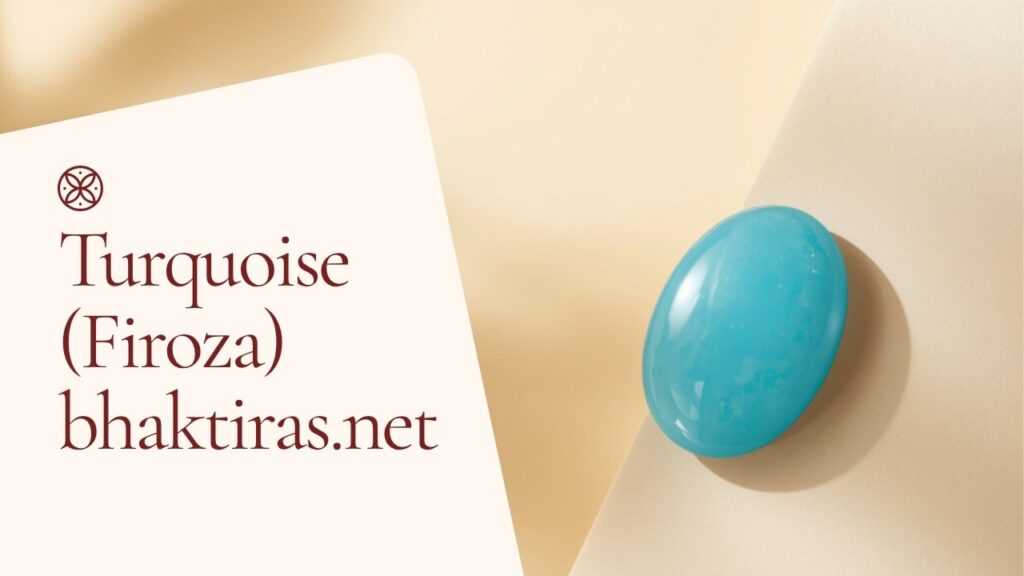
Turquoise (Firoza)
Jupiter's gentle blue stone for Sagittarius and Pisces, and a soft substitute for yellow sapphire.
- Jupiter
- Thursday
- Index finger
- 5-8 ratti
| Ruling planet | Jupiter (Guru); also worn as a general protective stone |
|---|---|
| Rashi (zodiac) | Sagittarius (Dhanu) and Pisces (Meena) |
| Day to wear | Thursday |
| Finger | Index finger of the working hand |
| Metal | Silver |
| Weight | 5-8 ratti |
| Mantra | Om Brim Brihaspataye Namah |
| Hardness | 5-6 on the Mohs scale |
| Colour | Sky blue to blue-green; Iranian stones are the purest blue |
Who Should Wear Turquoise?
Firoza belongs to the uparatna class, a substitute gemstone rather than a primary navaratna, which is exactly why it appeals to people who want Jupiter’s calming influence without committing to a fine yellow sapphire. The clearest fit is Dhanu lagna and Meena lagna natives, since Jupiter rules both these ascendants directly and the stone supports their own lagna lord rather than a borrowed house.
Beyond lagna, astrologers commonly suggest turquoise to people running a Jupiter mahadasha or antardasha whose birth chart shows Jupiter weak, combust or poorly placed, and to those who want Jupiter’s benefits but cannot source or afford a flawless Pukhraj. It is also reached for by people who travel often, given its long-standing reputation as a protective stone in Persian and Tibetan tradition, though this sits alongside its planetary role rather than replacing it. None of this should be decided from a web page alone; a qualified astrologer needs to read your actual chart before you commit to any stone.
The only way to know if your Jupiter is genuinely in a position to need this support, rather than assuming it from your moon sign or sun sign, is to check its house, sign and strength in your own birth chart.
Does Turquoise suit your kundali? The answer is in your birth chart, not your sun sign. Check free in under a minute.
Check My GemstoneBenefits of Wearing Turquoise
- Clearer judgement in study, career or legal matters – classical texts credit Jupiter’s stones with sharpening discernment, which is why turquoise is traditionally reached for before exams, interviews or important decisions.
- Steadier income and savings – wearers report better financial discipline and fewer impulsive losses once Jupiter, the karaka for wealth and abundance, is supported.
- Safer travel – Persian caravan traders and Tibetan pilgrims wore turquoise specifically to guard against falls, accidents and the evil eye on long journeys, a use that has carried into modern practice.
- Better outcomes in teaching, counselling or advisory roles – since Jupiter governs wisdom and guidance, those in these professions often credit the stone with easier rapport and clearer communication.
- Support for marriage and family harmony – Jupiter’s classical association with marital happiness and children means turquoise is sometimes worn by those facing delays or friction on this front.
How to Wear Turquoise (Firoza)
Firoza is worn on a Thursday morning, ideally during Shukla Paksha (the waxing moon fortnight) shortly after sunrise, when Jupiter’s hour is considered strongest.
- Metal and finger: set in silver and worn on the index finger, the finger classically assigned to Jupiter.
- Weight: 5 to 8 ratti is the standard range; an astrologer can narrow this based on your chart.
- Purification: soak the stone in raw milk for a few minutes, rinse with Gangajal or clean water, and pat dry before wearing.
- Mantra: chant “Om Brim Brihaspataye Namah” 108 times while holding the ring, ideally with a mala, before sliding it on.
- Replacement: turquoise is softer and more porous than most gemstones, so watch for fading, dulling or hairline cracks; once the colour turns chalky or greenish-grey and stays that way after cleaning, it has done its work and should be replaced.
Who Should Not Wear Turquoise
Jupiter’s classical adversaries are Mercury and Venus, so anyone running a strong Mercury or Venus dasha or antardasha, or whose chart shows Jupiter poorly disposed toward these planets, should get a professional reading before putting on turquoise rather than assuming it will only help.
Ascendants where Jupiter sits as a functional difficulty rather than a natural friend are also worth checking case by case; a general rule from a website cannot replace a chart reading, and the old jewellers’ trial custom exists for exactly this reason. Wear the ring for three to seven days first and pay attention to your sleep, digestion and mood; unusual restlessness, heaviness, headaches or irritability during this window is traditionally read as a sign the stone does not suit you, and it should come off rather than be pushed through.
Pregnant women, and anyone already wearing another Jupiter-related or Mercury-related stone, should also mention this to their astrologer before adding turquoise, so the two do not end up working against each other.
Turquoise Price in India
Genuine Iranian, or Nishapuri, firoza is priced between Rs 300 and Rs 3,000 per ratti, a wide range that mostly comes down to the depth and evenness of the blue; the purest sky-blue Iranian stones with no visible matrix sit at the top of that band. Tibetan and American turquoise, which typically show more of the spiderweb matrix veining, cost less than comparable Iranian pieces.
Within any origin, colour saturation, freedom from cracks, and whether the stone has been stabilised or treated all move the price. What should worry a buyer more than the number itself is that most cheap turquoise sold in the market today is not turquoise at all, it is dyed howlite or reconstituted turquoise powder pressed with resin. At these prices a lab certificate stating natural, untreated origin is not a luxury, it is the only real check you have against paying gemstone prices for coloured plastic or chalk.
How to Identify a Real Turquoise
- Matrix pattern under a loupe: genuine turquoise, especially from American and Tibetan mines, shows fine brown or black veining (the host rock matrix) running through the stone; fine Iranian pieces are prized for having almost none, but the surface should still show natural, irregular texture rather than a flat printed pattern.
- Hardness check: turquoise sits at 5 to 6 on the Mohs scale, softer than quartz or glass; a steel pin will just about mark it with light pressure, while a hard glass or crystal simulant will not scratch at all.
- Acetone or nail-polish-remover swab: dab a cotton bud with acetone on an inconspicuous spot; if colour transfers onto the cotton, the stone is dyed howlite, magnesite or reconstituted turquoise, not natural firoza.
- Warm needle test: a hot needle brought close to natural turquoise produces no smell, while plastic or resin-bonded imitations give off a faint chemical odour.
- Weight and feel: reconstituted turquoise, powdered stone pressed with resin, feels slightly lighter and warmer to the touch than a solid natural piece, which stays cool for longer when held.
None of these home checks replace a proper gemmological report; for a stone this widely faked, always buy with a certificate from a recognised lab that states natural, untreated origin.
FAQs About Turquoise
Who should wear Firoza (turquoise) stone?
Firoza suits Dhanu (Sagittarius) and Meena (Pisces) ascendants first, since Jupiter rules both signs directly. It is also chosen by people in a weak or difficult Jupiter dasha, or those wanting Jupiter's benefits without a full yellow sapphire. Confirm with an astrologer before wearing.
How does turquoise stone work and when will I see results?
Turquoise is believed to strengthen Jupiter's influence over wisdom, finance, marriage and travel safety once the stone touches skin in a purified state. Classical texts describe gradual results over weeks to months, not instantly, and outcomes depend on Jupiter's actual placement in your birth chart.
Firoza kis ungli aur din pehnna chahiye?
Wear turquoise on the index finger, set in silver, on a Thursday morning after sunrise. This is the standard combination for Jupiter's gemstones, and the metal and finger should not be substituted without an astrologer's advice.
What weight or ratti of turquoise should I buy?
Most astrologers recommend 5 to 8 ratti of turquoise for a standard ring, though the exact weight can be adjusted for your build and chart strength. Buy from a source that states the ratti weight clearly alongside a certificate.
Which combinations should I avoid with Firoza?
Avoid pairing turquoise with stones for Mercury or Venus, since these are Jupiter's classical adversaries, unless an astrologer has specifically approved the combination for your chart. Wear it alone first and use the traditional three to seven day trial to check for discomfort.
Asli Firoza ki price kya hai?
Genuine Iranian turquoise costs Rs 300 to Rs 3,000 per ratti depending on colour depth and matrix pattern, while Tibetan and American stones are usually cheaper. Because dyed howlite and reconstituted turquoise are common in the market, always insist on a lab certificate.
Can turquoise replace yellow sapphire (Pukhraj), and is there a cheaper substitute for it?
Yes, turquoise itself is the traditional uparatna substitute for yellow sapphire when Pukhraj is unaffordable or unavailable, worn for the same Jupiter benefits at a lower cost. Turquoise does not currently have its own further substitute stone recommended in this system.