
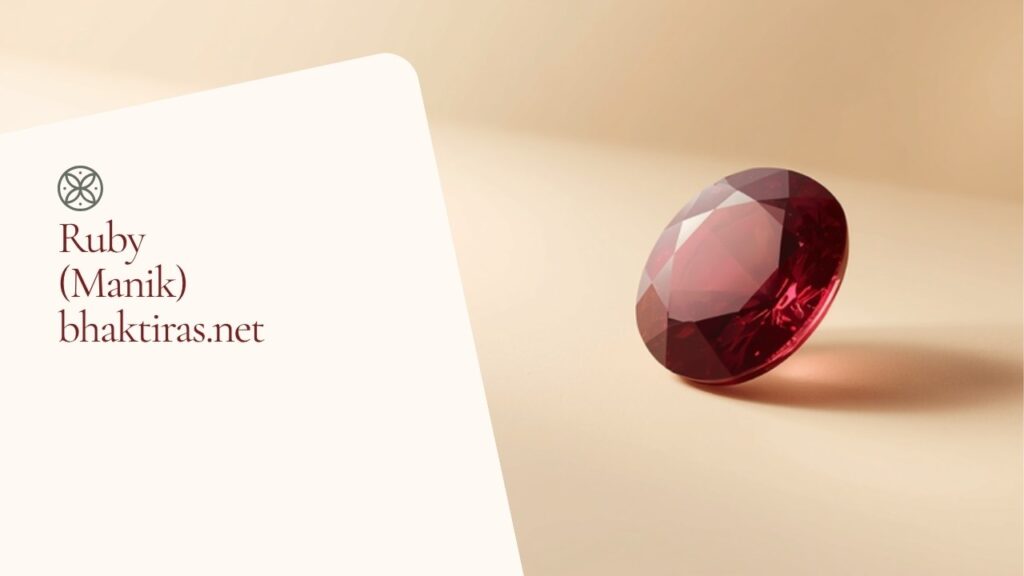
Ruby (Manik)
Manik, the ruby for Sun (Surya): who should wear it, real benefits, correct method and honest pricing before you buy.
- Sun
- Sunday
- Ring finger
- 3-6 ratti
| Ruling planet | Sun (Surya) |
|---|---|
| Rashi (zodiac) | Leo (Simha) |
| Day to wear | Sunday |
| Finger | Ring finger of the working hand |
| Metal | Gold or copper |
| Weight | 3-6 ratti |
| Mantra | Om Ghrinih Suryaya Namah |
| Hardness | 9 on the Mohs scale |
| Colour | Deep red (pigeon-blood is the most prized) |
Who Should Wear Ruby?
Sun is exalted in Aries and rules Leo, so the clearest fit for ruby is a Leo (Simha) ascendant, especially one where the Sun sits weak, combust, or poorly placed in the birth chart. It is also considered for those currently running a Sun mahadasha or antardasha where the Sun needs support, or for a chart where Sun is the lagna lord but placed in a debilitated or enemy sign.
Ruby is not a stone to pick from a magazine article about your sun sign. A birth chart reading by a qualified astrologer should confirm that Sun genuinely needs strengthening for you, and rule out combinations where it would work against you instead. If you want to check your own placements before that conversation use the free calculator below.
Does Ruby suit your kundali? The answer is in your birth chart, not your sun sign. Check free in under a minute.
Check My GemstoneBenefits of Wearing Ruby
- Confidence and presence – classical texts credit Manik with sharpening the qualities the Sun governs: self-assurance, willpower and the ability to hold a room.
- Authority and career standing – wearers report better recognition from superiors, employers and government bodies, all areas Vedic astrology places under Surya’s rule.
- Relationship with father figures – since Sun signifies the father in a chart, some wearers report smoother equations with fathers or senior men after wearing it.
- Vitality and constitution – Sun governs bones, eyes and general vigour in classical texts, so ruby is traditionally worn during a low-stamina or low-confidence phase.
- Name and public reputation – a strong Sun is linked to visibility and respect, so Manik is a common choice before elections, promotions or public-facing roles.
How to Wear Ruby (Manik)
- Day and time: wear it on a Sunday morning, ideally within an hour or two of sunrise, when the Sun’s hora is considered strongest.
- Metal and finger: set in gold or copper and worn on the ring finger of the working hand.
- Weight: 3 to 6 ratti of natural, unheated ruby is the range generally recommended; an astrologer can narrow this to your chart.
- Purification: before wearing, soak the ring for a few minutes in raw milk followed by a rinse in Gangajal, then wipe dry.
- Mantra: chant “Om Ghrinih Suryaya Namah” 108 times while holding the ring, ideally facing east at sunrise, before putting it on.
- Replacement: if the stone chips, cracks or the colour visibly dulls, treat it as having done its work and have it replaced rather than continuing to wear a damaged stone.
Who Should Not Wear Ruby
Ruby is a heating, high-energy stone, and that is exactly why it is not for everyone. If your ascendant is one where Sun functions as a malefic or rules a difficult house for you, wearing Manik can amplify ego friction, conflicts with authority or father figures, and a short temper rather than confidence. This is a chart-specific call, not something to guess from your sun sign alone.
Avoid combining it casually with stones for Sun’s classical enemies, Saturn (blue sapphire) and Venus (diamond), on the same hand at the same time, since the two energies are considered to work against each other. If you are currently in a difficult Saturn or Rahu-Ketu period, most astrologers will ask you to resolve that before adding a Sun stone. The traditional approach is always a trial: wear the ruby for three to seven days and watch for restlessness, headaches, irritability or disturbed sleep before committing to it long term.
Ruby Price in India
Colour does most of the pricing work with ruby. A stone with the deep, slightly blue-toned red that the trade calls pigeon-blood sits far above a pale, brownish or overly purplish red of the same size. Natural, unheated ruby generally runs from about Rs 5,000 to Rs 2,00,000 or more per ratti, and origin widens that gap further: old Burma stones from the Mogok mines sit at the top of the market, while Mozambique and Thai rubies are usually priced well below them for a comparable size.
Beyond colour and origin, clarity (how visible the internal silk and inclusions are), cut precision and whether the stone has been heat-treated all move the price. A glass-filled ruby, sold for a few hundred rupees, looks convincing to the naked eye but carries no astrological value since it is mostly lead glass holding fractured ruby fragments together. Buy only from a dealer who will put the treatment status and origin on the invoice, and insist on a lab certificate before paying anything close to the higher end of the range.
How to Identify a Real Ruby
- Loupe check: under 10x magnification, natural ruby usually shows fine needle-like rutile “silk”, healed fractures that look like fingerprints, or faint colour zoning bands; a stone that looks perfectly clean to the eye is worth a second look.
- Hardness test: corundum sits at 9 on the Mohs scale, so a genuine ruby scratches quartz and glass easily and will not itself scratch under a steel blade; never test with anything harder like a diamond, since that damages the stone.
- Density check: ruby is noticeably heavier than glass or synthetic spinel of the same size; a jeweller can confirm this with a specific gravity test using water displacement.
- Watch for common substitutes: flame-fusion synthetic ruby (curved growth lines under magnification), red spinel, red garnet and red-dyed glass or quartz are all sold as “ruby” to unwary buyers, especially online.
- Glass-filled stones: look for gas bubbles or a flash of blue or orange colour flare inside fractures when tilted under light, a strong sign of lead-glass filling rather than natural clarity.
None of this replaces a proper lab report. Buy with a certificate from a recognised gem testing lab such as GJEPC, IGI or GIA, which will confirm natural origin and disclose any treatment.
FAQs About Ruby
Manik stone kise pehnna chahiye?
Ruby (Manik) suits Leo (Simha) ascendants, especially when Sun is weak, combust or poorly placed, or during a Sun mahadasha or antardasha. It is not a generic sun-sign stone. Always confirm through a birth chart reading with a qualified astrologer before wearing it, since the wrong chart placement can work against you.
Ruby stone ke fayde kya hain aur yeh kaise kaam karta hai?
Classical texts credit Manik with boosting confidence, authority and career recognition, since these fall under Sun's rule in Vedic astrology. Wearers report better standing with superiors and government bodies, improved vitality, and smoother relationships with father figures. These are traditional attributions, not guaranteed outcomes.
Manik ratna kis finger, dhatu aur din mein pehnna chahiye?
Manik is traditionally worn in gold or copper, on the ring finger of the working hand, starting on a Sunday morning close to sunrise. It should be purified first in raw milk and Gangajal, then energised by chanting Om Ghrinih Suryaya Namah 108 times before putting it on.
Ruby stone ka weight kitne ratti ka lena chahiye?
Most astrologers recommend 3 to 6 ratti of natural, unheated ruby for a Manik ring, though the exact weight depends on your chart and how strong or weak Sun is in it. Buy the highest quality you can afford within that range rather than maximising size alone.
Manik ke sath kaun sa ratna nahi pehnna chahiye?
Avoid wearing Manik alongside blue sapphire (Saturn) or diamond (Venus) on the same hand at the same time, since both are considered classical enemies of Sun. If you are in a difficult Saturn or Rahu-Ketu period, resolve that first. Always trial the stone for a few days and watch your reaction.
Ruby (Manik) stone ki price India mein kitni hai?
Natural, unheated ruby generally costs Rs 5,000 to Rs 2,00,000 or more per ratti, driven mainly by colour, origin and clarity, with old Burma pigeon-blood stones at the top. Glass-filled ruby sells for a few hundred rupees but has no astrological value. Always buy with a lab certificate.
Ruby ka substitute stone kya hai agar budget kam ho?
Where a natural, unheated ruby of the right weight is out of budget or hard to source, red garnet is generally used as a substitute for Manik. It is far more affordable, though most astrologers consider it a milder stand-in rather than an equal replacement for genuine ruby.