
Varaha Jayanti 2026 – The Boar Avatar Who Lifted the Earth
वराह जयंती
When is Varaha Jayanti in 2026?
Varaha Jayanti falls on Sunday, 13 September 2026. It marks the appearance of Varaha, the boar avatar of Vishnu, who dived into the cosmic ocean to rescue the earth goddess Bhudevi from the demon Hiranyaksha. The day is observed on Bhadrapada Shukla Tritiya, the third day of the waxing moon in the month of Bhadrapada.
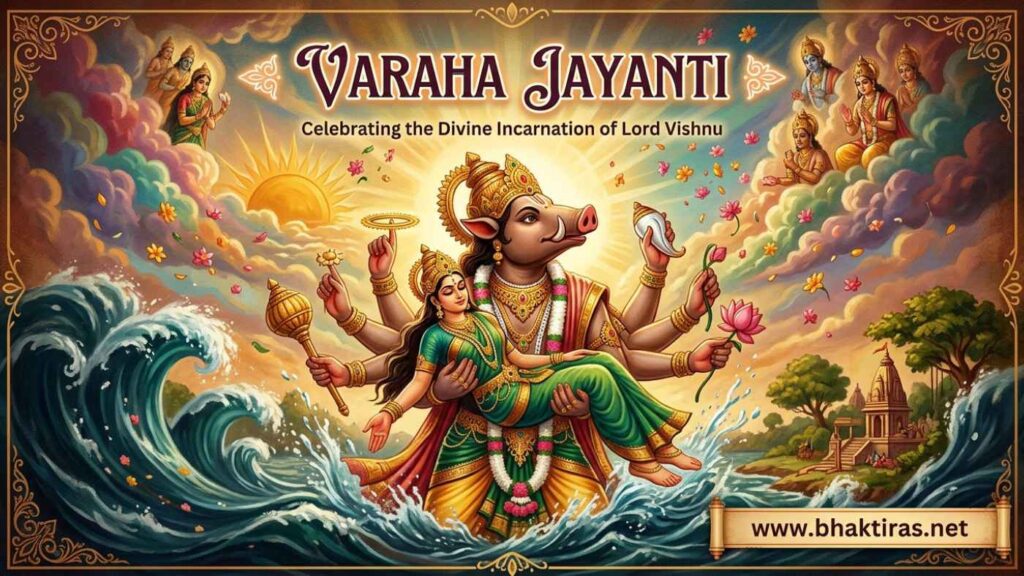
Varaha Jayanti celebrates the day Vishnu took the form of Varaha, a colossal boar, to rescue the earth itself. The story is one of the oldest in Vaishnava tradition: when the demon Hiranyaksha dragged the earth goddess Bhudevi down to the floor of the cosmic ocean, Vishnu plunged in after her, killed the demon, and raised the earth back into place on the tips of his tusks. Observed on Bhadrapada Shukla Tritiya, it falls on 13 September 2026 and is kept mostly by Vaishnava devotees across India.
Varaha Jayanti 2026-2028: Dates & Calendar
Varaha Jayanti next falls on 13 September 2026. Because it follows the lunar month of Bhadrapada, the Gregorian date shifts by a couple of weeks each year.
| Year | Date | Day | Notes |
|---|---|---|---|
| 2026 | 13 September | Sunday | Next occurrence |
| 2027 | 3 September | Friday | Bhadrapada Shukla Tritiya |
| 2028 | 22 August | Tuesday | Falls earlier in the season |
Varaha Jayanti comes in the same bright fortnight as Ganesh Chaturthi, which follows on the next day. Many households mark the boar avatar quietly with a Vishnu puja before the larger Ganesha celebrations begin.
Why Varaha Jayanti Is Celebrated
Varaha Jayanti celebrates the rescue of the earth itself. It remembers the moment Vishnu, as a boar, restored the world to its place and reunited with Bhudevi, the earth goddess.
The earth pulled under
In the Puranic story, the demon Hiranyaksha grew so powerful that he rolled up the earth like a mat and hid it beneath the waters of the cosmic ocean. With the world submerged, life had nowhere to stand. The gods turned to Vishnu, who chose a form suited to the depths.
The boar who dived
Vishnu took the shape of Varaha, an immense boar, and plunged into the ocean. He found Hiranyaksha guarding the sunken earth and fought him for a thousand years before killing him. Then he slid his tusks beneath Bhudevi and carried her back up to the surface.
The third of ten avatars
Varaha is the third of Vishnu’s ten avatars, following Matsya the fish and Kurma the tortoise. Each of these early forms answers a crisis of the deep water. Varaha’s task was to lift the solid earth back into the light so creation could continue.
Varaha and Bhudevi
The day also honours the bond between Varaha and Bhudevi. In temple images she is often shown seated on his tusk or in the crook of his arm, rescued and safe. For many devotees the festival is as much about the earth being cared for as about the demon being slain.
Deities & Figures Worshipped
The day centres on Vishnu in his Varaha form and on Bhudevi, the earth goddess he saves.
Varaha
Varaha is Vishnu as a boar, sometimes shown fully as an animal and sometimes with a boar’s head on a human body. He represents strength turned to protection: the raw power to reach into the deepest, darkest place and bring life back out of it.
Bhudevi
Bhudevi is the goddess of the earth, the one carried back to safety on Varaha’s tusks. She is worshipped as the ground that holds and feeds every living thing, and the festival treats her rescue as an act of tenderness, not just triumph.
Hiranyaksha
Hiranyaksha is the demon who hid the earth beneath the ocean. He is the twin brother of Hiranyakashipu, later slain by Vishnu’s Narasimha avatar. He is not worshipped but is central to the story as the force that Varaha overcomes.
Key Rituals, Step by Step
Varaha Jayanti is a devotional rather than a public festival. Observance is simple and centres on Vishnu at home or at a temple.
- Wake and bathe early. Devotees rise before dawn, bathe, and wear clean clothes, since the day is treated as a Vishnu vrat (vow) by those who keep it strictly.
- Set up the altar. An image or idol of Varaha, or of Vishnu, is placed on a clean cloth, often alongside a small figure of Bhudevi.
- Sankalpa and invocation. The worshipper takes a sankalpa, a quiet resolve to observe the day, and invokes Varaha as the protector who lifted the earth.
- Offer the puja. Flowers, tulsi leaves, sandalwood paste, incense and a lit lamp are offered. Tulsi is especially dear to Vishnu and rarely left out.
- Read or hear the story. Passages telling the Varaha avatara from the Bhagavata Purana or Vishnu Purana are read aloud or listened to.
- Chant Vishnu’s names. Devotees recite the Vishnu Sahasranama or simple mantras such as Om Namo Bhagavate Vasudevaya.
- Keep a fast if vowed. Some observe a full or partial fast, breaking it only after the evening worship.
- Share prasad. Fruit, milk sweets or other simple offerings are distributed to family and visitors to close the day.
Special Foods of Varaha Jayanti
As a Vishnu vrat, the food leans towards sattvic and fasting-friendly dishes rather than a grand feast. Offerings are pure and simple.
Panchamrit
A blend of milk, curd, honey, ghee and sugar used to bathe the deity and then shared as prasad. It is a standard Vishnu offering and appears on most altars for the day.
Fruit and milk
Those who fast often keep to fresh fruit, milk and dry fruits. It keeps the vow while allowing enough for a full day of worship.
Kheer
Rice or vermicelli kheer, cooked in milk with a little sugar and cardamom, is a common sweet offering to Vishnu and a gentle way to break a fast.
Sabudana dishes
Sabudana khichdi or vada, made from tapioca pearls, is eaten by those keeping a grain-free fast, seasoned with peanuts, potato and rock salt.
Regional Names & Variations
Varaha Jayanti is observed most strongly where Varaha is a temple deity, especially in the south and in Vaishnava centres.
Andhra Pradesh & Telangana
The hill temple of Sri Varahalakshmi Narasimha Swamy at Simhachalam near Visakhapatnam is a major Varaha shrine, and the avatar has a strong following across the Telugu-speaking states, where he is called Varaha Swamy.
Tamil Nadu
Varaha is honoured at several Divya Desam temples, including the Adi Varaha shrine at Tirumala’s foothills. Devotees often visit Varaha first before the main Venkateswara darshan.
Odisha & eastern India
Varaha appears among the Dashavatara worshipped alongside Jagannath traditions, and the boar form is depicted in temple sculpture across the region.
North India
In the north the day is a quieter household vrat, kept by Vaishnava families with a Vishnu puja and readings from the Puranas rather than large public gatherings.
Varaha Jayanti Do's and Don'ts
A short guide for those keeping the day as a Vishnu vrat.
Do
- Bathe and begin worship early in the morning.
- Offer tulsi leaves, which Vishnu is especially fond of.
- Read or listen to the Varaha avatara story from the Puranas.
- Keep the fast simple and sattvic if you have vowed one.
- Share prasad with family, neighbours and those in need.
Avoid
- Do not eat onion, garlic, or non-vegetarian food on the vrat day.
- Do not skip the tulsi offering if it can be avoided.
- Do not treat the day as only about slaying the demon; the rescue of the earth is its heart.
- Do not let the lamp go out during the evening worship.
- Do not rush the puja; the day rewards quiet, unhurried devotion.
Frequently Asked Questions
When is Varaha Jayanti in 2026?
Varaha Jayanti in 2026 falls on Sunday, 13 September. It is observed on Bhadrapada Shukla Tritiya, the third day of the bright fortnight in the lunar month of Bhadrapada. The day marks the appearance of Varaha, the boar avatar of Vishnu.
When is Varaha Jayanti in 2027 and 2028?
Varaha Jayanti falls on Friday, 3 September 2027 and on Tuesday, 22 August 2028. The date moves each year because it follows the Hindu lunar month of Bhadrapada rather than a fixed Gregorian date.
Why is Varaha Jayanti celebrated?
Varaha Jayanti is celebrated to honour Vishnu’s rescue of the earth. In the Puranic story, the demon Hiranyaksha dragged the earth goddess Bhudevi beneath the cosmic ocean, and Vishnu took the form of a giant boar to dive in, kill the demon, and lift the earth back to safety on his tusks.
Which god is worshipped on Varaha Jayanti?
Vishnu is worshipped on Varaha Jayanti in his third avatar, Varaha the boar. The earth goddess Bhudevi, whom Varaha rescues, is honoured alongside him, and many temple images show the two together.
What is the Varaha avatar?
Varaha is the third of Vishnu’s ten avatars, taking the form of a boar. He appears after Matsya the fish and Kurma the tortoise, and his role is to raise the submerged earth back out of the ocean so that life can continue.
How is Varaha Jayanti observed?
Varaha Jayanti is observed as a Vishnu vrat. Devotees bathe early, set up an image of Varaha, offer flowers, tulsi and a lamp, read the avatar story from the Puranas, chant Vishnu’s names, and sometimes keep a fast that is broken after evening worship.
Is Varaha Jayanti a public holiday?
Varaha Jayanti is not a national public holiday in India. It is a devotional observance kept mainly by Vaishnava families and at Varaha temples, with the largest gatherings at shrines such as Simhachalam in Andhra Pradesh.
How is Varaha Jayanti connected to Bhudevi?
Varaha Jayanti is tied to Bhudevi because she is the earth goddess Varaha rescues. The festival celebrates not only the defeat of the demon Hiranyaksha but the safe return and care of the earth, and temple images often show Bhudevi seated on Varaha’s tusk or arm.
May Varaha, who lifted the whole earth to safety, keep your ground steady. Jai Shri Hari.