
Sita Navami 2027 – The Birth of Goddess Sita
सीता नवमी
When is Sita Navami in 2027?
Sita Navami in 2027 falls on Friday, 14 May. It marks the birth anniversary of Goddess Sita, observed on Navami of the bright fortnight of the Hindu month of Vaishakha, roughly a month after Ram Navami. Married women often keep a fast on this day and temples across Mithila and Ayodhya hold special worship.
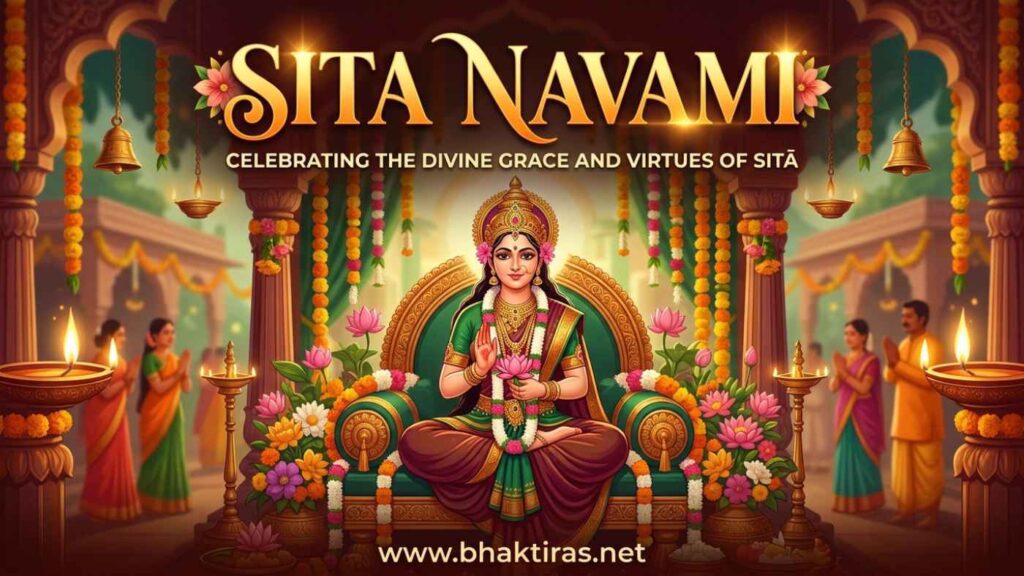
Sita Navami, also called Janaki Navami, honours the birth of Goddess Sita, the consort of Lord Rama and one of the most loved figures in the Ramayana. It falls on the ninth day of the bright half of Vaishakha, usually about a month after Ram Navami. The stories say King Janaka of Mithila found the infant Sita in a furrow while ploughing a field for a yajna, so she is remembered as a daughter of the earth. The day celebrates her as a model of devotion, patience and quiet strength.
Sita Navami 2026-2028: Dates & Calendar
The next Sita Navami is on Friday, 14 May 2027. The date shifts each year because it follows the Hindu lunar calendar, landing on the Navami tithi of Shukla Paksha in Vaishakha.
| Year | Date | Day | Tithi |
|---|---|---|---|
| 2026 | 25 April | Saturday | Vaishakha Shukla Navami |
| 2027 | 14 May | Friday | Vaishakha Shukla Navami |
| 2028 | 3 May | Wednesday | Vaishakha Shukla Navami |
Sita Navami arrives roughly a month after Ram Navami, which marks the birth of Lord Rama. Many families who observe Ram Navami keep this day too, tying the two celebrations together in the same season.
Why Sita Navami Is Celebrated
Sita Navami is celebrated as the birthday of Goddess Sita, wife of Lord Rama and the daughter of the earth found by King Janaka. It honours her as an ideal of devotion, loyalty and inner strength.
Daughter of the earth
The best known account holds that King Janaka of Mithila found the infant Sita in a furrow while ploughing a field to prepare for a yajna. Because she came from the earth she is called Bhumija, and because Janaka raised her she is called Janaki. This origin gives Sita Navami its quiet link to farming, soil and the giving nature of the land.
A model of devotion and patience
Through her years in the forest, her captivity in Lanka and her later trials, Sita is remembered for steadiness rather than spectacle. Sita Navami is a day to reflect on that patience, on loyalty within marriage and family, and on grace held under pressure.
A wife's prayer
Many married women keep a fast on Sita Navami for the wellbeing and long life of their husbands, in the same spirit as other vrats dedicated to Sita and Parvati. The day is felt as an occasion for the household, not only the temple.
Half of Sita-Ram
In much of North India the divine pair is invoked together as Sita-Ram. Celebrating her birth completes the devotion many already give to Rama, and kirtan on this day often weaves both their names into the same song.
Deities & Figures Worshipped
Sita Navami centres on Goddess Sita, worshipped alongside Lord Rama. King Janaka, her foster father, is also remembered on this day.
Goddess Sita
Sita, also known as Janaki, Vaidehi and Bhumija, is honoured as the ideal of devotion and strength. On her birthday she is dressed, garlanded and offered flowers, sweets and prayers, especially by women seeking her blessing for their marriage and home.
Lord Rama
Rama is worshipped beside Sita as her husband and the seventh avatar of Vishnu. Sita-Ram kirtan, readings from the Ramayana and joint jhankis of the couple are common in temples on this day.
King Janaka
Janaka, the wise ruler of Mithila who found and raised Sita, is remembered with affection. His discovery of the child in the field is retold in songs and small dramas, particularly around Janakpur and Sitamarhi.
Key Rituals, Step by Step
Sita Navami is observed with a morning bath, a day-long fast for many women, and worship of Sita with Rama at home or in the temple.
- Rise and bathe early. Devotees begin with a bath and clean clothes, then tidy the home shrine and set up an image or picture of Sita with Rama.
- Take the vrat sankalpa. Married women who fast make a simple vow for the wellbeing of their husband and family, deciding whether they will keep a waterless fast or a lighter one on fruit and milk.
- Set up the puja. The couple’s image is bathed, dressed and decorated with flowers, a red or yellow cloth, sindoor, bangles and other auspicious items associated with a married woman.
- Offer worship. Lamp, incense, flowers, fruit and sweets are offered while chanting Sita and Rama’s names and reciting verses in her honour.
- Read or hear the katha. The story of Sita’s birth from the furrow and her role in the Ramayana is read or narrated, often from the Ramcharitmanas.
- Sing kirtan. Families and temple groups sing Sita-Ram bhajans, and larger temples hold jhankis showing the child Sita found by Janaka.
- Perform aarti and give. The day closes with aarti, distribution of prasad, and often a small donation or feeding of others in Sita’s name.
- Break the fast. Those who fasted eat after the evening worship, usually with the prasad prepared during the day.
Special Foods of Sita Navami
Because many keep a fast, the food of the day leans towards simple vrat dishes and sweet offerings made for Sita and Rama.
Kheer
Rice or vermicelli pudding simmered in milk with sugar and cardamom is a common offering, mild and sweet and easy to share as prasad.
Panjiri and dry fruits
Roasted flour panjiri sweetened with sugar and studded with nuts is prepared in many North Indian homes, alongside plates of almonds, cashews and dried fruit.
Fruit and milk
Those keeping a lighter fast eat fresh fruit, milk and curd through the day, saving grain and cooked food for after the evening puja.
Vrat dishes
When a cooked meal is allowed, families make sabudana khichdi, kuttu or singhara flour preparations and boiled potatoes with rock salt, the usual foods permitted on a Hindu fast.
Regional Names & Variations
The heart of Sita Navami lies in Mithila, the region of Sita’s birth and childhood, but it is kept across North India and by Rama devotees everywhere.
Janakpur, Nepal
Janakpur, held to be the ancient capital of Mithila and the home of King Janaka, marks the day with great feeling. The Janaki Mandir sees crowds, processions and kirtan celebrating Sita as the region’s own daughter.
Sitamarhi, Bihar
Sitamarhi, whose very name recalls Sita and which tradition links to her birthplace, holds fairs and special worship. Temples in the district put on jhankis of the child Sita being found in the field.
Ayodhya
As the city of Rama, Ayodhya keeps Sita Navami with worship of the divine couple, Ramayana recitations and Sita-Ram kirtan in its many temples along the Sarayu.
North India and beyond
Across Uttar Pradesh, Bihar and neighbouring states, and among Rama-devotee families in the diaspora, the day is observed at home with the vrat, puja and bhajan, wherever Sita-Ram is loved.
Sita Navami Do's and Don'ts
A few simple practices help keep the day sincere and calm.
Do
- Bathe early and wear clean, preferably fresh clothes for the puja.
- Worship Sita together with Rama and remember King Janaka.
- Keep the fast honestly if you have taken the vow, in a spirit of devotion rather than strain.
- Read or hear the story of Sita’s birth and her life from the Ramayana.
- Share prasad and, where you can, offer food or a small gift to others in Sita’s name.
Avoid
- Do not treat the fast as a rule to boast about; keep it quietly.
- Do not fabricate elaborate muhurat claims; follow your family or local temple tradition.
- Avoid harsh words or quarrels in the home on a day given to Sita’s grace.
- Do not serve onion, garlic or non-vegetarian food during the observance.
- Do not skip the katha and kirtan for the ritual alone; the story is the heart of the day.
Frequently Asked Questions
When is Sita Navami in 2027?
Sita Navami in 2027 falls on Friday, 14 May. It is observed on the Navami tithi of the Shukla Paksha in the Hindu month of Vaishakha, marking the birth anniversary of Goddess Sita.
When is Sita Navami in 2026 and 2028?
Sita Navami is on Saturday, 25 April 2026 and on Wednesday, 3 May 2028. The date changes each year because it follows the Hindu lunar calendar, always landing on Vaishakha Shukla Navami.
Why is Sita Navami celebrated?
Sita Navami is celebrated as the birthday of Goddess Sita, the wife of Lord Rama. Tradition holds that King Janaka found the infant Sita in a furrow while ploughing a field, so the day honours her as a daughter of the earth and as a model of devotion and strength.
Who is Janaki, and why is the day called Janaki Navami?
Janaki is another name for Sita, meaning the daughter of Janaka, the king of Mithila who raised her. Because of this the festival is also called Janaki Navami or Sita Jayanti.
How is Sita Navami different from Ram Navami?
Ram Navami marks the birth of Lord Rama in the month of Chaitra, while Sita Navami marks the birth of Goddess Sita about a month later in Vaishakha. Both fall on a Navami tithi, and many families observe the two together as part of the same devotion to Sita-Ram.
Do people fast on Sita Navami?
Yes, many married women keep a fast on Sita Navami for the wellbeing and long life of their husbands. The fast may be waterless or lighter on fruit and milk, and is usually broken after the evening worship of Sita and Rama.
Where is Sita Navami celebrated most?
Sita Navami is celebrated most warmly in Mithila, the region of Sita’s birth, especially at Janakpur in Nepal and Sitamarhi in Bihar, as well as in Ayodhya, the city of Rama. It is also observed across North India and by Rama-devotee families worldwide.
What is the story of Sita's birth?
The best known account says King Janaka of Mithila was ploughing a field to prepare for a yajna when he found an infant girl in a furrow of the earth. He adopted and named her Sita, and because she came from the soil she is also called Bhumija, the daughter of the earth.
May the grace and quiet strength of Goddess Sita bless your home this Sita Navami. Jai Siya Ram.