
Samvatsari & Kshamavani 2026 – The Jain Day of Forgiveness
संवत्सरी · क्षमावाणी
When is Samvatsari (Kshamavani) in 2026?
Samvatsari falls on Tuesday, 15 September 2026 for Svetambara Jains, closing the eight days of Paryushan. Digambara Jains keep Kshamavani a few days later, at the end of the ten-day Das Lakshan Parva (around 24-25 September 2026). It is the holiest day of the Jain year, when everyone seeks and grants forgiveness from all living beings with the words Michchhami Dukkadam.
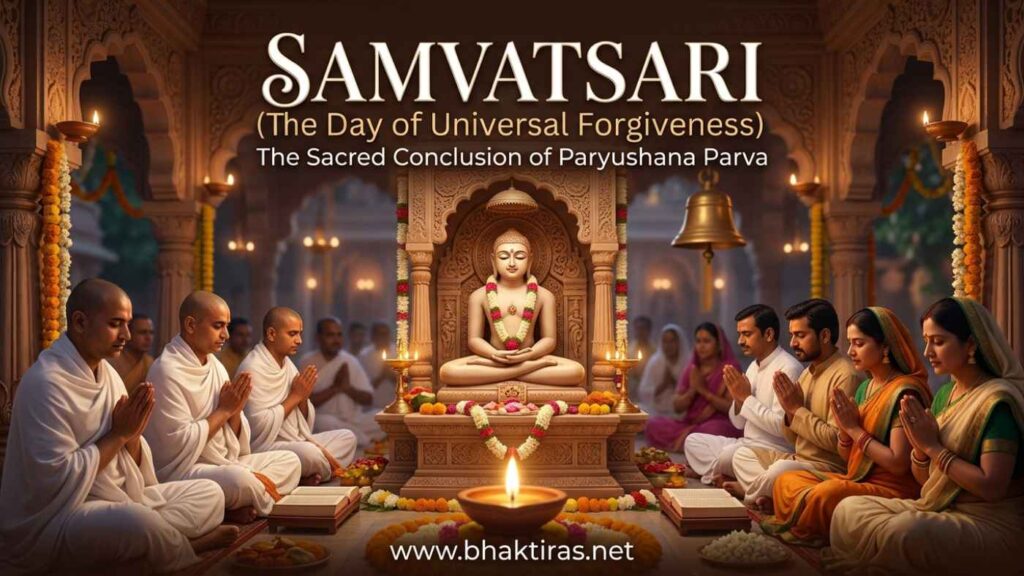
Samvatsari is the single most sacred day of the Jain year – the day set aside for asking and giving forgiveness to every living being for any harm caused over the past twelve months, whether done knowingly or by accident. Svetambara Jains observe it as Samvatsari on the last day of Paryushan, and Digambara Jains observe the same spirit as Kshamavani at the close of Das Lakshan a few days later. In 2026 Samvatsari falls on 15 September. The day distils the Jain ideals of ahimsa, humility and inner cleansing into one simple act: reaching out to say sorry.
Samvatsari & Kshamavani 2026-2028: Dates
Samvatsari 2026 falls on Tuesday, 15 September. The date shifts each year because it is fixed by the Jain lunar calendar – the fourth day of the bright half (Shukla Chaturthi) of the month of Bhadrapada, the last day of the eight-day Paryushan.
| Year | Samvatsari (Svetambara) | Day | Kshamavani (Digambara) |
|---|---|---|---|
| 2026 | 15 September | Tuesday | approx. 24-25 September |
| 2027 | 4 September | Saturday | a few days later |
| 2028 | 23 August | Wednesday | a few days later |
The Svetambara Samvatsari ends an eight-day Paryushan; the Digambara Kshamavani comes at the end of the ten-day Das Lakshan Parva, which begins the day after Svetambara Paryushan concludes. That gap is why the two traditions keep the forgiveness day on slightly different dates, though the meaning is identical.
Why Samvatsari Is Celebrated
Samvatsari is celebrated as the annual day of universal forgiveness, when Jains clear the year’s accumulated ill-will by asking pardon from every living being and freely granting it to all who ask. It is the emotional and spiritual peak of Paryushan.
Jain thought holds that the soul gathers a fine dust of karma through careless words, actions and even thoughts. Forgiveness – given and received without conditions – is one of the most powerful ways to shed that karma and lighten the soul. Samvatsari sets aside one day a year to do this fully and deliberately, so that no grudge is carried into the new year.
The peak of Paryushan
Paryushan is eight days of fasting, self-study and restraint. Samvatsari is its final day, when the introspection of the week is turned outward into the concrete act of reconciliation. Everything that comes before builds towards this moment.
Ahimsa made personal
Non-violence in Jainism is not only about not harming others physically. Samvatsari extends it to the hurt carried in words, silence and memory. Seeking forgiveness repairs the small daily injuries that ordinary life causes.
Cleansing the soul
The day is understood as a spiritual reset. By genuinely letting go of resentment and admitting one’s own faults, a person removes the weight of ill-feeling and starts the year with a lighter, clearer conscience.
What Is Honoured on This Day
Samvatsari is not centred on the worship of a personal god – Jainism has no creator deity. Instead the day honours the path shown by the Tirthankaras and the supreme virtue of forgiveness itself.
The Tirthankaras
Jains revere the twenty-four Tirthankaras, the enlightened teachers who showed the way to liberation. Lord Mahavira, the twenty-fourth, taught forgiveness and non-attachment as central to the soul’s freedom, and his teachings shape the whole observance.
Uttam Kshama
The Digambara Das Lakshan celebrates ten supreme virtues, and the first is Uttam Kshama, supreme forgiveness. Kshamavani takes its name from this virtue, placing the quality itself at the heart of the day rather than any deity.
Key Rituals, Step by Step
The day follows a rhythm of scripture, repentance, fasting and, above all, the exchange of forgiveness. Here is how many Jain families observe it.
- Complete the Paryushan fast. Many keep a full fast on Samvatsari itself, taking only boiled water during daylight, or observe a partial fast if health does not allow more.
- Attend Pratikraman. The annual Samvatsari Pratikraman is a long, solemn session of reflection in which one reviews the year’s conduct and repents each fault, small and large.
- Listen to the Kalpa Sutra and scripture. Passages recounting the life of Mahavira and the vows of Jain living are read at the temple or upashray, focusing the mind on right conduct.
- Ask forgiveness first. Rather than wait to be approached, Jains take the first step – bowing to elders, calling relatives and reaching out to anyone they may have wronged.
- Say Michchhami Dukkadam. The words Michchhami Dukkadam (Svetambara) or Uttam Kshama (Digambara) are offered to family, friends and strangers alike, meaning may all my wrong deeds be forgiven.
- Grant forgiveness freely. Just as one asks, one gives – releasing every grievance without keeping score, which is considered as important as seeking pardon.
- Send the message far. Today the greeting travels by letter, phone call and message across cities and continents, so that even those far away are included before the day ends.
How Samvatsari Is Observed Across Communities
The forgiveness day is kept by Jains everywhere, but the name, timing and detail vary a little between the main traditions.
Svetambara – Samvatsari
Svetambara Jains observe Samvatsari on the eighth and final day of Paryushan, in Bhadrapada. The day is marked by the great Samvatsari Pratikraman and the greeting Michchhami Dukkadam.
Digambara – Kshamavani
Digambara Jains keep Kshamavani at the close of the ten-day Das Lakshan Parva, a few days after Svetambara Paryushan ends. The greeting used is Uttam Kshama, supreme forgiveness.
Sthanakvasi and Terapanthi
Within the Svetambara fold, Sthanakvasi and Terapanthi communities also centre the day on Pratikraman and forgiveness, sometimes observing it on a slightly different tithi as decided by their sangh.
The Jain diaspora
In Jain communities across the United States, United Kingdom, East Africa and beyond, temples hold Pratikraman and forgiveness gatherings, and Michchhami Dukkadam messages are exchanged worldwide by call and text.
Samvatsari Do's and Don'ts
A few simple points help keep the spirit of the day sincere rather than a formality.
Do
- Ask forgiveness first, before you are asked
- Forgive freely and without conditions when someone reaches out to you
- Attend or complete the Samvatsari Pratikraman if you can
- Keep the fast to the degree your health allows
- Include those far away with a heartfelt Michchhami Dukkadam message
Avoid
- Do not treat the greeting as an empty formality or a social duty
- Do not hold on to any grudge into the new year
- Avoid quarrels, harsh words and gossip on the day
- Do not harm any living being; keep strictly to ahimsa
- Avoid forcing a full fast if you are unwell or frail
Frequently Asked Questions
When is Samvatsari in 2026?
Samvatsari 2026 falls on Tuesday, 15 September for Svetambara Jains, the last day of the eight-day Paryushan. It is fixed by the Jain lunar calendar on Bhadrapada Shukla Chaturthi. Digambara Jains observe the equivalent Kshamavani a few days later.
When is Samvatsari in 2027 and 2028?
Samvatsari falls on Saturday, 4 September 2027 and on Wednesday, 23 August 2028. The date moves each year because it is set by the Jain lunar calendar rather than the Gregorian one, so it drifts through late August and September.
What is the difference between Samvatsari and Kshamavani?
Samvatsari and Kshamavani are the same forgiveness day observed by different Jain traditions. Samvatsari is the Svetambara name, kept on the last day of Paryushan; Kshamavani is the Digambara name, kept at the end of the ten-day Das Lakshan Parva a few days later. The meaning – universal forgiveness – is identical.
What does Michchhami Dukkadam mean?
Michchhami Dukkadam is a Prakrit phrase meaning may all my wrong deeds be forgiven. On Samvatsari, Jains say it to family, friends and strangers to ask pardon for any hurt caused over the year, knowingly or unknowingly. Digambara Jains use Uttam Kshama, meaning supreme forgiveness, in the same spirit.
Why is Samvatsari celebrated?
Samvatsari is celebrated as the day of universal forgiveness, when Jains clear the year’s ill-will by asking pardon from and granting it to every living being. In Jain thought, sincere forgiveness sheds accumulated karma and lightens the soul, making it the holiest day of the year and the peak of Paryushan.
Do Jains fast on Samvatsari?
Yes, many Jains keep a complete fast on Samvatsari, taking only boiled water during daylight, as the climax of the fasting through Paryushan. Those who cannot fast fully observe a partial fast. Fasting is paired with the long Samvatsari Pratikraman and the exchange of forgiveness.
What is Pratikraman on Samvatsari?
Samvatsari Pratikraman is the annual, in-depth session of repentance in which Jains review their conduct over the past year and repent each fault. It is the longest Pratikraman of the year and forms the spiritual core of Samvatsari, preparing the mind before forgiveness is exchanged.
Is Samvatsari a Hindu festival?
No, Samvatsari is a Jain festival, not a Hindu one. It is the holiest day of the Jain year, observed by Svetambara Jains at the end of Paryushan, with Digambara Jains keeping the parallel Kshamavani. It centres on the Jain ideals of ahimsa, humility and forgiveness.
May any hurt caused over the year, in word, thought or deed, be forgiven – Michchhami Dukkadam.