
Rabindra Jayanti 2026 – Celebrating Tagore's Birth Anniversary
রবীন্দ্র জয়ন্তী
When is Rabindra Jayanti in 2027?
Rabindra Jayanti falls on 9 May 2027. It marks the birth anniversary of Rabindranath Tagore, the poet and Nobel laureate, and is observed on the 25th day of the Bengali month of Boishakh, known as Pochishe Boishakh. Bengalis in West Bengal, Tripura and Bangladesh mark the day with song, dance-drama and poetry.
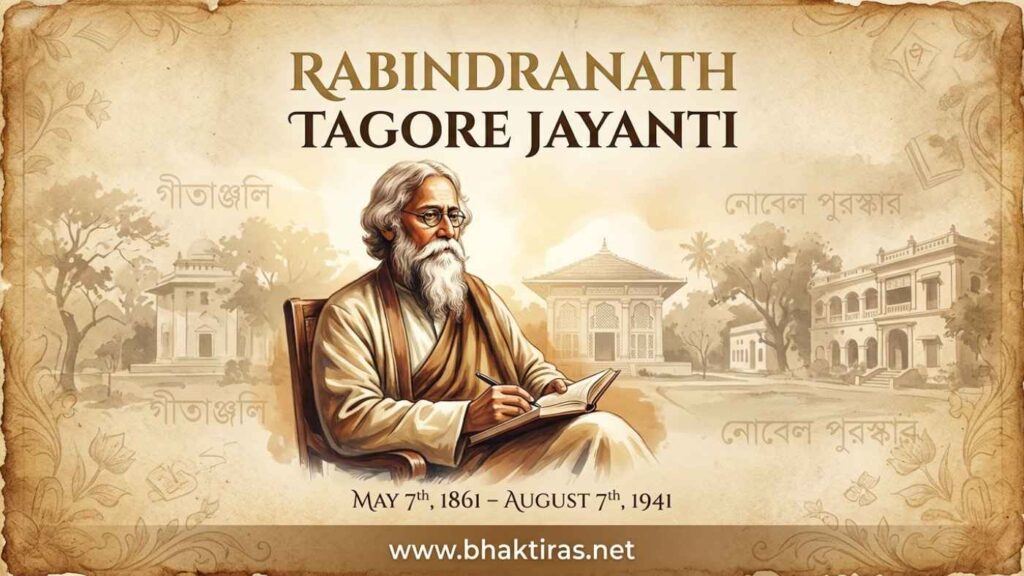
Rabindra Jayanti honours the birth of Rabindranath Tagore (1861-1941), the Bengali poet, playwright, painter and composer who became the first non-European to win the Nobel Prize in Literature. Bengalis call it Pochishe Boishakh because it falls on the 25th day of Boishakh in the Bengali calendar, which lands on 8 or 9 May most years. Far more than a formal anniversary, the day is a lived celebration of Bengali cultural identity, filled with the songs, verses and dance-dramas Tagore left behind.
Rabindra Jayanti 2026-2028: Dates & Calendar
The next Rabindra Jayanti is on 9 May 2027. The date shifts by a day or so between years because it follows the 25th of Boishakh in the Bengali solar calendar rather than a fixed Gregorian date.
| Year | Date | Day | Notes |
|---|---|---|---|
| 2026 | 9 May | Saturday | 25 Boishakh 1433 |
| 2027 | 9 May | Sunday | Next occurrence – 25 Boishakh 1434 |
| 2028 | 8 May | Monday | 25 Boishakh 1435 |
Tagore was born on 7 May 1861 by the Gregorian calendar. Because Bengalis observe his birth by the Bengali date of 25 Boishakh, the annual commemoration usually lands on 8 or 9 May instead of 7 May.
Why Rabindra Jayanti Is Celebrated
Rabindra Jayanti is celebrated to honour Rabindranath Tagore’s legacy in literature, music, art and education, and to affirm a shared Bengali cultural identity.
A literary giant
Tagore reshaped Bengali prose and verse and won the 1913 Nobel Prize in Literature for Gitanjali, the first Asian and first non-European to do so. His poems, short stories and novels are still read and taught across the subcontinent.
Composer of two anthems
He wrote and set to music the national anthems of two nations: ‘Jana Gana Mana’ for India and ‘Amar Sonar Bangla’ for Bangladesh. Few figures in world history have given a melody to more than one country.
Rabindra Sangeet
Tagore composed over two thousand songs, a body of work known as Rabindra Sangeet that forms its own musical tradition. On his birthday these songs fill homes, stages and radio across Bengal.
Educator and reformer
He founded Visva-Bharati at Santiniketan, an open-air school that blended Indian and world learning. The institution remains a living centre of the celebration each year.
The Figure Honoured
Rabindra Jayanti is a cultural birth-anniversary observance rather than a religious festival, so no deity is worshipped. The day centres entirely on the memory and work of one person.
Rabindranath Tagore
Poet, novelist, playwright, painter, composer and philosopher, Tagore was born in Kolkata to the Tagore family of Jorasanko. Known affectionately as Gurudev, he travelled the world, corresponded with thinkers across continents, and left a legacy that Bengalis treat almost as a national inheritance.
How Rabindra Jayanti Is Observed, Step by Step
The day unfolds through community and school programmes rather than temple rites, beginning at dawn and running through cultural evenings.
- Prabhat Pheri. Groups walk through neighbourhoods at daybreak singing Rabindra Sangeet, a morning procession that opens the day.
- Floral tribute. Portraits and busts of Tagore are garlanded at schools, colleges, libraries and public squares.
- Rabindra Sangeet recitals. Trained and amateur singers perform his songs, often accompanied by the harmonium, esraj and tabla.
- Poetry and prose readings. Students and elders recite his poems and passages from his stories and essays.
- Dance-dramas. Troupes stage his works such as Chandalika and Shyama, blending song, dance and narration.
- Programmes at Santiniketan. Visva-Bharati, the university he founded, holds special assemblies, music and open-air performances.
- Sharing sweets. Families and gatherings pass around Bengali sweets and light refreshments as the celebrations close.
Foods Shared on Rabindra Jayanti
There is no fixed ritual menu; instead people share the Bengali sweets and light fare that mark any cultural gathering in the region.
Sondesh
A soft sweet of fresh chhena and sugar, sometimes scented with cardamom or shaped into delicate moulds. It is among the most loved offerings at any Bengali celebration.
Rosogolla
Spongy chhena balls simmered in light sugar syrup, served cool and syrup-soaked. A near-universal sweet at Bengali festive moments.
Mishti
The broad family of Bengali sweets, from mishti doi (sweet yoghurt) to assorted chhena-based confections, shared freely among guests and neighbours.
Festive Bengali fare
Beyond sweets, gatherings often include tea, savoury snacks and simple Bengali dishes served to those attending the day’s programmes.
Where It Is Celebrated
Rabindra Jayanti is observed wherever Bengali culture has roots, with the same songs and readings taking on a local character.
West Bengal
The heartland of the celebration, with Kolkata and Santiniketan hosting the largest gatherings, recitals and dance-drama stagings.
Tripura
The Bengali-majority state marks the day with school functions, music and public programmes honouring Tagore.
Bangladesh
Tagore is revered as the composer of the national anthem ‘Amar Sonar Bangla’, and his birthday is widely observed with cultural events.
Bengali diaspora worldwide
Bengali associations across India and abroad hold Rabindra Sangeet evenings, readings and community meals to keep the tradition alive.
Rabindra Jayanti Do's and Don'ts
A few simple ways to take part respectfully in the day.
Do
- Join or listen to a Rabindra Sangeet recital
- Read a Tagore poem or story, in Bengali or translation
- Attend a local school or community programme
- Learn about his work at Santiniketan and Visva-Bharati
- Share Bengali sweets with family and friends
Avoid
- Do not treat it as a religious rite – it honours a person, not a deity
- Do not confuse his 7 May Gregorian birth with the observed 25 Boishakh date
- Do not misattribute his songs or claim them as folk music
- Do not assume it is celebrated only in West Bengal
- Avoid reducing the day to a formality – it is a living cultural event
Frequently Asked Questions
When is Rabindra Jayanti in 2027?
Rabindra Jayanti is on 9 May 2027, a Sunday. It follows the 25th day of Boishakh (Pochishe Boishakh) in the Bengali calendar, which is why it falls in early May each year.
When is Rabindra Jayanti in 2026 and 2028?
Rabindra Jayanti falls on 9 May in 2026 and on 8 May in 2028. The date shifts slightly year to year because it tracks 25 Boishakh in the Bengali solar calendar rather than a fixed Gregorian date.
Why is Tagore's birthday on 8 or 9 May and not 7 May?
Rabindranath Tagore was born on 7 May 1861 by the Gregorian calendar, but Bengalis observe his birth by the Bengali date of 25 Boishakh. That date usually corresponds to 8 or 9 May in the Gregorian calendar, so the annual commemoration lands on those days rather than on 7 May.
Why is Rabindra Jayanti celebrated?
Rabindra Jayanti is celebrated to honour the legacy of Rabindranath Tagore in literature, music, art and education. As the day also affirms Bengali cultural identity, it is marked with song, poetry and dance-drama across Bengal and Bangladesh.
What is Pochishe Boishakh?
Pochishe Boishakh means ‘the 25th of Boishakh’ in Bengali, the date on which Tagore was born in the Bengali calendar. It is the traditional name for Rabindra Jayanti and marks the start of the Bengali summer month of Boishakh’s fourth week.
How is Rabindra Jayanti celebrated?
Rabindra Jayanti is celebrated with Prabhat Pheri song processions at dawn, recitals of Rabindra Sangeet, readings of Tagore’s poetry and prose, and stagings of his dance-dramas such as Chandalika and Shyama. Schools, colleges and Visva-Bharati at Santiniketan hold special cultural programmes.
Is Rabindra Jayanti a religious festival?
No, Rabindra Jayanti is a cultural birth-anniversary observance rather than a religious festival. It honours the poet Rabindranath Tagore, so no deity is worshipped; the focus is on his songs, writings and contribution to Bengali culture.
What did Rabindranath Tagore achieve?
Rabindranath Tagore won the 1913 Nobel Prize in Literature, the first non-European to do so, for his poetry collection Gitanjali. He composed the national anthems of both India and Bangladesh, wrote thousands of songs known as Rabindra Sangeet, and founded Visva-Bharati university at Santiniketan.
However you mark the day, may it bring you closer to Gurudev’s words and music. শুভ রবীন্দ্র জয়ন্তী.