
Pang Lhabsol 2026 – Sikkim's Festival of the Guardian Mountain
དཔང་ལྷ་གསོལ།
When is Pang Lhabsol in 2026?
Pang Lhabsol falls on approximately 27 August 2026 (the exact date is fixed nearer the time from the Tibetan lunar calendar). It is a uniquely Sikkimese festival that honours Mount Khangchendzonga as the guardian deity of Sikkim and remembers the blood-brotherhood treaty sworn between the Bhutia and Lepcha peoples beneath the mountain.
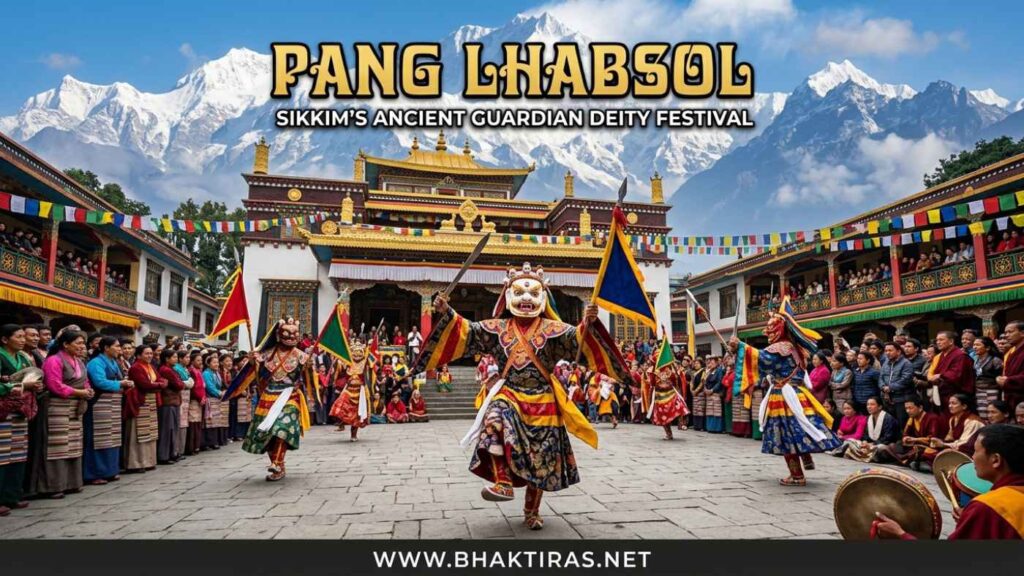
Pang Lhabsol is Sikkim’s very own festival, celebrated nowhere else in quite the same way. On the fifteenth day of the seventh Tibetan month, usually in late August or early September, the state honours Mount Khangchendzonga – the third-highest peak on earth – as its guardian deity, and remembers the day the Bhutia and Lepcha peoples swore an oath of friendship under the mountain. Its heart is the Pangtoed Chaam, a masked warrior dance in which a red-faced mountain deity appears in full armour to receive the offerings of the land.
Pang Lhabsol 2026-2028: Dates & Calendar
Pang Lhabsol 2026 is expected around 27 August. Because it follows the fifteenth day of the seventh month of the Tibetan lunar calendar, the Gregorian date shifts each year and is confirmed close to the time.
| Year | Date (approx.) | Day | Notes |
|---|---|---|---|
| 2025 | 7 September | Sunday | Observed date |
| 2026 | 27 August (approx.) | Thursday | Next occurrence |
| 2027 | 15 September (approx.) | Wednesday | To be confirmed |
The 2026 and 2027 dates above are our best estimate from the Tibetan calendar and should be treated as approximate until Sikkim publishes its official holiday list. A leap-month year can move the festival by several weeks.
Why Pang Lhabsol Is Celebrated
Pang Lhabsol is celebrated to honour Mount Khangchendzonga as Sikkim’s guardian deity and to remember the treaty of brotherhood between the Bhutia and Lepcha communities. It is a thanksgiving to the mountain and a reminder of the state’s ethnic harmony.
The guardian mountain
Sikkimese tradition treats Khangchendzonga not just as a peak but as a living protector, called Dzonga. The word ‘Pang Lhabsol’ carries the sense of offering thanks and witnessing an oath before this deity. Farmers, monks and officials alike ask the mountain-god for a good harvest, safety from landslides and the wellbeing of the land in the year ahead.
The blood-brotherhood treaty
The festival recalls a historic pact between the Bhutia leader and the Lepcha chief, said to have been sworn at Kabi Lungchok with animal blood and the mountain as witness. Two peoples of different origin agreed to live as one. Pang Lhabsol keeps that promise alive every year, which is why it is as much a civic festival of unity as a religious one.
Consecration of the deity
The observance is credited to Lhatsun Chenpo, an early teacher who helped bring Buddhism to Sikkim in the seventeenth century and formally established Khangchendzonga as the country’s protector. The third Chogyal, Chakdor Namgyal, is remembered for shaping the Pangtoed warrior dance that gives the festival its dramatic form.
Deities & Figures Worshipped
The central figure of Pang Lhabsol is Dzonga, the deity of Mount Khangchendzonga, worshipped as the guardian of Sikkim. His commander and the teachers who established his worship are honoured alongside him.
Dzonga (Khangchendzonga)
The presiding spirit of the sacred mountain, shown in the Chaam as a fierce red-faced warrior in armour, often riding a snow lion. He is treated as the supreme protector of the land and the one who receives the festival’s offerings.
Yabdu
The warrior general of Khangchendzonga, who appears in the dance as the deity’s chief attendant and commander of his army of local spirits. His arrival in mask and armour is one of the festival’s most striking moments.
Mahakala
The wrathful protector of Buddhist teaching is invoked in the monastery rituals that frame the day, tying the local mountain-worship to the wider Vajrayana Buddhist tradition of Sikkim.
Lhatsun Chenpo
The revered teacher honoured for consecrating Khangchendzonga as Sikkim’s guardian and for helping bring Buddhism to the region. He is remembered in prayers as the founder of the observance.
Key Rituals, Step by Step
Pang Lhabsol combines quiet monastery prayer with the open-air spectacle of masked dance. Here is how a typical observance unfolds, most famously at the Tsuklakhang Palace Monastery in Gangtok.
- Preparation and purification. In the days before, monks prepare the monastery courtyard, ready the masks and costumes, and perform cleansing rituals so the ground is fit to receive the deity.
- Morning prayers. On the day itself, lamas begin with chanting, offerings of butter lamps, incense and torma cakes, invoking Khangchendzonga, Mahakala and the local protectors.
- Calling the deity. The rites formally invite Dzonga and his commander Yabdu to be present and to accept the community’s thanks and requests for protection.
- The Pangtoed Chaam begins. Monks in heavy brocade robes and masks take to the courtyard for the warrior dance, moving to drums, cymbals and long horns.
- Arrival of the mountain-god. The climax comes when the red-faced warrior deity appears, mounted and in armour, honouring Khangchendzonga; the crowd watches in reverence as the guardian is embodied before them.
- Offerings and blessings. Grain, drink and symbolic gifts are offered to the deity for a good harvest and the safety of the land, and blessings are shared with those present.
- Community gathering. The day closes with people of all communities coming together, reflecting the friendship the festival commemorates, often with shared food and folk celebration.
Special Foods of Pang Lhabsol
Pang Lhabsol food is the hearty, warming fare of the Sikkim hills, shared among neighbours after the ceremonies. There are no strict festive-only dishes, but certain foods appear at almost every gathering.
Momos
Steamed dumplings filled with vegetables, cheese or meat, served with a fiery dalle-chilli chutney. They are the everyday celebration food of the region and appear at family gatherings during the festival.
Thukpa
A warming noodle soup with vegetables and sometimes meat, well suited to the cool late-monsoon days when Pang Lhabsol falls.
Chhurpi & sael roti
Chhurpi is a traditional yak or cow-milk cheese, while sael roti is a ring-shaped rice bread fried till golden – both common at community feasts across Sikkim’s communities.
Chhaang
A mild fermented millet or rice brew, sipped warm from a bamboo vessel. It is a customary drink of hospitality in Bhutia and Lepcha homes during festive days.
Where Pang Lhabsol Is Celebrated
Pang Lhabsol is a festival of Sikkim, and its grandest form is seen in the capital, though monasteries and villages across the state keep the day in their own way.
Gangtok
The Tsuklakhang Palace Monastery inside the former royal palace complex hosts the best-known Pangtoed Chaam, once performed in the presence of the Chogyal and still the centrepiece of the celebrations.
Pemayangtse & Rabdentse
In west Sikkim, the historic monasteries near the old capital hold their own observances, tying the festival to the state’s early royal history.
Yuksam
The site of Sikkim’s first coronation marks the day with traditional ceremony, keeping alive its deep link to the founding of the kingdom under the mountain’s protection.
Villages across Sikkim
Bhutia and Lepcha communities in smaller towns and villages honour Khangchendzonga locally, so the festival is felt across the whole of Sikkim, not only in the capital.
Pang Lhabsol Do's and Don'ts
A little awareness helps visitors take part respectfully in what is both a sacred rite and a community celebration.
Do
- Watch the Chaam dance quietly and attentively, as it is an act of worship, not a stage show.
- Dress modestly when entering monastery grounds and remove your shoes where asked.
- Ask before photographing monks, masks or rituals up close.
- Learn a little about Khangchendzonga’s meaning to Sikkim before you attend.
- Join the community spirit of unity that the day celebrates, greeting people of all backgrounds warmly.
Avoid
- Do not treat the sacred mountain or its images casually or point at them dismissively.
- Do not walk across the dance area or disturb the performers during the Chaam.
- Do not raise your voice or use flash photography inside the monastery during prayers.
- Do not litter the monastery courtyards or festival grounds.
- Do not assume it is the same as Losar or other Buddhist festivals – Pang Lhabsol is unique to Sikkim.
Frequently Asked Questions
When is Pang Lhabsol in 2026?
Pang Lhabsol in 2026 is expected around 27 August. The date is approximate because the festival follows the fifteenth day of the seventh month of the Tibetan lunar calendar, and Sikkim confirms the exact gazetted date closer to the time.
When is Pang Lhabsol in 2025 and 2027?
Pang Lhabsol was observed on 7 September in 2025 and is expected around 15 September in 2027. As a lunar-calendar festival, its Gregorian date shifts each year, so the 2027 date should be treated as approximate until officially confirmed.
Why is Pang Lhabsol celebrated?
Pang Lhabsol is celebrated to honour Mount Khangchendzonga as the guardian deity of Sikkim and to remember the treaty of brotherhood sworn between the Bhutia and Lepcha peoples under the mountain. It is both a thanksgiving to the mountain-god and a yearly reminder of the state’s ethnic harmony.
Which deity is worshipped during Pang Lhabsol?
The chief deity worshipped during Pang Lhabsol is Dzonga, the spirit of Mount Khangchendzonga, honoured as Sikkim’s supreme protector. His commander Yabdu, the protector Mahakala, and the teacher Lhatsun Chenpo who established the worship are also revered.
What is the Pangtoed Chaam?
The Pangtoed Chaam is the spectacular masked warrior dance that is the highlight of Pang Lhabsol, performed by monks in armour and brocade robes. Its climax is the appearance of a fierce red-faced warrior deity, mounted and in full armour, honouring the guardian mountain Khangchendzonga.
Where is Pang Lhabsol celebrated?
Pang Lhabsol is celebrated across Sikkim, and nowhere else in quite the same form. The best-known celebration is the Chaam dance at the Tsuklakhang Palace Monastery in Gangtok, with further observances at monasteries such as Pemayangtse, Rabdentse and the historic site of Yuksam.
Is Pang Lhabsol a public holiday in Sikkim?
Yes, Pang Lhabsol is a gazetted public holiday in the state of Sikkim, reflecting how central the festival is to Sikkimese identity. The Government of Sikkim publishes the exact date each year in its official holiday list.
How is Pang Lhabsol different from Losar?
Pang Lhabsol is unique to Sikkim and centres on worshipping Mount Khangchendzonga and the Bhutia-Lepcha friendship treaty, while Losar is the Tibetan Buddhist New Year celebrated widely across the Himalayas. Pang Lhabsol falls in late summer, whereas Losar comes in late winter.
May the guardian mountain watch over all who keep this day – Pang Lhabsol Tashi Delek from all of us at Bhaktiras.