
Dree Festival 2026 – The Apatani Harvest Prayer of Ziro
When is the Dree Festival in 2026?
The Dree Festival falls on 5 July 2026, with village rituals from 4 July and the main day on the 5th. It is the agricultural festival of the Apatani people of the Ziro valley in Arunachal Pradesh, held on fixed dates each year (roughly 5 to 7 July). Priests pray to four gods for a good harvest and protection from pests, disease and famine.
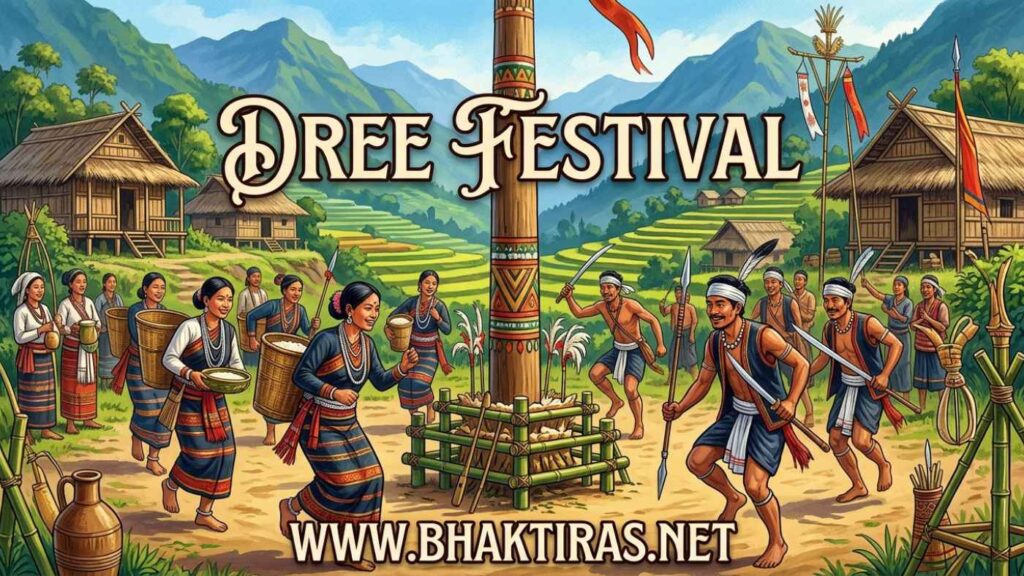
The Dree Festival is the main agricultural festival of the Apatani people, who farm the wet-rice terraces of the Ziro valley in Lower Subansiri, Arunachal Pradesh. Held on fixed July dates each year, with 5 July as the central day, it is a season of prayer before the harvest. Apatani priests appeal to four gods to keep pests, disease and famine away and to secure a full crop. Cucumbers are shared with everyone present, and the valley fills with folk dance, songs and traditional sport.
Dree Festival 2026-2028: Dates & Calendar
The next Dree Festival is on 5 July 2026. Unlike most Hindu festivals, Dree follows fixed solar-calendar dates, so it lands on the same days every year rather than shifting with the moon.
| Year | Main day | Day | Notes |
|---|---|---|---|
| 2026 | 5 July | Sunday | Next occurrence; central celebration at Ziro |
| 2027 | 5 July | Monday | Same fixed date |
| 2028 | 5 July | Wednesday | Same fixed date |
The central celebration runs for about three days (roughly 5 to 7 July), with preparatory rituals in the villages on 4 July. Since 1967, when students led by Shri Lod Kojee first organised a common gathering, the community has marked the festival together at a central ground near Old Ziro.
Why the Dree Festival Is Celebrated
The Dree Festival is celebrated to secure a bumper harvest and to protect the Apatani community from pests, crop disease, epidemics and famine. It is an act of collective thanksgiving and prayer before the main paddy harvest of the Ziro valley.
The Apatani are known for an unusually productive system of wet-rice farming, in which fish are reared in the flooded paddy fields alongside the rice. A single failed season can threaten the food supply of the whole valley, so the community’s prayers focus squarely on the crop: healthy plants, fertile soil, plentiful fish and freedom from blight.
A prayer against famine
Dree is, at heart, an appeal to keep hunger away. The priests ask the gods to spare the fields from insects, disease and drought so that the paddy ripens and no household goes short. The whole festival is built around that single agricultural concern.
Rooted in Donyi-Polo belief
The Apatani follow Donyi-Polo, the indigenous Sun and Moon faith of several Arunachal tribes, in which Danyi (the Sun) is honoured as a supreme, life-giving power. Dree draws on this belief, with the sun-linked deity Danyi at the centre of its prayers.
Community over the individual
Since the first central gathering in 1967, Dree has grown from scattered village rites into one shared observance. Families come together on common ground, which makes the festival as much about Apatani unity and identity as about the harvest itself.
Deities & Figures Worshipped
The Dree Festival honours four gods, each asked to guard a different part of the harvest. Together their blessings are meant to guarantee a full, healthy crop.
Danyi
Danyi, linked to the Sun in the Donyi-Polo faith, is the chief deity of Dree. Danyi is asked to ensure a bumper harvest, fertile fields, an abundance of fish in the paddy waters, healthy cattle and the general well-being of the people.
Tamu
Tamu is prayed to for protection of the crops from insects and pests. Keeping the paddy free of infestation is one of the festival’s central concerns.
Metii
Metii is invoked to ward off epidemics and other illnesses among the people. The prayer guards not just the crop but the health of the community that depends on it.
Harniang
Harniang is honoured to keep the soil fertile. A rich, productive earth is the foundation on which the rest of the harvest depends, which makes Harniang’s blessing essential to the season.
Key Rituals, Step by Step
Dree combines solemn priestly rites with days of communal celebration. The core sequence runs roughly as follows.
- Village preparation. On the day before the central festival, families and villages carry out their own preparatory rites and ready the offerings for the main gathering.
- Priestly chanting. Apatani priests recite the traditional ritual chants, calling on Tamu, Metii, Danyi and Harniang to protect the crop and the people.
- Offerings and sacrifices. Ritual offerings, including animal sacrifices in keeping with Apatani custom, are made to the four gods to seek their favour for the season.
- Purification of the fields. Cleansing rites are performed to clear the agricultural land of harmful influences, so the coming harvest is not spoiled.
- Cucumber distribution. Cucumbers are shared out among everyone present, guests included, as a token of the sacredness of the crop and a wish for fruitful farming.
- Communal feast. The community gathers to eat and to drink the local rice and millet beer, marking the shared hope for a good harvest.
- Dance and song. Folk dances such as the Daminda and other traditional songs are performed, with women and children in customary Apatani dress.
- Traditional sport. Youths compete in indigenous games such as wrestling and high jump, while elders take part in knowledge contests, rounding off the celebration.
Special Foods of the Dree Festival
The food and drink of Dree are simple and local, drawn from the valley’s own fields.
Dree Taku (cucumber)
The shared cucumber is the signature of the festival. Handed to guests and participants alike, it stands for the sacredness of the crop and a prayer for a fruitful season.
Rice and millet beer
The local rice and millet beer, known among the Apatani as apong, is served throughout the celebration. Tangy and mildly fermented, it is the customary drink of the feast.
Rice and field fish
Rice from the valley’s wet terraces is the staple of the communal meal, often served alongside fish reared in the same paddy fields, a hallmark of Apatani farming.
Where the Dree Festival Is Celebrated
Dree is a local festival of one community, the Apatani, so it is closely tied to a single place and the people who have carried it beyond it.
Ziro valley, Arunachal Pradesh
The festival’s home is the Ziro valley in Lower Subansiri, where the central celebration is held on common ground near Old Ziro. The wider Apatani cultural landscape of Ziro is on India’s tentative list for UNESCO World Heritage status.
The Apatani diaspora
Apatani people living outside Ziro, in other parts of Arunachal Pradesh and beyond, often mark Dree with community gatherings of their own, keeping the harvest tradition alive away from the valley.
Dree Festival Do's and Don'ts
If you attend Dree as a visitor, a little respect goes a long way in a living indigenous tradition.
Do
- Treat the priestly rites as sacred and observe quietly
- Ask before photographing rituals, elders or offerings
- Accept the shared cucumber graciously when offered
- Learn a little about the four gods and their roles beforehand
- Support local Apatani hosts, food and crafts
Avoid
- Do not interrupt or step into the ritual space during chants
- Do not treat the sacrifices or offerings as a spectacle
- Do not litter the festival ground or paddy fields
- Do not overindulge in the rice beer and cause disruption
- Do not photograph people without their consent
Frequently Asked Questions
When is the Dree Festival in 2026?
The Dree Festival is on 5 July 2026, which is the central main day. Village-level rituals begin on 4 July, and the celebration continues for about three days, roughly 5 to 7 July, at Ziro in Arunachal Pradesh.
Is the Dree Festival always on the same date?
Yes. The Dree Festival falls on fixed dates each year, with 5 July as the main day, so it does not shift like moon-based Hindu festivals. It lands on 5 July in 2026, 2027 and 2028 alike.
Why is the Dree Festival celebrated?
The Dree Festival is celebrated to secure a bumper harvest and to protect the Apatani community from pests, crop disease, epidemics and famine. It is an agricultural prayer held before the paddy harvest in the Ziro valley.
Which gods are worshipped during Dree?
Four gods are worshipped during Dree: Danyi, Tamu, Metii and Harniang. Danyi, linked to the Sun, is the main deity who ensures a good harvest; Tamu guards against pests, Metii against epidemics, and Harniang keeps the soil fertile.
Who celebrates the Dree Festival?
The Dree Festival is celebrated by the Apatani people, an indigenous community of the Ziro valley in Lower Subansiri, Arunachal Pradesh. They follow the Donyi-Polo faith, which honours the Sun and Moon, and are known for their wet-rice farming.
Why is a cucumber shared during Dree?
Cucumbers are distributed to guests and participants during Dree as a symbol of the sacredness of the crop and a wish for fruitful farming. The shared cucumber is one of the festival’s best-known customs.
Where is the Dree Festival held?
The Dree Festival is held in the Ziro valley of Lower Subansiri district, Arunachal Pradesh, with the central celebration on common ground near Old Ziro. Apatani communities living elsewhere also hold their own gatherings.
What food and drink mark the Dree Festival?
The Dree Festival is marked by the shared cucumber, valley rice and paddy-field fish, and the local rice and millet beer known as apong. These simple, local foods anchor the communal feast that follows the rituals.
May the fields of Ziro stay green and the harvest be full – a happy Dree to the Apatani community.