
Dhammachakra Pravartan Din 2026 – The Turning of the Wheel of Dhamma
धम्मचक्र प्रवर्तन दिन
When is Dhammachakra Pravartan Din in 2026?
Dhammachakra Pravartan Din falls on Ashoka Vijayadashami, which is Tuesday, 20 October 2026. It marks the day in 1956 when Dr B. R. Ambedkar and roughly half a million followers embraced Buddhism at Deekshabhoomi in Nagpur. Many communities also keep the fixed calendar date of 14 October, the actual date of the 1956 ceremony.
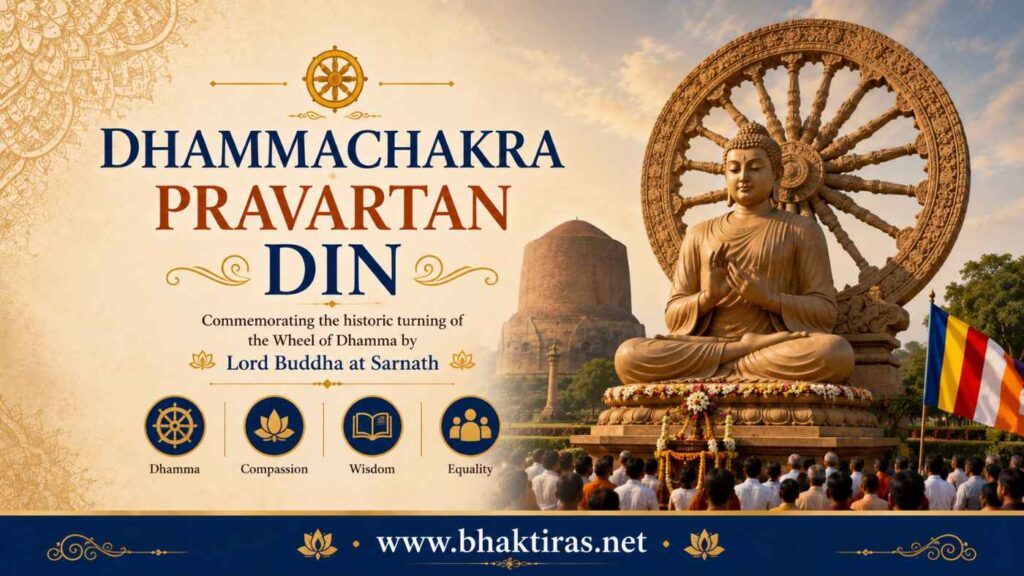
Dhammachakra Pravartan Din, also called Ashoka Vijayadashami, remembers the day in 1956 when Dr B. R. Ambedkar led around half a million people out of caste Hinduism and into Buddhism at Nagpur. The name means the turning of the wheel of Dhamma, and for Ambedkarite Buddhists it is the most important day of the year. Each October, huge crowds gather at the Deekshabhoomi stupa to bow to the Buddha, take the 22 vows, and mark a fresh start built on equality and reason rather than birth.
Dhammachakra Pravartan Din 2026-2028: Dates & Calendar
The main gathering at Deekshabhoomi follows Ashoka Vijayadashami, the Dussehra day, so it shifts with the Hindu lunar calendar. In 2026 that falls on Tuesday, 20 October.
| Year | Vijayadashami date | Day | Fixed date |
|---|---|---|---|
| 2026 | 20 October | Tuesday | 14 October |
| 2027 | 9 October | Saturday | 14 October |
| 2028 | 27 September | Wednesday | 14 October |
Two reckonings run side by side. The fixed date is 14 October, the actual date of the 1956 ceremony, kept by many Buddhist organisations and as an official observance. The Ashoka Vijayadashami date moves each year with the lunar calendar, and Deekshabhoomi’s main annual rally is timed to it. Ambedkar deliberately chose Vijayadashami, the day linked to Emperor Ashoka’s own turn to Buddhism, so both dates carry meaning.
Why Dhammachakra Pravartan Din Is Celebrated
Dhammachakra Pravartan Din is celebrated because it marks Dr B. R. Ambedkar’s public conversion to Buddhism on 14 October 1956, a turning point in the struggle against caste oppression. It is remembered as the moment the wheel of Dhamma was set turning again in India.
Ambedkar had said years earlier that though he was born a Hindu, he would not die one. On 14 October 1956 at Nagpur he acted on that pledge, taking the three refuges and five precepts from the monk Chandramani, and then administering his own 22 vows to the crowd. An estimated half a million people converted with him, and more followed in the days after.
The turning of the wheel
Dhammachakra Pravartan means setting the wheel of Dhamma in motion, the phrase used for the Buddha’s first sermon at Sarnath. Ambedkar cast his mass conversion as a revival of that teaching in the land of its birth, reframing Buddhism as a path of liberty and reason.
A stand against caste
For millions born into castes treated as untouchable, the conversion was a way to step out of a hierarchy that denied them dignity. Choosing Buddhism, with its rejection of birth-based rank, was both a spiritual and a political act of freedom.
Why Ashoka Vijayadashami
Ambedkar picked Vijayadashami, the day associated with Emperor Ashoka embracing Buddhism after Kalinga. The date turns a festival of victory over evil into a victory over social injustice, linking the new movement to India’s own Buddhist past.
Navayana Buddhism
The conversion founded what is now called Navayana, or the new vehicle, a socially engaged reading of Buddhism focused on this-worldly equality. It remains one of the largest religious conversions in modern history.
Who Is Honoured
Dhammachakra Pravartan Din centres on the Buddha and his Dhamma rather than a ritual deity, and it honours Dr B. R. Ambedkar as the leader of the 1956 conversion. Emperor Ashoka is also remembered for the day that carries his name.
The Buddha
The day begins with homage to Gautama Buddha, whose teaching of the Middle Way and the Four Noble Truths the converts accepted. Offerings of white flowers, candles and incense are made before his image at the stupa.
Dr B. R. Ambedkar
Babasaheb Ambedkar is revered as the guide who led his people to Buddhism. His portrait stands beside the Buddha’s at Deekshabhoomi, and his 22 vows are recited by the gathered crowds.
Emperor Ashoka
The name Ashoka Vijayadashami recalls the Mauryan emperor who turned to Buddhism and spread it across Asia. Ambedkar saw himself as continuing that older effort to root the Dhamma in India.
Key Rituals, Step by Step
The day at Deekshabhoomi follows a steady rhythm of homage, vows and quiet devotion rather than elaborate ceremony.
- Journey to Deekshabhoomi. Followers travel from across Maharashtra and India, many walking the final stretch, to reach the great white stupa at Nagpur where the 1956 ceremony took place.
- Homage to the Buddha. Devotees bow before the Buddha’s image, offer white flowers, light candles and incense, and sit in silence to pay their respects.
- Taking the refuges and precepts. Led by monks, the crowd recites the three refuges in the Buddha, Dhamma and Sangha, and takes the five precepts of Buddhist practice.
- Reciting the 22 vows. Ambedkar’s 22 vows, rejecting caste worship and affirming equality and reason, are read aloud and repeated by the gathering.
- New conversions. Each year fresh converts formally embrace Buddhism at the site, continuing the movement Ambedkar began.
- Talks and readings. Speeches on Ambedkar’s thought, readings from his book The Buddha and His Dhamma, and community meetings fill the day.
- Paying respects at the relics. Visitors file through the stupa to see the relics and the memorial to Babasaheb before heading home.
Where It Is Observed
Deekshabhoomi in Nagpur is the heart of the observance, but the day is kept by Ambedkarite Buddhist communities across India and abroad.
Deekshabhoomi, Nagpur
The original conversion site draws the largest gathering, with lakhs of people arriving over the weekend closest to Vijayadashami. The domed white stupa is lit up and the surrounding grounds fill with pilgrims, book stalls and community kitchens.
Maharashtra
Across Maharashtra, viharas and Buddhist societies hold their own homage meetings, vow recitations and processions, and many families keep the day at home with readings and simple offerings.
Pan-India and diaspora
Ambedkarite Buddhist groups in other Indian states and among the diaspora mark the day with prayer meetings and talks, keeping the memory of the 1956 conversion alive far from Nagpur.
Dhammachakra Pravartan Din Do's and Don'ts
A few simple points help visitors take part respectfully.
Do
- Wear clean, modest clothing, often white, in keeping with the day.
- Bow to the Buddha and take the refuges and precepts with sincerity.
- Read or recite Ambedkar’s 22 vows and reflect on their meaning.
- Carry water and be patient in the very large Deekshabhoomi crowds.
- Support the community kitchens and keep the grounds clean.
Avoid
- Do not treat the gathering as a fair; it is a day of homage and reflection.
- Avoid loud or disruptive behaviour near the stupa and relics.
- Do not push in the crowds; move slowly and mind children and elders.
- Avoid alcohol and intoxicants, which run against the precepts.
- Do not confuse the day with Dussehra rituals; here Vijayadashami marks a different victory.
Frequently Asked Questions
When is Dhammachakra Pravartan Din in 2026?
Dhammachakra Pravartan Din in 2026 is on Ashoka Vijayadashami, Tuesday, 20 October. This is when the main gathering at Deekshabhoomi in Nagpur takes place. Many groups also observe the fixed date of 14 October, the actual date of the 1956 conversion.
When is Dhammachakra Pravartan Din in 2027 and 2028?
By the Ashoka Vijayadashami reckoning, Dhammachakra Pravartan Din falls on Saturday, 9 October 2027 and Wednesday, 27 September 2028. The fixed calendar date stays 14 October each year. The Deekshabhoomi rally follows the Vijayadashami date.
Why is Dhammachakra Pravartan Din celebrated?
Dhammachakra Pravartan Din is celebrated to mark Dr B. R. Ambedkar’s mass conversion to Buddhism at Nagpur on 14 October 1956. Around half a million followers embraced Buddhism with him, rejecting caste oppression. The name means the turning of the wheel of Dhamma, echoing the Buddha’s first sermon.
Who led the conversion at Deekshabhoomi?
Dr B. R. Ambedkar led the conversion at Deekshabhoomi in Nagpur. He took the refuges and precepts from the monk Chandramani, then gave his own 22 vows to the crowd of roughly half a million people. He died less than two months later, in December 1956.
Why did Ambedkar choose Ashoka Vijayadashami?
Ambedkar chose Ashoka Vijayadashami because it is linked to Emperor Ashoka’s own turn to Buddhism. Holding the conversion on this day of victory over evil framed the movement as a victory over caste injustice, and tied it to India’s earlier Buddhist heritage. This is why the festival is also called Ashoka Vijayadashami.
What are the 22 vows?
The 22 vows are pledges Ambedkar composed for the new Buddhists, rejecting worship of Hindu gods and caste practices while affirming equality, compassion and reason. They are recited each year at Deekshabhoomi as a statement of the Navayana path. They shape the movement’s identity as much as the refuges do.
Where is Dhammachakra Pravartan Din mainly observed?
Dhammachakra Pravartan Din is mainly observed at Deekshabhoomi in Nagpur, Maharashtra, the site of the 1956 conversion. Lakhs of Ambedkarite Buddhists gather there over the Vijayadashami weekend. Communities across Maharashtra, the rest of India and the diaspora also keep the day.
Is Dhammachakra Pravartan Din the same as Dussehra?
No, Dhammachakra Pravartan Din is not the same as Dussehra, although it is held on the same Vijayadashami day. Dussehra marks Rama’s victory over Ravana, while Dhammachakra Pravartan Din remembers Ambedkar’s conversion to Buddhism. They share a date but honour very different events.
May the wheel of Dhamma keep turning. Namo Buddhaya to all who gather at Deekshabhoomi this Dhammachakra Pravartan Din.