
Datta Jayanti 2026 – Birth of the Three-in-One Guru
दत्त जयंती
When is Datta Jayanti in 2026?
Datta Jayanti falls on Wednesday, 23 December 2026. It is the birth anniversary of Lord Dattatreya, celebrated on Margashirsha Purnima, the full-moon day of the month of Margashirsha (November-December). Devotees mark it with a Gurucharitra reading, fasting and a visit to a Datta shrine.
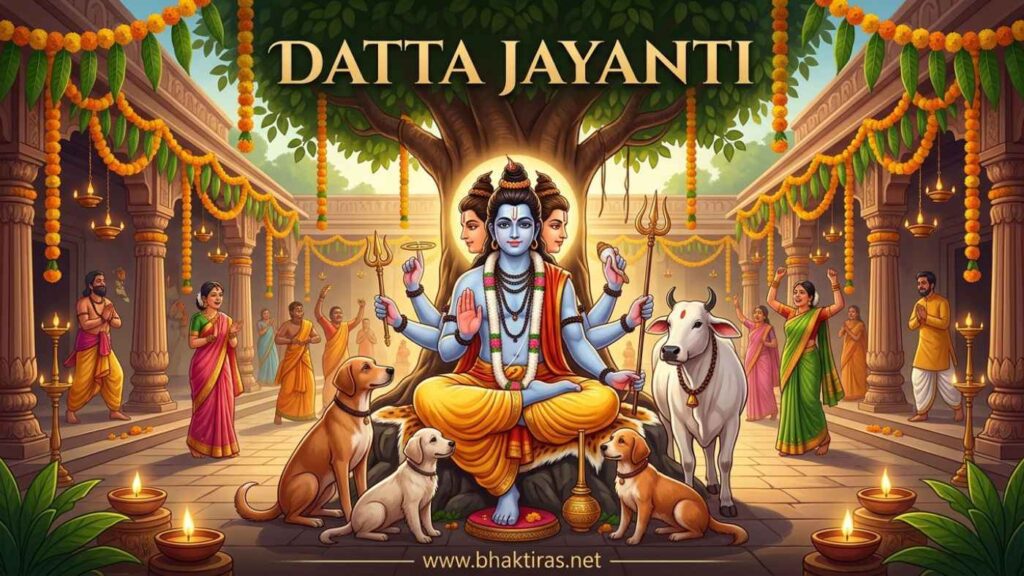
Datta Jayanti is the birth anniversary of Lord Dattatreya, the guru who holds Brahma, Vishnu and Shiva in a single form. It arrives on Margashirsha Purnima, the full moon of the Hindu month of Margashirsha, which usually lands in December. In Maharashtra and Karnataka especially, families keep a seven-day observance that closes on this full-moon evening, reading the Gurucharitra, fasting through the day, and gathering at the Datta peethas of Gangapur, Audumbar and Narsobawadi to sit with a lamp and a name they trust.
Datta Jayanti 2026-2028: Dates & Calendar
The next Datta Jayanti is Wednesday, 23 December 2026. The date shifts each year because it follows the lunar calendar – the full moon (Purnima) of the month of Margashirsha – rather than a fixed solar date.
| Year | Date | Day | Tithi |
|---|---|---|---|
| 2026 | 23 December | Wednesday | Margashirsha Purnima – Next occurrence |
| 2027 | 13 December | Monday | Margashirsha Purnima |
| 2028 | 1 December | Friday | Margashirsha Purnima |
The observance is centred on the Purnima evening, when the moon is full, since tradition places Dattatreya’s birth at the sunset hour of that day. Many temples begin the reading of the Gurucharitra seven days earlier so it concludes on the Jayanti itself.
Why Datta Jayanti Is Celebrated
Datta Jayanti celebrates the birth of Lord Dattatreya, the combined form of the three great gods and the model of the ideal guru. It honours both his divine origin and the way he learned – from the world around him rather than from a single teacher.
Born of Atri and Anasuya
The story goes that the sage Atri and his wife Anasuya, famed for her devotion, longed for a son. Pleased by Anasuya’s virtue, Brahma, Vishnu and Shiva blessed her – and a portion of all three was born as Dattatreya, whose very name means “given” (datta) to the sage Atri. This is why he is shown with three heads.
The Trimurti in one form
Dattatreya is the rare deity who holds Brahma, Vishnu and Shiva together, usually pictured with three faces, six arms carrying the emblems of all three, four dogs beside him for the four Vedas, and a cow behind him for the earth and its nourishment. For his devotees he is proof that the divine wears many names but is one.
The guru who learned from nature
In the Bhagavata, Dattatreya explains that he took twenty-four gurus from the natural world – the earth for patience, the wind for detachment, the honeybee for gathering only what is needed, the python for contentment. Datta Jayanti is, at heart, a day about the guru principle and the humility to keep learning.
Head of the Avadhuta path
He is revered as the adi-guru of the Nath yogis and the Avadhuta tradition, the source of the Avadhuta Gita and a living presence in the sampradaya carried on by saints such as Sripad Srivallabha and Narasimha Saraswati. For these lineages the day is less a festival than a homecoming to their founder.
Deities & Figures Worshipped
The day belongs to Lord Dattatreya, but his form gathers the whole Trimurti, and his parents are honoured alongside him.
Dattatreya
The three-in-one guru, worshipped as Guru Dev Datta. His image – three heads, six arms, the four dogs and the cow – is the focus of the day’s puja, and his name is chanted as “Digambara Digambara Sripada Vallabha Digambara.”
Brahma, Vishnu & Shiva
The three heads of Dattatreya are the three gods themselves. Worshipping Datta is understood as worshipping all three at once, which is part of why the festival draws devotees across sectarian lines.
Atri & Anasuya
The sage and his devoted wife, Dattatreya’s parents. Anasuya in particular is remembered on this day as a symbol of pativrata devotion and the power of a pure heart to summon the divine.
Key Rituals, Step by Step
The observance is quiet and inward – reading, fasting and remembrance rather than fireworks. Here is how a typical devotee keeps the day.
- Begin the seven-day parayan. Many start a Gurucharitra parayan seven days before the Jayanti, reading a set number of chapters (adhyayas) daily so the whole text finishes on the full-moon day.
- Fast on the Jayanti. Devotees keep a fast (upvas) through the day, some taking only fruit and milk, breaking it after the evening worship.
- Clean and set the altar. A picture or idol of Dattatreya is bathed, dressed and placed on a clean seat, with fresh flowers, a lit lamp and incense.
- Offer the puja. Sandal paste, flowers, fruit and naivedya are offered; audumbar (cluster fig) leaves, which are sacred to Datta, are often part of the worship.
- Read the Avadhuta Gita and Gurucharitra. The Avadhuta Gita and the day’s closing chapters of the Gurucharitra are read aloud, and the Datta mantra is chanted.
- Sing the aarti at moonrise. As the full moon rises, the Datta aarti is sung – the traditional hour associated with his birth – and the day’s fast is broken with prasad.
- Visit a Datta peeth if you can. Those who are able travel to Gangapur, Audumbar, Narsobawadi or Girnar, where huge crowds gather for darshan and the palkhi (palanquin) procession.
Special Foods of Datta Jayanti
Since the day carries a fast, the food is simple, sattvic and shared as prasad rather than feasted upon. What appears varies by region.
Sabudana khichdi
The classic fasting dish – tapioca pearls tossed with peanuts, potato, cumin and a little green chilli. Light enough to keep the upvas, filling enough to carry a devotee through the day’s reading.
Sunthawada & panchamrit
Sunthawada, a dry-ginger and jaggery sweet, is a traditional Datta Jayanti offering, along with panchamrit (milk, curd, ghee, honey and sugar) used in the abhishek and then shared.
Milk, fruit & dry fruits
Those fasting through the day usually take only milk, seasonal fruit and a handful of dry fruits until the evening puja is complete.
Kheer & sattvic naivedya
A simple rice or vermicelli kheer is often cooked as naivedya, kept free of onion and garlic, and offered before being distributed to everyone present.
Regional Names & Variations
Datta worship is strongest along the Deccan, and each region keeps the day in its own key.
Maharashtra
The heartland of Datta bhakti. The peethas at Audumbar and Narsobawadi (on the Krishna) and the Datta temples across the state see enormous seven-day observances, with the Gurucharitra read in almost every Datta-following household.
Karnataka
Gangapur, on the banks of the Bhima, is the great Datta centre here and draws lakhs of pilgrims. The nirgun paduka (footprints) shrine is the focus, and the palkhi procession is a highlight of the Jayanti.
Andhra Pradesh & Telangana
Datta is revered as Sripada Srivallabha, whose birthplace Pithapuram is a major pilgrimage site. Temples hold special abhishekams and readings on the full-moon day.
Gujarat
Mount Girnar near Junagadh, with its Dattatreya peak, is the pilgrimage draw. Devotees climb the long flight of steps to the shrine at the summit, especially around the Jayanti.
Datta Jayanti Do's and Don'ts
A few simple practices keep the day in the right spirit.
Do
- Keep the fast with a calm, sattvic diet if your health allows.
- Read even a few chapters of the Gurucharitra or the Avadhuta Gita.
- Light a lamp before Dattatreya and chant his name.
- Offer audumbar leaves and simple sattvic naivedya.
- Feed a hungry person or an animal – Datta is fond of the humble and the stray.
Avoid
- Do not fabricate elaborate muhurat rules – keep the worship simple and sincere.
- Avoid onion, garlic and tamasic food if you are observing the fast.
- Do not rush the Gurucharitra reading just to finish; read with attention.
- Avoid quarrels, harsh speech and anger on a day meant for the guru.
- Do not treat the day as a mere holiday – the point is remembrance, not leisure.
Frequently Asked Questions
When is Datta Jayanti in 2026?
Datta Jayanti in 2026 falls on Wednesday, 23 December. It is observed on Margashirsha Purnima, the full-moon day of the month of Margashirsha, and marks the birth of Lord Dattatreya.
When is Datta Jayanti in 2027 and 2028?
Datta Jayanti is on Monday, 13 December 2027 and on Friday, 1 December 2028. The date changes each year because it follows the Hindu lunar calendar, always falling on Margashirsha Purnima.
Why is Datta Jayanti celebrated?
Datta Jayanti is celebrated as the birth anniversary of Lord Dattatreya, born to the sage Atri and his devoted wife Anasuya. He is the combined form of Brahma, Vishnu and Shiva, and the day honours him as the ideal guru who learned from twenty-four teachers in nature.
Which god is worshipped on Datta Jayanti?
Lord Dattatreya is worshipped on Datta Jayanti. Because he holds Brahma, Vishnu and Shiva in one form – usually shown with three heads and six arms – worshipping him is understood as worshipping all three deities at once.
What do devotees do on Datta Jayanti?
On Datta Jayanti devotees fast, read the Gurucharitra and Avadhuta Gita, and perform Dattatreya’s puja with a lamp, flowers and audumbar leaves. Many keep a seven-day Gurucharitra parayan that concludes on the Jayanti, and pilgrims visit Datta peethas such as Gangapur, Audumbar and Narsobawadi.
What is the Gurucharitra parayan?
The Gurucharitra parayan is a seven-day reading of the Gurucharitra, a sacred text on the lives of Datta’s incarnations Sripad Srivallabha and Narasimha Saraswati. Devotees read a set number of chapters each day so the whole book finishes on Datta Jayanti.
Why is Dattatreya shown with three heads and four dogs?
Dattatreya’s three heads represent Brahma, Vishnu and Shiva, whose combined blessing brought him into being. The four dogs beside him stand for the four Vedas, and the cow behind him represents the earth and the nourishment it gives.
Which are the main Dattatreya temples for the festival?
The main Datta pilgrimage centres are Gangapur in Karnataka, Audumbar and Narsobawadi in Maharashtra, Pithapuram in Andhra Pradesh, and Mount Girnar in Gujarat. These peethas draw huge crowds for darshan and palkhi processions on Datta Jayanti.
May the three-in-one guru light your path with patience and clear sight. Digambara Digambara Sripada Vallabha Digambara – a blessed Datta Jayanti to you and yours.