
Bhadu Parab 2026 – The Folk Goddess of Rarh Bengal
ভাদু পরব
When is Bhadu Parab in 2026?
Bhadu Parab is observed through the whole month of Bhadra and closes on Bhadra Sankranti, which falls around 16-17 September 2026 (approximate, set by the solar calendar). It is a folk festival of the Rarh region of West Bengal, where girls and women worship Bhadu, a young folk goddess, with daily songs and finally immerse her clay image.
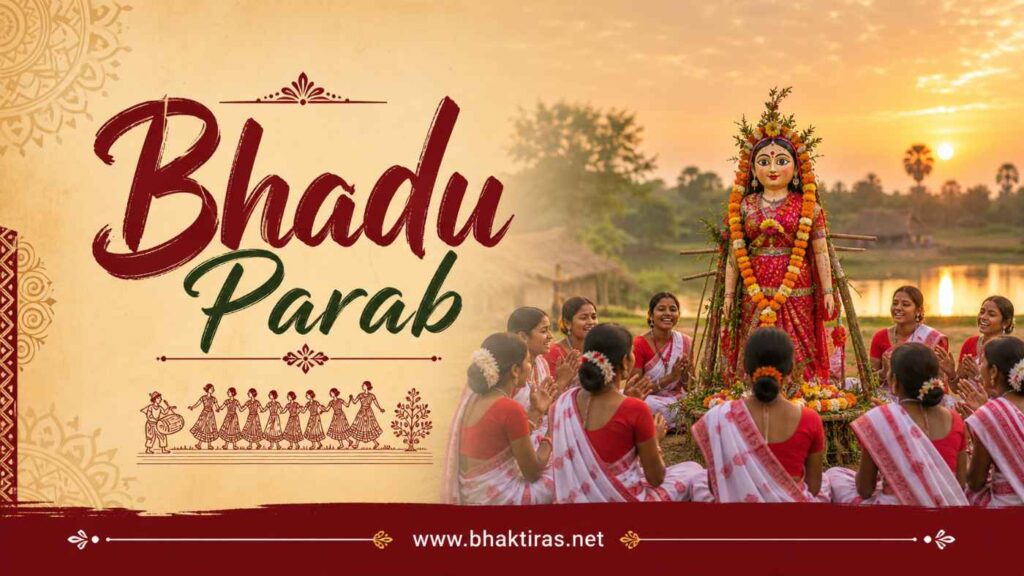
Bhadu Parab is a quiet, tender festival of the Rarh countryside – the red-soil districts of Purulia, Bankura and Birbhum in West Bengal and the neighbouring edge of Jharkhand. Its goddess is Bhadu, remembered in folk memory as a young princess of the Panchakot royal house who died before her time. All through the Bengali month of Bhadra, girls and women keep a small clay image of her at home, dress her, and sing to her each day. On Bhadra Sankranti they carry her out in a small procession and set her afloat, closing a month of song, friendship and remembrance.
Bhadu Parab 2026-2028: Dates & Calendar
Bhadu is worshipped daily through the month of Bhadra and the festival ends on Bhadra Sankranti, the day the sun leaves the month of Bhadra. Because that date follows the solar calendar, it stays close to mid-September each year.
| Year | Immersion (Bhadra Sankranti) | Month of worship | Notes |
|---|---|---|---|
| 2026 | 16-17 September (approx) | Bhadra (mid-Aug to mid-Sep) | Month-long observance ending on Bhadra Sankranti |
| 2027 | 17 September (approx) | Bhadra | Solar reckoning keeps it near mid-September |
| 2028 | 16 September (approx) | Bhadra | Confirm with a regional almanac |
Unlike lunar festivals that swing across weeks, Bhadu Parab is tied to a solar transit, so the immersion day barely moves – it lands on 16 or 17 September in most years. The worship itself is not a single day: it is a slow, month-long habit of song that builds towards that final morning.
Why Bhadu Parab Is Celebrated
Bhadu Parab is celebrated to honour and remember Bhadu, a folk goddess loved as a real young woman rather than a distant deity. The festival carries grief, affection and the ordinary rhythms of village life into song.
The most widely told story makes Bhadu a daughter of the Panchakot (Panchet) royal family of the Rarh region who died young. Rather than mourning her once and letting her go, the women of these districts chose to keep her close – to raise her image each year, care for it, sing to it, and then send her off with love. In that sense Bhadu Parab is less a temple festival and more a shared act of memory that a whole community renews together.
Like its winter companion Tusu, Bhadu belongs to the people, not to priests. There is no Brahmin, no Sanskrit liturgy and no elaborate rulebook. The songs are in the local Bengali dialect, the tunes are learned from mothers and neighbours, and the goddess is spoken to plainly, as one would speak to a girl of the house.
A goddess who was a girl
Bhadu is worshipped as a young woman who lived, was loved and died early. Her divinity grows out of tenderness and loss rather than cosmic power, which is why her songs feel so personal.
A festival without priests
There is no priestly ritual and no fixed scripture. Women and girls lead everything – the making of the image, the daily songs, the final immersion – which makes Bhadu a genuinely folk and community-owned tradition.
Song as devotion
The heart of the festival is the Bhadu gaan, gentle songs about her life, her longing and everyday village concerns. Singing to her every evening is itself the worship.
Who Is Worshipped
The festival centres on Bhadu, a folk goddess of the Rarh region, honoured in the form of a small clay image kept and cared for at home.
Bhadu
Bhadu is the young folk goddess of Rarh Bengal, remembered in tradition as a princess of the Panchakot line who died in her youth. She is not part of the classical pantheon; she belongs to the songs and households of Purulia, Bankura, Birbhum and the Jharkhand border, where she is loved as a daughter of the community.
Key Rituals, Step by Step
The observance is simple and repeats through the month, gathering into a final day of procession and immersion.
- Make the image. At the start of Bhadra, a small clay figure of Bhadu is made or brought home, often placed on a decorated tray or low seat.
- Dress and decorate her. The image is adorned with colour, flowers and small ornaments, and given a clean, cared-for corner of the home.
- Sing to her daily. Each evening through the month, girls and women gather to sing Bhadu gaan – songs about her life, her moods and the everyday world around them.
- Offer simple things. Everyday offerings of flowers, sweets and food are made with affection rather than formal ritual, since there is no priest to lead.
- Gather on the last night. As Bhadra Sankranti nears, neighbours and nearby villages come together for longer singing sessions, sometimes turning into friendly song exchanges.
- Carry her in procession. On Bhadra Sankranti the image is taken out in a small procession, accompanied by song and, in places, drums.
- Immerse Bhadu. The image is set afloat in a river, pond or tank, sending the goddess off for the year and closing the month of worship.
Special Foods of Bhadu Parab
Bhadu Parab keeps to homely village food rather than grand feasting, shared among the girls and women who sing together.
Rice sweets and pithe
Simple rice-based sweets and pithe (rice-flour cakes) are prepared at home and shared, in keeping with the rural, home-centred spirit of the festival.
Muri and gur
Puffed rice (muri) with jaggery (gur) is common everyday fare that turns up during the long evening singing sessions.
Seasonal offerings
Fruits and small sweets of the season are offered to Bhadu and then shared, since the goddess is treated as a member of the household.
Where Bhadu Parab Is Observed
Bhadu Parab is a regional folk festival of the Rarh belt, strongest in a handful of districts and closely tied to the Tusu tradition of the same area.
Purulia
Purulia is the heartland of Bhadu Parab, where the songs and the month-long worship are most alive. Bhadu gaan here is a recognised part of the district’s folk-song heritage.
Bankura & Birbhum
The neighbouring red-soil districts of Bankura and Birbhum also keep Bhadu, with the same pattern of daily song and a Bhadra Sankranti immersion.
Jharkhand border
In the villages along the Jharkhand side of the Rarh region, Bhadu is observed much as in West Bengal, part of a shared cultural belt rather than a state one.
Bhadu Parab Do's and Don'ts
A few gentle points to keep the spirit of this folk festival right.
Do
- Treat Bhadu as a cherished young girl of the house, with care and affection.
- Learn and sing the local Bhadu gaan; the song is the worship.
- Keep the observance simple and home-centred, as tradition intends.
- Include girls and women of the family, who traditionally lead the festival.
- Immerse the image respectfully and cleanly on Bhadra Sankranti.
Avoid
- Do not expect priests, Sanskrit rituals or a fixed rulebook – there are none.
- Do not confuse Bhadu with Tusu; they are separate goddesses of different months.
- Do not turn it into a loud commercial event at the cost of the songs.
- Do not litter rivers and ponds; use eco-friendly clay and natural colours.
- Do not treat the grief in the songs as mere performance – it is heartfelt.
Frequently Asked Questions
When is Bhadu Parab in 2026?
Bhadu Parab is observed through the whole month of Bhadra and ends on Bhadra Sankranti, which falls around 16-17 September 2026 (approximate, set by the solar calendar). The daily worship of Bhadu runs for the month before, closing with the immersion of her clay image.
When is Bhadu Parab in 2027 and 2028?
Because Bhadu Parab ends on Bhadra Sankranti, a solar date, it stays near mid-September each year – around 17 September 2027 and 16 September 2028 (both approximate). Always confirm the exact immersion day against a local Bengali panjika, as it can shift by a day.
Why is Bhadu Parab celebrated?
Bhadu Parab is celebrated to honour and remember Bhadu, a folk goddess of Rarh Bengal loved as a young princess of the Panchakot family who died early. It is an act of shared memory and affection, expressed through a month of gentle daily songs rather than formal ritual.
Who is the goddess Bhadu?
Bhadu is a folk goddess of the Rarh region of West Bengal, worshipped in the form of a small clay image. Tradition remembers her as a beloved young woman of the Panchakot royal house who died in her youth, and she is treated with the tenderness owed to a daughter of the community.
Where is Bhadu Parab celebrated?
Bhadu Parab is celebrated mainly in the Rarh region – the districts of Purulia, Bankura and Birbhum in West Bengal and the neighbouring Jharkhand border. Purulia is its heartland, where Bhadu gaan is a well-known part of the local folk-song tradition.
How is Bhadu Parab different from Tusu Parab?
Bhadu and Tusu are two folk goddesses of the same Rarh region, but they are observed in different months and are not the same figure. Bhadu is worshipped through the month of Bhadra ending in mid-September, while Tusu is a winter festival ending around Makar Sankranti in mid-January.
How is Bhadu worshipped?
Bhadu is worshipped without any priest. Girls and women keep and decorate a small clay image at home, sing to her every evening through the month of Bhadra, and finally carry her in a small procession to be immersed on Bhadra Sankranti.
What are Bhadu songs about?
Bhadu gaan are gentle folk songs in the local Bengali dialect about Bhadu’s life, her longing and the everyday world of village women. Sung daily through the month, they are the real form of worship and carry the affection and quiet grief at the heart of the festival.
May Bhadu’s month of songs keep her memory tender in every Rarh home – Bhadu maa, bhalo theko.