
ॐ
Vindhyavasini Chalisa
श्री विंध्यवासिनी चालीसा
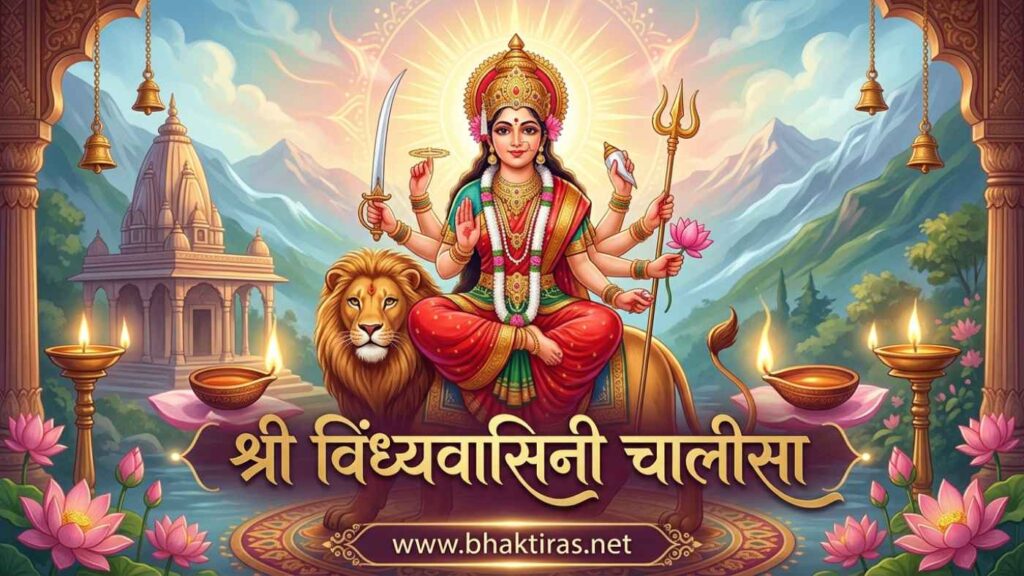
The Vindhyavasini Chalisa is a 40-verse hymn to Maa Vindhyavasini (also called Vindheshwari), the goddess who dwells in the Vindhya hills at Vindhyachal near Mirzapur, Uttar Pradesh. Worshipped as a form of Durga and Mahalakshmi, she is the Adi Shakti who defeated the demons Shumbha and Nishumbha, and Vindhyachal counts among the Shakti Peethas. This page gives the full chalisa in easy English transliteration, with an original line-by-line meaning for every doha and chaupai so you can follow both the sound and the sense as you recite.
Vindhyavasini Chalisa Lyrics in English (Transliteration)
Roman transliteration for easy chanting. Tap “Meaning” under any verse for the English translation.
Namo Namo Vindhyeshwari, Namo Namo Jagadamba
Santa Jano Ke Kaja Mein, Maa Karati Nahin Vilamba
Meaning
Again and again I bow to Vindhyeshwari, Mother of the whole universe. When it comes to the needs of the good and the devoted, the Mother never keeps them waiting.
Jai Jai Jai Vindhyachala Rani
Adi Shakti Jaga Vidita Bhavani
Meaning
Glory, glory, glory to the Queen of Vindhyachal. You are the primal power, known across the world as Bhavani.
Sinhavahini Jai Jagamata
Jai Jai Jai Tribhuvana Sukhadata
Meaning
Victory to the World Mother who rides the lion. Victory again and again to the one who brings joy to all three worlds.
Kashta Nivarini Jai Jaga Devi
Jai Jai Jai Jai Asurasura Sevi
Meaning
Victory to the Goddess of the world who ends every hardship, whom both gods and demons come to serve and honour.
Mahima Amita Apara Tumhari
Shesha Sahasa Mukha Varnata Hari
Meaning
Your greatness is boundless and beyond measure. Even Shesha with his thousand mouths grows tired trying to describe it.
Dinana Ke Duhkha Harata Bhavani
Nahin Dekhyo Tuma Sama Koi Dani
Meaning
O Bhavani, you carry away the pain of the poor and the helpless. No giver as open-handed as you has ever been seen.
Saba Kara Manasa Puravata Mata
Mahima Amita Jagata Vikhyata
Meaning
Mother, you grant the heartfelt wishes of everyone. Your endless glory is spoken of throughout the world.
Jo Jana Dhyana Tumharo Lavai
So Turatahi Vanchhita Phala Pavai
Meaning
Anyone who fixes their mind on you in meditation quickly receives the very reward they longed for.
Tu Hi Vaishnavi Tu Hi Rudrani
Tu Hi Sharada Aru Brahmani
Meaning
You alone are Vaishnavi and Rudrani. You alone are Sharada, goddess of learning, and Brahmani.
Rama Radhika Shyama Kali
Tu Hi Mata Santana Pratipali
Meaning
You appear as Rama, Radhika, Shyama, and Kali. Mother, you sustain and shelter your devoted children.
Uma Madhavi Chandi Jwala
Begi Mohi Para Hohu Dayala
Meaning
You are Uma, Madhavi, Chandi, and Jwala. Be quick to turn your kindness toward me.
Tu Hi Hingalaja Maharani
Tu Hi Shitala Aru Vigyani
Meaning
You are the great queen Hinglaj herself. You are Sheetala, and you are the source of true understanding.
Durga Durga Vinashini Mata
Tu Hi Lakshmi Jaga Sukha Data
Meaning
You are Durga, the one who ends every difficulty. You are Lakshmi, who gives the world its wealth and comfort.
Tu Hi Janhavi Aru Utrani
Hemavati Ambe Nirvani
Meaning
You are Janhavi and Utrani. O Amba, you are Hemavati, the giver of final release.
Ashtabhuji Varahini Devi
Karata Vishnu Shiva Jakara Sevi
Meaning
You are the eight-armed goddess Varahini, whom even Vishnu and Shiva wait upon in devotion.
Chonsatthi Devi Kalyani
Gauri Mangala Saba Guna Khani
Meaning
You are the sixty-four goddesses who bring welfare to all. You are Gauri and Mangala, the storehouse of every good quality.
Patana Mumba Danta Kumari
Bhadrakali Suna Vinaya Hamari
Meaning
Known as Patan Mumba, Danta, and Kumari, O Bhadrakali, please hear this humble plea of mine.
Vajradharini Shoka Nashini
Ayu Rakshini Vindhyavasini
Meaning
You hold the thunderbolt and destroy all sorrow. You guard the span of life, O Vindhyavasini.
Jaya Aura Vijaya Baitali
Matu Sugandha Aru Vikarali
Meaning
You are Jaya, Vijaya, and Baitali. Mother, you take the gentle form of Sugandha and the fierce form of Vikarali.
Nama Ananta Tumhara Bhavani
Baranain Kimi Manusha Agyani
Meaning
O Bhavani, your names have no end. How could an unknowing human ever count and describe them all?
Japara Kripa Matu Tava Hoi
To Vaha Karai Chahai Mana Joi
Meaning
When your grace, Mother, rests on someone, that person can accomplish whatever their heart desires.
Kripa Karahu Mopara Maharani
Siddhi Kariya Ambe Mama Bani
Meaning
Pour your grace upon me, O great queen. O Amba, let the words of this prayer come true.
Jo Nara Dharai Matu Kara Dhyana
Takara Sada Hoya Kalyana
Meaning
Whoever holds the Mother in steady meditation finds lasting well-being in every part of life.
Bipatti Tahi Sapanehu Nahi Avai
Jo Devi Kara Japa Karavai
Meaning
Trouble does not reach, even in a dream, the one who keeps repeating the Goddess's name.
Jo Nara Kahan Rina Hoya Apara
So Nara Patha Karai Shata Bara
Meaning
A person weighed down by enormous debt should recite this chalisa a hundred times.
Nishchaya Rina Mochana Hoi Jai
Jo Nara Patha Karai Mana Lai
Meaning
The debt will surely be cleared for anyone who recites it with a focused and attentive heart.
Astuti Jo Nara Padhe Padhave
Ya Jaga Mein So Bahu Sukha Pave
Meaning
Whoever reads this praise, or helps others to read it, gains abundant happiness in this very life.
Jako Vyadhi Satavai Bhai
Japa Karata Saba Duri Parai
Meaning
O friend, whoever is tormented by illness sees every ailment fall away through steady chanting.
Jo Nara Ati Bandi Mahan Hoi
Bara Hajara Patha Kara Soi
Meaning
A person held in heavy confinement or bondage should recite this twelve thousand times.
Nishchaya Bandi Te Chhuti Jai
Satya Bachana Mama Manahu Bhai
Meaning
They will certainly be set free from that bondage. Take these words of mine as the truth, O friend.
Japara Jo Kachhu Sankata Hoi
Nishchaya Debihi Sumirai Soi
Meaning
Whatever crisis descends on a person, they should firmly call the Goddess to mind, and she removes it.
Jo Nara Putra Hoya Nahin Bhai
So Nara Ya Vidhi Kare Upai
Meaning
O friend, one who longs for a child yet has none should take up this practice as the remedy.
Pancha Varsha So Patha Karavai
Nauratara Mein Vipra Jimavai
Meaning
Have the chalisa recited for five years, and feed Brahmins during the Navratri days.
Nishchaya Hoya Prasanna Bhavani
Putra Dehi Takahan Guna Khani
Meaning
Bhavani, the treasury of every virtue, is sure to be pleased and to grant the gift of a child.
Dhwaja Nariyala Ani Chadhavai
Vidhi Sameta Pujana Karavavai
Meaning
Bring a flag and a coconut to offer, and carry out the worship with all its proper rites.
Nita Prati Patha Karai Mana Lai
Prema Sahita Nahin Ana Upai
Meaning
Recite it every day with an attentive mind and heartfelt love; there is truly no other means than this.
Yaha Shri Vindhyachala Chalisa
Ranka Padhata Hove Avanisa
Meaning
This is the sacred Vindhyachal Chalisa; by reciting it even a pauper can rise to the standing of a king.
Yaha Jani Acharaja Manahu Bhai
Kripa Drishti Tapara Hoi Jai
Meaning
Do not treat this as some strange marvel, O friend; it happens simply because the Goddess's kind gaze falls on the devotee.
Jai Jai Jai Jaga Matu Bhawani
Kripa Karahu Mo Para Jana Jani
Meaning
Glory, glory, glory to Bhavani, Mother of the world. Knowing me as your own, be gracious to me.
Jo Yaha Chalisa Patha Karai
Chit Lai Shraddha Aru Prem
Meaning
Whoever recites this chalisa with a settled mind, with faith and with love,
Taa Par Kripa Vindhyeshvari Hoi
Purave Manasa Saba Kema
Meaning
upon that person Vindhyeshwari showers her grace and fulfils every wish held in their heart.
Benefits of Reciting the Vindhyavasini Chalisa
Devotees turn to the Vindhyavasini Chalisa when they need the Mother’s protection and a lift in their spiritual and worldly life. Regular, sincere recitation is associated with these benefits:
- Relief from obstacles: The goddess is invoked to clear away hardships and the tangles that block everyday progress.
- Courage over fear: Calling on Vindhyavasini as the lion-riding protector is believed to steady the mind and ease anxiety and insecurity.
- Financial recovery: Several verses speak directly of release from crushing debt for those who recite with focus.
- Health and well-being: The chalisa is chanted as a prayer for freedom from lingering illness.
- Freedom from confinement: Its verses appeal to the Mother for release from bondage of every kind, inner and outer.
- Fulfilment of wishes: The closing dohas promise that heartfelt desires offered with faith are answered by her grace.
When and How to Chant the Vindhyavasini Chalisa
Navratri, both the Chaitra and the Sharadiya seasons, is the most auspicious time to recite the Vindhyavasini Chalisa, and Fridays and Ashtami days are also favoured. Many devotees keep an unbroken forty-day recitation, one round each morning. Bathe and put on clean clothes, sit facing east or north, and light a ghee lamp with a few flowers before an image of the goddess. Begin with the opening doha, move through all forty chaupais at an unhurried pace, and close with a short prayer. The count and the ritual matter less than reciting with steady attention and genuine devotion.
About the Vindhyavasini Chalisa
The Vindhyavasini Chalisa follows the classic chalisa form: an opening doha, forty chaupais, and closing couplets, composed in the Hindi-Awadhi devotional register used across North Indian bhakti hymns. Its verses praise Vindhyavasini as Adi Shakti and name her many forms, from Durga, Lakshmi, and Sharada to the fierce Bhadrakali and the eight-armed Varahini. Later verses turn practical, describing specific recitations for debt, illness, bondage, and the wish for a child, before ending with the promise that faithful recitation earns the Mother’s grace. The transliteration and meanings on this page are provided to make the traditional text easy to follow for English readers.
Frequently Asked Questions
What is the Vindhyavasini Chalisa?
It is a forty-verse Hindi-Awadhi devotional hymn to Maa Vindhyavasini, the goddess of Vindhyachal near Mirzapur, Uttar Pradesh. Built from an opening doha, forty chaupais, and closing couplets, it praises her as Adi Shakti and a form of Durga and asks for her protection and blessings.
What are the benefits of reciting the Vindhyavasini Chalisa?
Devotees recite it seeking relief from obstacles, courage in the face of fear, recovery from debt and illness, freedom from confinement, and the fulfilment of sincere wishes. Regular recitation is also valued for deepening devotion and steadying the mind.
Which day is best to recite the Vindhyavasini Chalisa?
Navratri, in both the Chaitra and Sharadiya seasons, is considered the most auspicious time, and Fridays and Ashtami tithis are also favoured. Many devotees keep an unbroken forty-day recitation, reciting once each morning.
How many verses are in the Vindhyavasini Chalisa?
It has forty chaupai verses, framed by an opening doha and closing couplets, which is the standard chalisa structure.
Can the Vindhyavasini Chalisa be recited in English?
Yes. You can recite the Roman transliteration on this page with devotion and follow the English meaning of each verse. The original Hindi-Awadhi is ideal, but reciting from transliteration with sincerity is perfectly fine.
Is Vindhyavasini the same as Durga?
Vindhyavasini is worshipped as a form and incarnation of Durga. Her shrine at Vindhyachal is counted among the Shakti Peethas and is linked to the goddess who slew the demons Shumbha and Nishumbha.
॥ Vindhyavasini Chalisa ॥