
ॐ
Vastu Purush Chalisa
श्री वास्तु पुरुष चालीसा
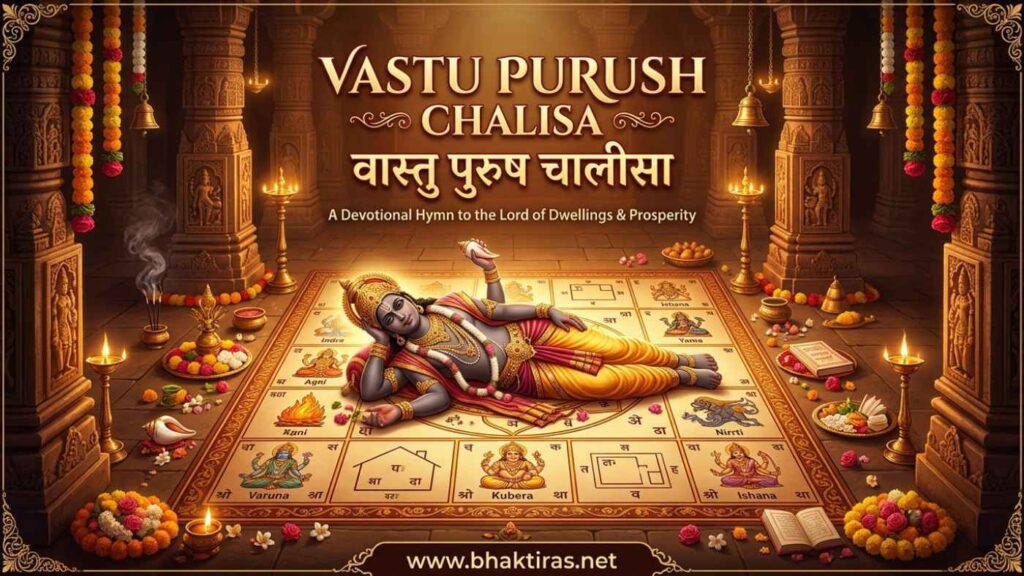
The Vastu Purush Chalisa is a short devotional hymn addressed to Vastu Purush, the cosmic spirit of the dwelling and the site it stands on. Its verses honour the eight directional lords who guard a building, and people recite it to clear Vastu dosha and invite peace and prosperity at home. This page gives the full Roman-English transliteration with a plain-English meaning under every verse.
Vastu Purush Chalisa Lyrics in English (Transliteration)
Roman transliteration for easy chanting. Tap “Meaning” under any verse for the English translation.
Shri guru charan saroj raj, nij manu mukura sudhaar
Barnaun Raghubar vimal jasu, jo daayaku phal chaari
Buddhiheen tanu jaanike, sumiraun Pavan-kumaar
Bal buddhi vidya dehu mohin, harahu kalesh vikaar
Meaning
Cleaning the mirror of my mind with the dust of my Guru's lotus feet, I sing the spotless glory of Lord Rama, which grants the four rewards of life. Aware that I lack wisdom, I call on Hanuman, son of the Wind God: give me strength, intellect and knowledge, and take away my troubles and faults.
Jai Vastu Purush sukhdaata, bhavan ke Ish sakal jag gyata
Tum bin koi rachna na hoi, tum sam dev na dooja koi
Meaning
Victory to you, Vastu Purush, giver of comfort, lord of every building and known across the whole world. Nothing is built without you, and no other deity is your equal.
Dharati ke tum praan adhaara, srishti rache tum karat vichaara
Brahma Vishnu Sadaashiv dhyaavahin, riddhi siddhi sab tohi manaavahin
Meaning
You are the life-breath and support of the earth, and you shaped creation through deep thought. Brahma, Vishnu and Shiva meditate on you, and every power of plenty and attainment seeks your favour.
Aadikaal mein katha suhaai, Prabhu tumko sab dev banaai
Vishwaroop dhari tum vistaaro, grih nirmaan mein buddhi vichaaro
Meaning
From the dawn of time a fair story is told: the gods themselves brought you into being, O Lord. Taking your universal form you spread everywhere; grant us clear judgement when we build our homes.
Uttar-poorv mein dev nivaasa, Ishaan kon sab jagat prakaasha
Poorv disha mein Indra dev ka baasa, Aagney kon mein Agni prakaasa
Meaning
The gods dwell in the north-east, the Ishaan corner that lights up the whole world. Lord Indra lives in the east, and in the south-east corner Lord Agni, the fire, burns bright.
Dakshin disha Yamraaj ki pyaari, Nairitya kon mein rakshashon ki baari
Pashchim disha mein Varun vishaala, Vaavyav mein Pavan karat pratipaala
Meaning
The south belongs to Yamraj, lord of death, and the south-west corner is the domain of the demons. The wide west is held by Varuna, lord of waters, and in the north-west the Wind God keeps watch and protects.
Uttar disha dhan Kuber ki saaja, madhya bhaag mein Brahma raaja
Jo jan tumko nitya manaave, ghar mein sukh-sampatti paave
Meaning
The north holds the riches of Kubera, lord of wealth, and Lord Brahma reigns over the centre. Whoever worships you each day finds comfort and wealth within the home.
Kalah-klesh sab door ho jaave, Vastu dosh nikat nahin aave
Praat utthai jo tumko dhyaavai, sab kaaryan mein safalta paavai
Meaning
Quarrels and pain are driven far off, and Vastu defects never come close. The one who rises at dawn and meditates on you succeeds in every task.
Bhoomi pujan jab-jab hoi, sumiran kare tumhaara soi
Deepak dhoop naivedya chadhaavai, pushpahaar se tumko sajaavai
Meaning
Whenever the worship of the ground is performed, the one who remembers you, who offers a lamp, incense and sacred food, and decorates you with garlands of flowers, is blessed.
Jo tumri yeh chaalisa gaavai, sab sankat se mukti paavai
Dhan-dhaanya sukh bhog vilaasa, poorn ho mann ki har aasha
Meaning
Whoever sings this Chalisa to you is freed from every distress. They gain wealth, grain, comfort and ease, and each wish of the heart is fulfilled.
Vaastu dev daya karo, harahu sakal agyaan
Poorn kijai kaamna, kripa karahu Bhagwaan
Meaning
O Vastu Deva, be merciful and take away all my ignorance. Fulfil my wishes, Lord, and grant me your grace.
Benefits of Reciting the Vastu Purush Chalisa
Devotees recite the Vastu Purush Chalisa to settle the energy of a home and align it with the eight directional deities. Commonly cited benefits include:
- Clears Vastu dosha: It is chanted to ease directional imbalances and unsettled energy in a house or plot.
- Domestic harmony: Verse seven speaks of quarrels and afflictions moving away, so the hymn is used to calm friction in the household.
- Wealth and plenty: The text invokes Kubera and asks for grain, comfort and prosperity within the home.
- Success in tasks: Reciting it at dawn is associated with steadiness and success in daily work.
- Blessings while building: It is offered during land selection, Bhoomi Pujan and construction to seek sound foundations.
- Inner calm: Daily recitation is meant to steady the mind and bring a sense of order to one’s living space.
When and How to Chant the Vastu Purush Chalisa
The hymn is most often recited in the early morning after a bath, in clean clothes, while seated on a mat. Face east or north-east (the Ishaan corner), light a lamp and incense, and offer a flower or fruit before a picture or a Vastu Purush Mandala. It is also chanted during Bhoomi Pujan, the ground-breaking rite, and at Griha Pravesh, the housewarming. Begin with the opening Doha, recite the nine chaupais slowly and clearly, and close with the final Doha as a prayer for grace.
About the Vastu Purush Chalisa
This is a short modern devotional hymn rather than an ancient fixed scripture. Unlike the Hanuman Chalisa, there is no single standardized text for Vastu Purush, so editions vary. The version here keeps to a compact, well-formed structure: an opening Doha of Guru and Hanuman invocation, nine chaupai verses, and a closing Doha. Across those nine verses it names the eight directional lords who rule a dwelling, from Indra in the east and Agni in the south-east to Kubera in the north and Brahma at the centre, and asks Vastu Purush for protection, prosperity and a settled home.
Frequently Asked Questions
What is the Vastu Purush Chalisa?
It is a short devotional hymn to Vastu Purush, the cosmic spirit of the dwelling and its site. Its verses honour the eight directional deities who guard a building, and it is recited to clear Vastu dosha and bring peace and prosperity to the home.
Is there an official, standardized Vastu Purush Chalisa?
No. Unlike the Hanuman Chalisa, there is no single ancient standardized text. It is a modern composition in Chalisa form, and the wording can differ between editions. The version on this page is a compact nine-verse hymn that correctly names the directional deities and Vastu principles.
What are the benefits of reciting the Vastu Purush Chalisa?
Devotees recite it to ease Vastu dosha, calm household friction, invite wealth and plenty, and seek blessings while choosing land or building a home. It is also chanted simply for a steadier mind and a more orderly living space.
Which day is best to recite the Vastu Purush Chalisa?
It is usually chanted every morning just after sunrise, and especially during Bhoomi Pujan or Griha Pravesh ceremonies. For specific Vastu concerns, some recite it daily for a fixed period such as twenty-one or forty-five days.
How many verses are in the Vastu Purush Chalisa?
This version has nine chaupai verses, framed by an opening Doha and a closing Doha. Because no standardized forty-verse text exists for Vastu Purush, the page presents these nine reliable verses rather than padding the count.
Can the Vastu Purush Chalisa be recited in English?
Yes. The full Roman-English transliteration on this page lets you recite it phonetically even if you do not read Devanagari, with a plain-English meaning under each verse so the sense stays clear.
॥ Vastu Purush Chalisa ॥