
ॐ
Surya Chalisa
श्री सूर्य चालीसा
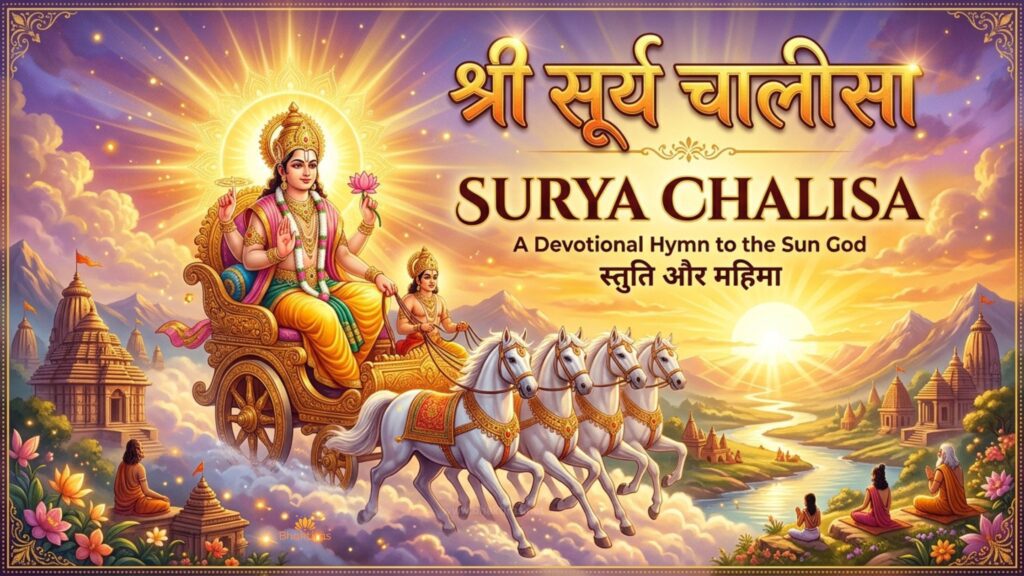
The Surya Chalisa is a forty-verse Hindi devotional hymn that praises Surya Dev, the Sun who lights every world and keeps life moving. Its couplets list the Sun’s many names — Savita, Bhaskar, Bhanu, Aditya — and recall the seven-horse chariot that carries him across the sky each day. Devotees recite it to draw warmth, clarity, and steady energy into daily life, most often as the first rays touch the horizon.
Surya Chalisa Lyrics in English (Transliteration)
Roman transliteration for easy chanting. Tap “Meaning” under any verse for the English translation.
Kanak badan kundal makar, mukta mala ang
Padmasan sthit dhyaiye, shankh chakra ke sang
Meaning
Picture Surya with a golden body, crocodile-shaped earrings, and a pearl garland — seated on a lotus, holding the conch and discus — and hold that image in meditation.
Jai Savita jai jayati Divakar
Sahasranshu Saptashwa timirhar
Meaning
Victory to Savita, the life-giver, and to Divakar who brings the day — the thousand-rayed one drawn by seven horses, who scatters all darkness.
Bhanu Patang Marichi Bhaskar
Savita Hans Sunur Vibhakar
Meaning
He is hailed by many names — Bhanu, Patang, Marichi, Bhaskar, Savita, Hans, Sunur, and Vibhakar.
Vivasvan Aditya Vikartan
Martand Haripp Virochan
Meaning
He is also called Vivasvan, Aditya, Vikartan, Martand, Haripp, and Virochan.
Ambarmani Khag Ravi kahlate
Ved Hiranyagarbh kah gate
Meaning
He is named Ambarmani, Khag, and Ravi, while the Vedas address him as Hiranyagarbha, the golden womb of creation.
Sahasranshu Pradyotan kahin
Munigan hot prasanna modlahin
Meaning
Called Sahasranshu and Pradyotan, his light delights the sages, who rejoice in his presence.
Arun Sadrish Sarathi manohar
Hankat hay saat chadhi rath par
Meaning
His handsome charioteer is Arun, who drives the seven horses yoked to the Sun's chariot.
Mandal ki mahima ati nyari
Tej roop keri balihari
Meaning
The glory of his shining disc is beyond compare; one can only marvel at his radiant form.
Uchchaisrava sadrish hay jote
Dekh purandar lajjit hote
Meaning
His horses rival the celestial steed Uchchaisrava in splendour, leaving even Indra humbled at the sight.
Mitra Marichi Bhanu Arun Bhaskar
Savita Surya Arkk Khag Kalihar
Meaning
By his names — Mitra, Marichi, Bhanu, Arun, Bhaskar, Savita, Surya, Arka, Khag, and remover of strife — he is invoked.
Pusha Ravi Aditya naam lai
Hiranyagarbhay namah kahi kai
Meaning
Taking the names Pusha, Ravi, and Aditya, the devotee bows with 'salutations to Hiranyagarbha.'
Dwadas naam prem so gaavain
Mat kar baarah baar navavain
Meaning
Whoever sings his twelve names with love and bows twelve times in devotion is blessed.
Chaar padarth so jan paavai
Dukh daridra agh punj nasavai
Meaning
Such a devotee gains the four aims of life, and sorrow, poverty, and heaps of sin are destroyed.
Namaskar ko chamatkar yah
Vidhi harihar kau kripasar yah
Meaning
This salutation works wonders; through it flows the grace of Brahma, Vishnu, and Shiva.
Sevai bhanu tumhin man laai
Ashtasiddhi navnidhi tehi paai
Meaning
One who serves Surya with a focused mind attains the eight powers and nine treasures.
Baarah naam uchcharan karte
Sahas janam ke paatak tarte
Meaning
Reciting his twelve names washes away the sins of a thousand lifetimes.
Upakhyaan jo karte tav jan
Ripu so jamlahte sote hin chhan
Meaning
Those who recount your story, O Sun, see their enemies fall away as if asleep in an instant.
Chhan chhan sut jut parivaar badhtu hai
Ripu balmoh ko phand kattu hai
Meaning
Their family and prosperity grow moment by moment, and the snares of foes and delusion are cut.
Arkk sheesh ko raksha karte
Ravi lalaat par nitya biharte
Meaning
As Arka he guards the head, and as Ravi he forever rests upon the forehead.
Surya netra par nitya viraajat
Karn desh par dinkar chhajat
Meaning
Surya shines steadily over the eyes, and the day-maker rests over the region of the ears.
Bhanu naasika vaas karahin nit
Bhaskar karat sada mukh kau hit
Meaning
As Bhanu he dwells at the nose, and as Bhaskar he always favours the face.
Onth rahain Parjanya hamare
Rasna beech teekshan bas pyaare
Meaning
As Parjanya he stays on the lips, and the sharp one resides upon the tongue.
Kanth suvarn ret kee shobha
Tigm tejsah kaandhe lobha
Meaning
Golden splendour adorns the throat, and the fierce, blazing one rests gloriously on the shoulders.
Pusha baahu mitra peethihin par
Twashtra-varun rahain suurnakar
Meaning
Pusha guards the arms and Mitra the back, while Twashtra and Varun grace the hands with golden light.
Yugal haath par raksha kaaran
Bhanuman ursthal sundarchan
Meaning
For the protection of both hands stands Bhanuman, whose beautiful form rests upon the chest.
Basat naabhi Aditya manohar
Kati manh hans, rahat man mudbhar
Meaning
The lovely Aditya dwells at the navel, and Hans at the waist, keeping the heart full of joy.
Jangha gopati Savita baasa
Guru Divakar karat hullasa
Meaning
Gopati and Savita dwell in the thighs, and Guru Divakar fills the body with delight.
Vivasvan pad kee rakhwaari
Baahar baste nit tam haari
Meaning
Vivasvan watches over the feet, while outside he forever drives away the darkness.
Sahasranshu sarvang sanharai
Raksha kavach vichitra vichaarai
Meaning
The thousand-rayed one guards the whole body — consider this wondrous armour of protection.
As jojan jan apne na mahin
Bhay jag beej karahin tehi nahin
Meaning
One who keeps this protection close knows no fear, for the seeds of worldly dread cannot reach him.
Daridra kusht tehin kabahun na vyaapai
Jojan yaako man manh jaapai
Meaning
Poverty and disease never touch the one who repeats this prayer within the heart.
Andhkaar jag ka jo harta
Nav prakaash se aanand bharta
Meaning
He who removes the world's darkness fills it instead with fresh light and joy.
Grah gan grasi na mitavat jaahi
Koti baar main pranavoon taahi
Meaning
He whom even the planets cannot eclipse or undo — to him I bow a million times.
Mand sadrish sut jag mein jaake
Dharmaraj sam adbhut baanke
Meaning
His sons in this world include Shani, slow and steady, and the just Dharmaraj (Yama), both remarkable.
Dhanya-dhanya tum dinmani deva
Kiya karat surmuni nar seva
Meaning
Blessed are you, O jewel of the day, served devotedly by gods, sages, and human beings alike.
Bhakti bhaavyut purna niyam so
Door hatat so bhav ke bhram so
Meaning
Worshipped with full devotion and discipline, he lifts away the illusions of worldly existence.
Param dhanya so nar tandhaari
Hain prasanna jehi par tam haari
Meaning
Most fortunate is the person in whose favour the darkness-remover is pleased.
Arun Maagh mahan Surya Phaalgun
Madh Vedangnaam Ravi uday
Meaning
He rises as Arun in Magha and as Surya in Phalguna; the Vedangas honour his rising through the months.
Bhanu uday Vaisaakh ginaavai
Jyeshtha Indra Aashaadh Ravi gaavai
Meaning
As Bhanu he rises in Vaisakha, as Indra in Jyeshtha, and is sung as Ravi in Ashadha.
Yam Bhaadon Aashwin Himreta
Kaartik hot Divakar neta
Meaning
He is Yama in Bhadrapada, Himreta in Ashwin, and the leading Divakar in Kartika.
Aghan bhinn Vishnu hain Poosihin
Purush naam Ravi hain Malmaasihin
Meaning
In Margashirsha he is Vishnu, in Pausha he is Poosha, and in the intercalary month he is named Purush — appearing differently through each month of the year.
Bhanu Chalisa prem yut, gaavahin je nar nitya
Sukh sampatti lahai vividh, honhi sada kritkritya
Meaning
Whoever sings this Bhanu Chalisa daily with love gains many kinds of comfort and prosperity, and finds every undertaking fulfilled.
Benefits of Reciting the Surya Chalisa
Devotees turn to the Surya Chalisa for steady physical and inner strength, and many weave it into a morning routine for the focus it brings to the day ahead. Its commonly cited rewards include:
- Health and vitality: the hymn is linked with bodily strength and resilience, fitting the Sun’s role as the source of life-energy.
- Confidence and resolve: regular recitation is said to steady the mind and sharpen willpower for facing daily challenges.
- Eyesight and clarity: Surya is the deity associated with vision, and the prayer is chanted for healthy eyes and mental clarity.
- Success and prosperity: the closing couplet promises comfort, abundance, and the fulfilment of one’s efforts.
When and How to Chant the Surya Chalisa
Sunday is the day dedicated to Surya, so the Chalisa is most often recited then, though daily practice is encouraged. The ideal time is sunrise, facing east, after offering Arghya — pouring water from a small vessel toward the rising Sun while chanting. The festival of Ratha Saptami, which marks the Sun turning his chariot northward, is considered an especially auspicious occasion to chant it with full devotion.
About the Surya Chalisa
The Surya Chalisa is a traditional Hindi composition with no single named author, passed down through devotional practice. It honours Surya Dev, the Sun who is worshipped as the visible source of light, warmth, and life across the Hindu tradition. Counted among the Navagraha, he rides a chariot drawn by seven horses and is remembered as the father of Shani, the slow-moving planet, and of Yama, the lord of cosmic justice. Reciting the Chalisa is a way of acknowledging the Sun’s daily gift of energy and order to the living world.
Frequently Asked Questions
Who is the Surya Chalisa dedicated to?
It is dedicated to Surya Dev, the Sun god, who is praised as the source of light and life and counted among the nine planetary deities known as the Navagraha.
How many verses are in the Surya Chalisa?
It follows the standard Chalisa form: an opening doha, forty chaupai verses listing the Sun's names and attributes, and a closing doha that promises prosperity to those who recite it.
What are the benefits of reciting the Surya Chalisa?
Devotees recite it for health and vitality, confidence, healthy eyesight and clarity, and success — the hymn ties these to the Sun's role as the giver of life-energy.
When should the Surya Chalisa be chanted?
It is most often chanted on Sundays, the day sacred to Surya, and at sunrise after offering Arghya. The festival of Ratha Saptami is a particularly auspicious time.
Is the Surya Chalisa chanted at sunrise?
Yes. The customary practice is to face east at sunrise, offer water (Arghya) to the rising Sun, and then recite the Chalisa, which aligns the prayer with the Sun's first rays.
॥ Surya Chalisa ॥