
ॐ
Parvati Chalisa
श्री पार्वती चालीसा
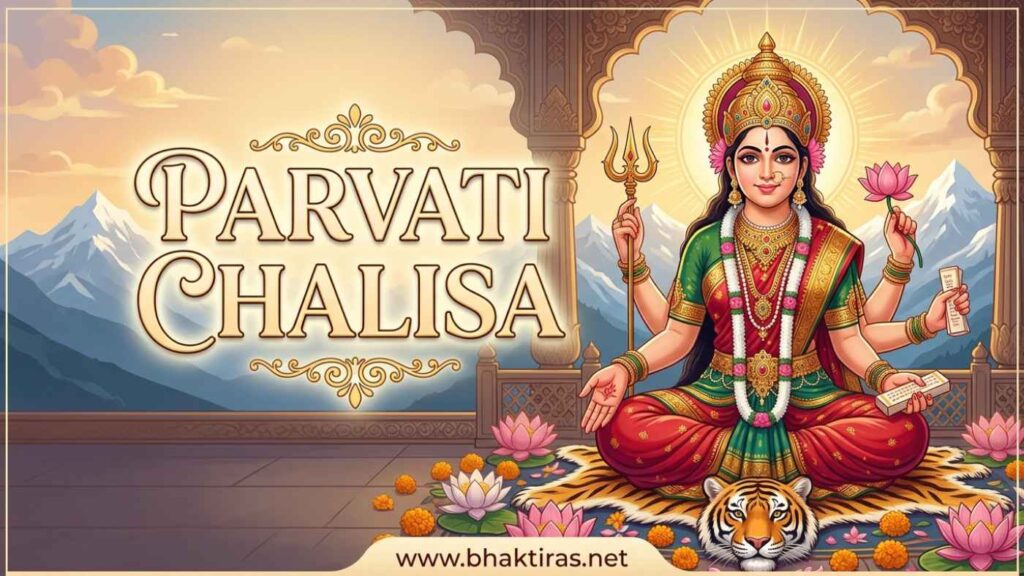
The Parvati Chalisa is a 40-verse devotional hymn to Goddess Parvati — also called Gauri, Uma, Bhavani and Shakti — the daughter of the Himalaya, consort of Shiva and mother of Ganesha. Its verses praise her beauty, her fierce penance to win Shiva as her husband, and her power as the energy behind creation, protection and dissolution. This page gives the full Parvati Chalisa lyrics in English transliteration, so anyone can read and chant it correctly, along with a plain-English meaning for every single verse.
Parvati Chalisa Lyrics in English (Transliteration)
Roman transliteration for easy chanting. Tap “Meaning” under any verse for the English translation.
Jai Giri Tanaye Dakshaje, Shambhu Priye Gunkhani
Ganpati Janani Parvati, Ambe! Shakti! Bhavani
Meaning
Glory to the daughter of the mountain Himalaya and of Daksha, the beloved of Shambhu and the very source of all virtues. You are the mother of Ganesha, O Parvati, O universal Mother Ambe, O divine power, O Bhavani.
Brahma bhed na tumharo paave
Panch badan nit tumko dhyaave
Meaning
Even Brahma cannot uncover your secret. The five-faced Shiva meditates on you without pause.
Shadmukh kahi na sakat yash tero
Sahasabadan shram karat ghanero
Meaning
The six-faced Kartikeya cannot voice your full glory, and the thousand-mouthed Shesha wearies himself trying to describe it.
Teu paar na paavat mata
Sthiti raksha lay hit sajata
Meaning
Even they never reach your limit, O Mother. For the good of all, you arrange the universe's creation, protection and dissolution.
Adhar praval sadrish arunaare
Ati kamaniya nayan kajaraare
Meaning
Your lips are red like coral, and your kohl-lined eyes are deeply lovely and inviting.
Lalit lalaat vilepit keshar
Kunkum akshat shobha manahar
Meaning
Saffron paste graces your fair forehead, and the vermilion and rice grains upon you make a captivating sight.
Kanak basan kanchuki sajaaye
Kati mekhla divya laharaaye
Meaning
You are dressed in golden cloth and a fine bodice, while a divine girdle sways gracefully at your waist.
Kanth madaar haar ki shobha
Jaahi dekhi sahjahi man lobha
Meaning
So beautiful is the flower garland around your neck that any heart is naturally drawn to you on sight.
Baalaarun anant chhabi dhaari
Aabhushan ki shobha pyaari
Meaning
You carry the endless glow of the rising sun, and the loveliness of your ornaments is dear to all who behold it.
Nana ratna jatit sinhaasan
Taapar raajati Hari Chaturaanan
Meaning
Your throne is set with many jewels, and upon it you shine while Vishnu and the four-faced Brahma attend you.
Indraadik parivaar poojit
Jag mrig naag yaksh rav koojit
Meaning
Indra and the host of gods worship you, and the world echoes with the calls of deer, serpents and yakshas in your praise.
Gir Kailas nivaasini jai jai
Kotik prabha vikaasini jai jai
Meaning
Victory, victory to you, dweller of Mount Kailash. Victory, victory to you who unfold the radiance of countless lights.
Tribhuvan sakal kutumb tihaari
Anu anu mahan tumhaari ujiyaari
Meaning
Every family across the three worlds belongs to you, and your light shines within each and every atom.
Hain Mahesh Pranesh! tumhaare
Tribhuvan ke jo nit rakhwaare
Meaning
Mahesh and Pranesh are yours, the ones who forever guard the three worlds.
Unaso pati tum praapt kinh jab
Sukrit puraatan udit bhaye tab
Meaning
When you won Shiva as your husband, the merit of your ancient good deeds rose into fruit.
Budha bail savaari jinki
Mahima ka gaave koi tinki
Meaning
Whose mount is an aged bull — who could ever sing the full greatness of such a Lord?
Sada shmashan bihaari Shankar
Aabhushan hain bhujang bhayankar
Meaning
Shankar ever wanders the cremation grounds, and dreadful serpents serve as his ornaments.
Kanth halahal ko chhabi chhaayi
Neelkanth ki padvi paayi
Meaning
The Halahal poison rests upon his throat, and by holding it he earned the name Nilakantha, the blue-throated one.
Dev magan ke hit as kinho
Vish lai aapu tinahi ami dinho
Meaning
For the good of the gods he did this — he swallowed the poison himself and let them keep the nectar.
Taaki tum patni chhavi dhaarini
Durit vidaarini mangal kaarini
Meaning
You are the radiant wife of that Lord, the one who tears away misfortune and brings about every blessing.
Dekhi param saundarya tihaaro
Tribhuvan chakit banavan haaro
Meaning
Seeing your supreme beauty, even Brahma, the maker of the three worlds, is left amazed.
Bhay bhita so mata Ganga
Lajja may hai salil taranga
Meaning
Mother Ganga, full of fear, flows in waves brimming with modesty before you.
Saut saman Shambhu pahaayi
Vishnu padaabj chhodi so dhaayi
Meaning
Like a rival wife she rushed to Shambhu, leaving behind the lotus feet of Vishnu.
Tehi ko kamal badan murajhaayo
Lakhi satvar Shiv shish chadhaayo
Meaning
At this your lotus face dimmed, and noticing it, Shiva swiftly set Ganga upon his own head.
Nityaanand kari varadaayini
Abhay bhakt kar nit anapaayini
Meaning
You grant unending joy and boons, and you give your devotees fearlessness, never once forsaking them.
Akhil paap trayataap nikandini
Maheshwari Himalaya nandini
Meaning
You uproot every sin and the three kinds of suffering. You are Maheshwari, the joyful daughter of the Himalaya.
Kaashi puri sada man bhaayi
Siddh peeth tehi aapu banaayi
Meaning
The city of Kashi has always delighted your heart, and you yourself made it a Siddha Peeth, a seat of spiritual power.
Bhagwati pratidin bhiksha daatri
Kripa pramod sneh vidhaatri
Meaning
O Goddess, you give alms each day, and you are the giver of grace, gladness and tender love.
Ripukshay karini jai jai Ambe
Vaacha siddh kari avalambe
Meaning
Victory, victory to you, Ambe, destroyer of foes. Make my words come true and be my support.
Gauri Uma Shankari Kali
Annapurna jag pratipaali
Meaning
You are Gauri, Uma, Shankari and Kali. As Annapurna you feed and sustain the whole world.
Sab jan ki Ishvari Bhagwati
Patipraana Parameshwari Sati
Meaning
You are the Goddess and ruler of every being. Devoted to your husband as your very life, you are the supreme Parameshwari, the faithful Sati.
Tumne kathin tapasya kini
Naarad so jab shiksha lini
Meaning
You undertook a severe penance after receiving guidance from the sage Narada.
Ann na neer na vaayu aahaara
Asthi maatra tan bhau tumhaara
Meaning
You took neither food, nor water, nor even air for nourishment, until your body was reduced to little more than bone.
Patra ghaas ko khaadya na bhaayo
Uma naam tab tumne paayo
Meaning
You would not even eat leaves or grass, and so you earned the name Uma, she who refused even a leaf.
Tap biloki rishi saat padhaare
Lage digvaan digi na haare
Meaning
Seeing your penance, the seven sages came and tried to test and dissuade you, but you would not waver.
Tab tab jai jai jai uchchareu
Saptarshi nij geh sidhaareu
Meaning
Again and again they cried 'Victory, victory, victory,' and the seven sages then returned to their hermitages.
Sur Vidhi Vishnu paas tab aaye
Var dene ke vachan sunaaye
Meaning
Then the gods, along with Brahma and Vishnu, came to you and offered to grant you a boon.
Maange Uma var pati tum tinason
Chahat jag tribhuvan nidhi jinason
Meaning
O Uma, you asked of them a husband who is the treasure of the three worlds and longed for by all creation.
Evamastu kahi te dou gaye
Suphal manorath tumne laye
Meaning
Saying 'so be it,' the two departed, and your heart's wish was fulfilled.
Kari vivaah Shiv saun bhaama
Punah kahai Hari ki baama
Meaning
Having married Shiva, O lovely one, you came once more to be known as the left half, the beloved consort, of Hara.
Jo padhihai jan yah chaaleesa
Dhan jan sukh deihai tehi eesa
Meaning
Whoever recites this Chalisa — the Lord grants that person wealth, family and happiness.
Koot chandrika subhag shir, jayati jayati sukh khaani
Parvati nij bhakt hit, rahahu sada varadaani
Meaning
Like the lovely crescent moon resting on Shiva's head, you are victorious, ever-victorious, the wellspring of joy. O Parvati, for the sake of your own devotees, remain forever the giver of boons.
Benefits of Reciting the Parvati Chalisa
Devotees recite the Parvati Chalisa to invite Maa Gauri’s blessings into their home and married life. Its commonly cited benefits include:
- Marriage and a worthy partner: Parvati won Shiva through devotion, so unmarried devotees pray to her for a suitable, loving life partner.
- Marital harmony: As the ideal consort, she is invoked for understanding, loyalty and lasting peace between husband and wife.
- Family and children: The mother of Ganesha and Kartikeya is sought for the wellbeing, protection and progress of one’s children.
- Strength in hardship: Her great penance inspires devotees to face difficulty with patience and unshaken resolve.
- Removal of obstacles and sins: The verses describe her as the one who clears misfortune and the three kinds of suffering.
- Inner steadiness: Regular recitation calms the mind and deepens faith and devotion.
When and How to Chant the Parvati Chalisa
Monday is especially dear to Parvati and Shiva, and recitation is most fruitful during Navratri, on Hartalika Teej, and during Gauri Puja, when unmarried women and wives traditionally honour her. Bathe and sit before an image of Parvati or Shiva-Parvati, light a lamp or incense, and read the Chalisa slowly with a settled mind. What matters most is sincere feeling rather than perfect pronunciation, so recite at whatever pace lets you follow the meaning and offer your prayer with an honest heart.
About the Parvati Chalisa
The Parvati Chalisa follows the classic chalisa form — an opening doha, forty chaupai verses, and a closing doha — in the Hindi-Awadhi devotional style. It is a traditional text with no single named author and is chanted across North India. The verses move through three themes: the goddess’s radiant beauty and her cosmic role as Shakti; the story of Shiva drinking the Halahal poison and the descent of Ganga; and Parvati’s intense penance by which she won Shiva as her husband, earning the names Uma and Gauri. It closes with the promise of wealth, family and happiness to those who recite it.
Frequently Asked Questions
What is the Parvati Chalisa?
The Parvati Chalisa is a forty-verse Hindu devotional hymn praising Goddess Parvati — Gauri, Uma, Bhavani and Shakti — the consort of Shiva and mother of Ganesha. It recounts her beauty, her power as the mother goddess, and her famous penance to marry Shiva.
What are the benefits of reciting the Parvati Chalisa?
Devotees recite it for marriage and a suitable life partner, harmony between husband and wife, the wellbeing of children and family, strength during hardship, and the removal of obstacles. It is also chanted to calm the mind and deepen devotion to the mother goddess.
Which day is best to recite the Parvati Chalisa?
Monday is considered the most auspicious day, as it is dedicated to Shiva and Parvati. Recitation is especially favoured during Navratri, on Hartalika Teej, and during Gauri Puja, occasions tied to marriage and marital blessings.
How many verses are in the Parvati Chalisa?
It contains forty main verses (chaupais), framed by an opening doha and a closing doha, which is the standard chalisa structure.
Can the Parvati Chalisa be recited in English?
Yes. This page provides the complete Parvati Chalisa in English (Roman) transliteration with the meaning of every verse, so anyone who cannot read Devanagari can still chant it correctly and understand what each line means.
॥ Parvati Chalisa ॥