
ॐ
Narmada Chalisa
श्री नर्मदा चालीसा
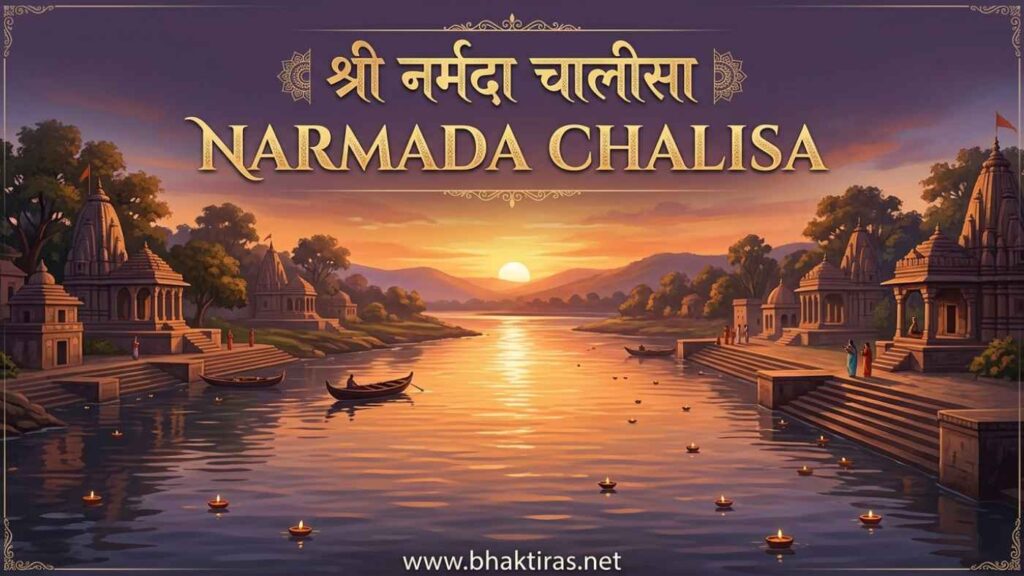
The Narmada Chalisa is a forty-verse hymn of praise to Maa Narmada, the river-goddess also called Reva, who rises at Amarkantak and flows west through central India. Devotees recite it to honour the river revered along the Narmada Parikrama and to seek purification and the grace of Shiva, whose presence the river is said to carry. This page gives the full Roman-English transliteration of every couplet and chaupai together with a clear, original meaning for each verse.
Narmada Chalisa Lyrics in English (Transliteration)
Roman transliteration for easy chanting. Tap “Meaning” under any verse for the English translation.
Devi poojit, Narmada,
Mahima badi apaar.
Chalisa varnan karat,
Kavi aru bhakta udaar.
Meaning
Narmada is worshipped as a goddess, and her glory is beyond measure. With open hearts, poets and devotees set out to describe her in this chalisa of forty verses.
Inki seva se sada,
Mitte paap mahaan.
Tat par kar jap daan nar,
Paate hain nit gyaan.
Meaning
By her service even the gravest sins are always erased. Those who chant her name and give charity on her banks steadily gain spiritual wisdom.
Jai-jai-jai Narmada Bhavani,
Tumhari mahima sab jag jaani.
Meaning
Victory, victory, victory to Narmada Bhavani; the whole world knows your greatness.
Amarkanth se nikli mata,
Sarv siddhi nav nidhi ki data.
Meaning
O Mother, you spring forth from Amarkantak, and you are the giver of every accomplishment and of the nine treasures.
Kanya roop sakal gun khani,
Jab prakatin Narmada Bhavani.
Meaning
You appeared as Narmada Bhavani in the form of a maiden, a mine of all virtues.
Saptami surya makar ravivara,
Ashwani magh maas avatara.
Meaning
You descended on the seventh day, on a Sunday with the sun in Capricorn, under the Ashwini star in the month of Magh.
Vahan makar aapko sajain,
Kamal pushp par aap virajain.
Meaning
The crocodile graces you as your mount, and you are seated upon a lotus flower.
Brahma Hari Har tumko dhyavain,
Tab hi manvanchhit phal pavain.
Meaning
Brahma, Vishnu and Shiva meditate on you, and only then do they obtain the fruit their hearts desire.
Darshan karat paap kati jate,
Koti bhakt gan nitya nahate.
Meaning
Merely beholding you cuts away sins, and millions of devotees bathe in your waters every day.
Jo nar tumko nit hi dhyavai,
Vah nar Rudra lok ko javai.
Meaning
The person who meditates on you daily reaches the realm of Rudra (Shiva).
Magarmachha tum mein sukh pavain,
Antim samay parampad pavain.
Meaning
Even the crocodiles find happiness within you, and at their final hour they attain the supreme state.
Mastak mukut sada hi sajain,
Paav painjani nit hi rajain.
Meaning
A crown forever adorns your head, and anklets always shine upon your feet.
Kal-kal dhvani karti ho mata,
Paap taap harati ho mata.
Meaning
O Mother, you flow with a murmuring, rippling sound, and you carry away sin and suffering.
Poorab se pashchim ki ora,
Bahtin mata nachat mora.
Meaning
From the east toward the west you flow, O Mother, while peacocks dance along your course.
Shaunak rishi tumharau gun gavain,
Soot aadi tumharau yash gavain.
Meaning
The sage Shaunaka sings of your qualities, and Suta and others sing of your fame.
Shiv Ganesh bhi tere gun gavain,
Sakal dev gan tumko dhyavain.
Meaning
Even Shiva and Ganesha sing your praises, and all the hosts of gods meditate upon you.
Koti teerth Narmada kinaare,
Ye sab kahlate dukh haare.
Meaning
Countless places of pilgrimage line the banks of the Narmada, and all of them are known as removers of sorrow.
Manokamna pooran karti,
Sarv dukh maan nit hi hartin.
Meaning
You fulfil the wishes of the heart, O Mother, and you always take away every grief.
Kankhal mein Ganga ki mahima,
Kurukshetra mein Saraswati mahima.
Meaning
At Kankhal the glory belongs to the Ganga, and at Kurukshetra the glory belongs to the Saraswati.
Par Narmada graam jangal mein,
Nit rahti mata mangal mein.
Meaning
But the Narmada, even through villages and forests, the Mother always abides in auspiciousness everywhere.
Ek baar kar ke snaana,
Tarat pidi hai nar naara.
Meaning
By bathing in you even once, men and women carry their whole lineage across to liberation.
Mekal kanya tum hi Reva,
Tumhari bhajan karein nit deva.
Meaning
You are the daughter of Mekal mountain, you are Reva, and the gods sing your praises every day.
Jata Shankari naam tumhara,
Tumne koti janon ko hai taara.
Meaning
Jata-Shankari is one of your names, for you have ferried millions of people across the ocean of existence.
Samodbhava Narmada tum ho,
Paap mochani Reva tum ho.
Meaning
You are Narmada, self-born and ever-joyful, and as Reva you are the one who releases people from sin.
Tumhari mahima kahi nahin jaai,
Karat na banti maatu badai.
Meaning
Your glory cannot be told in full; O Mother, your greatness is beyond anyone's power to describe.
Jal prataap tum mein ati mata,
Jo ramaniya tatha sukh data.
Meaning
The power of your waters is immense, O Mother, and they are both beautiful and a giver of happiness.
Chaal sarpini sam hai tumhari,
Mahima ati apaar hai tumhari.
Meaning
Your winding course moves like a serpent, and your glory is utterly boundless.
Tum mein padi asthi bhi bhaari,
Chhuvat paashaan hot var vaari.
Meaning
It is said that even bones cast into you grow weighty, and at their touch your blessed water can turn stones sacred.
Yamuna mein jo manuj nahata,
Saat dinon mein vah phal paata.
Meaning
A person who bathes in the Yamuna receives the merit of it after seven days.
Saraswati teen dinon mein deti,
Ganga turat baad hi deti.
Meaning
The Saraswati grants its merit in three days, and the Ganga grants it immediately after a bath.
Par Reva ka darshan karke,
Maanav phal paata man bhar ke.
Meaning
But simply by beholding the Reva (Narmada), a person receives the full reward at once, to the heart's content.
Tumhari mahima hai ati bhaari,
Jisko gaate hain nar-naari.
Meaning
Your glory is immense, and men and women alike sing of it.
Jo nar tum mein nitya nahata,
Rudra lok mein pooja jaata.
Meaning
The person who bathes in you every day is honoured in the realm of Rudra (Shiva).
Jari bootiyan tat par rajain,
Mohak drishya sada hi sajain.
Meaning
Healing herbs flourish along your banks, and the enchanting scenery forever adorns them.
Vaayu sugandhit chalti teera,
Jo hartin nar tan ki peera.
Meaning
A fragrant breeze blows along your shores, and it takes away the pain of the human body.
Ghaat-ghaat ki mahima bhaari,
Kavi bhi gaa nahin sakte saari.
Meaning
The glory of each of your bathing ghats is great, so great that even poets cannot sing of all of it.
Nahin jaanu main tumhari pooja,
Aur sahaara nahin mam dooja.
Meaning
I do not know the proper way to worship you, and I have no other refuge but you.
Ho prasann oopar mam mata,
Tum hi maatu moksh ki data.
Meaning
Be pleased with me, O Mother; you alone are the bestower of liberation.
Jo maanav yah nit hai padhta,
Uska maan sada hi badhta.
Meaning
The person who reads this hymn daily finds that their honour keeps on growing.
Jo shat baar ise hai gaata,
Vah vidya dhan daulat paata.
Meaning
Whoever sings it a hundred times gains learning, wealth and prosperity.
Aganit baar padhe jo koi,
Pooran manokamna hoi.
Meaning
For anyone who reads it countless times, the wishes of the heart are fulfilled.
Sabke ur mein bast Narmada,
Yahan vahan sarvatra Narmada.
Meaning
Narmada dwells inside everyone's heart; here, there and everywhere, there is Narmada.
Bhakti bhav ur aani ke,
Jo karta hai jaap.
Mata ji ki kripa se,
Door hot santaap.
Meaning
Whoever holds devotion in the heart and recites this prayer finds, by the Mother's grace, that all their distress is driven away.
Benefits of Reciting the Narmada Chalisa
Regular recitation of the Narmada Chalisa is believed to bring purification of body and mind along with the protective grace of the river-goddess.
- Purification: The hymn invokes the river’s power to wash away accumulated sins and inner impurity, even for those who cannot reach her banks.
- Shiva bhakti: Narmada is closely tied to Shiva, so reciting it deepens devotion and is said to lead the sincere toward Rudra-loka.
- Relief from suffering: Verse after verse names the Mother as the remover of grief, pain and bodily distress.
- Fulfilment of wishes: The chalisa promises that sincere repetition helps fulfil the heartfelt desires of the devotee.
- Support for Narmada Parikrama: Pilgrims who circumambulate the river use it to keep the goddess in mind throughout the long journey.
- Peace of mind: The closing couplet states that devotion paired with this jaap drives away anxiety and torment.
When and How to Chant the Narmada Chalisa
The most auspicious time to recite the Narmada Chalisa is on Narmada Jayanti and on other festival days dedicated to the river, though it may be read on any morning. After bathing, sit before an image or symbol of Maa Narmada, light a lamp, and recite the verses calmly with attention to their meaning. Reciting it on the river’s banks during the Narmada Parikrama is held to be especially fruitful, but the spirit of sincere devotion matters more than any rule.
About the Narmada Chalisa
The Narmada Chalisa is a traditional Hindi devotional hymn in the classic chalisa form: two introductory dohas (couplets), forty chaupais (the main four-line verses), and a closing doha, for forty-three verses in all. Its authorship is not attributed to any single named poet and it is sung in the central Indian regions of Madhya Pradesh and Gujarat through which the Narmada flows. The verses praise the river’s origin at Amarkantak, her names Reva and Mekal-kanya, her link to Shiva, the merit of bathing in her, and the countless sacred ghats and pilgrimage sites along her course.
Frequently Asked Questions
What is the Narmada Chalisa?
The Narmada Chalisa is a forty-verse Hindi devotional hymn praising Maa Narmada, the river-goddess also called Reva who rises at Amarkantak in central India. It honours her origin, her names, her tie to Shiva, and the spiritual merit of her waters.
What are the benefits of reciting the Narmada Chalisa?
Devotees recite it for purification from sins, the grace of Shiva, relief from grief and bodily suffering, fulfilment of sincere wishes, and peace of mind. It is also chanted by pilgrims undertaking the Narmada Parikrama.
Which day is best to recite the Narmada Chalisa?
Narmada Jayanti, the festival marking the river's appearance, is considered the most auspicious day, though the chalisa can be recited on any morning after bathing, and especially while on the Narmada Parikrama.
How many verses are in the Narmada Chalisa?
It has forty main chaupai verses, framed by two introductory dohas and one closing doha, giving forty-three verses in total in the standard text.
Can the Narmada Chalisa be recited in English?
Yes. This page provides the full Roman-English transliteration of every verse so non-Hindi readers can recite it accurately, along with an English meaning for each line.
॥ Narmada Chalisa ॥