
ॐ
Matangi Chalisa
श्री मातंगी चालीसा
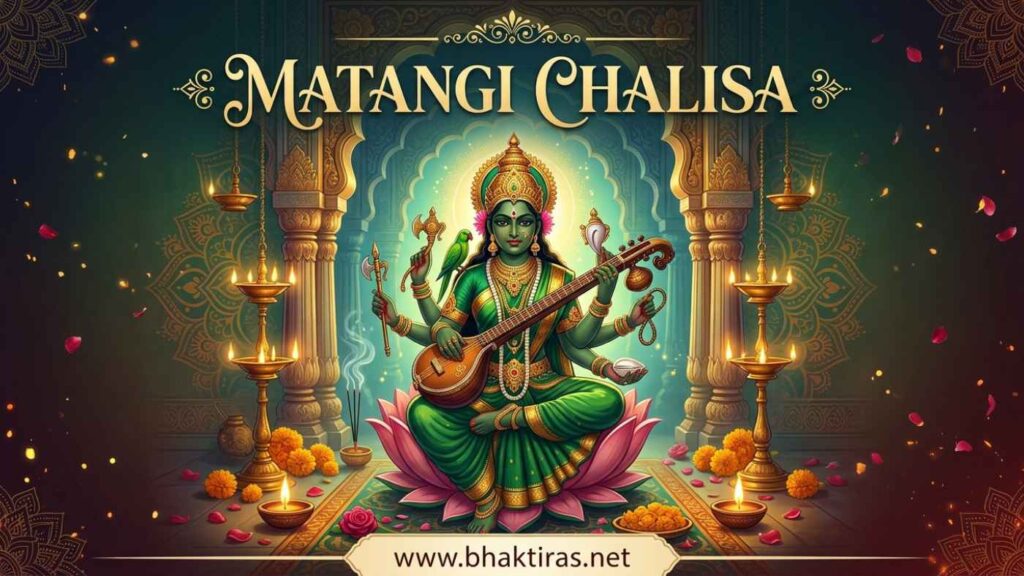
The Matangi Chalisa is a forty-verse hymn to Goddess Matangi, the ninth of the ten Mahavidyas and the Tantric form of Saraswati. She is the goddess of speech, music, learning and the arts, honoured for granting vak siddhi (mastery of the spoken word) and a sharp, calm mind. This page carries the full chalisa in easy English (Roman) transliteration, so you can read it aloud even without knowing Devanagari, with an original line-by-line meaning under every verse.
Matangi Chalisa Lyrics in English (Transliteration)
Roman transliteration for easy chanting. Tap “Meaning” under any verse for the English translation.
Jai Matangi jagat mata, gyan vachan ki khaan
Ajnan andhkar haro, do vidya var daan
Meaning
An opening salutation to Matangi as Mother of the world and the source of knowledge and speech. The devotee asks her to dispel the darkness of ignorance and grant the boon of learning.
Jai Jai Matangi Jagat Janani
Sukha Sampada Vidya Dataani
Meaning
Victory to Matangi, mother of the whole world, who bestows happiness, prosperity and knowledge on those who turn to her.
Dash Mahavidya Mein Tum Nauvani
Tantra Mantra Ki Tum Ho Swamini
Meaning
Among the ten Mahavidyas she stands ninth, and she is the sovereign mistress of every tantra and mantra.
Veena Vadana Mein Tum Biraajati
Shabda Brahma Ki Shuddhi Tum Laajati
Meaning
She dwells in the music of the veena and lends purity to Shabda Brahma, the divine sound from which speech itself arises.
Vani Ko Tum Bal Data Ho
Vidya Aur Buddhi Ka Dham Ho
Meaning
She gives strength and power to a person's speech and is the very abode of learning and intellect.
Matangi Aru Dhoomawati Mata
Bhuvaneshwari Bagala Sukhdata
Meaning
She is worshipped as Matangi and as Mother Dhumavati, and as Bhuvaneshwari and Bagalamukhi she becomes the giver of ease and comfort. The verse links her to her sister Mahavidyas.
Shree Bhairav Tara Jag Tarani
Chhinna Bhala Bhava Dukh Nivarini
Meaning
As Tara she ferries the world across, and as Chhinnamasta she cuts through bondage and removes the sorrows of worldly life.
Hingulaj Mein Tum Bhavani Ho
Jagat Janani Jagadambe Ho
Meaning
At the seat of Hinglaj she is present as Bhavani; she is Jagadamba, mother of all creation.
Tum Ho Kali, Tum Ho Tara
Tum Ho Matangi, Bhuvaneshwari Pyara
Meaning
She is Kali and she is Tara; she is Matangi and the beloved Bhuvaneshwari. One goddess wears many forms.
Tumhari Mahima Varnan Na Aave
Tumhin Bhakta Ka Sankat Bhanje
Meaning
Her greatness is beyond full description in words, yet she alone breaks apart the crises and troubles of her devotees.
Jo Dhyave Tumhe Man Lagave
Uske Sare Dukh Mit Jave
Meaning
Whoever meditates on her with a settled, focused mind finds all their sorrows wiped away.
Tumhi Ho Vidya, Tumhi Gyana
Tumhi Ho Shakti, Tumhi Prana
Meaning
She herself is learning and she herself is wisdom; she is the power within all things and the very breath of life.
Raja Shyamala Kehlati Ho
Uchchhishta Chandali Kehlati Ho
Meaning
She is called Raja Shyamala and also Uchchhishta Chandalini, the form that accepts what the world calls impure and shows that nothing lies outside the sacred.
Vashikaran Ki Shakti Data
Sammohana Ki Kala Vidhata
Meaning
She grants the power of rightful attraction and is the source of the art of drawing hearts and minds toward what is good.
Shreshtha Vidya Ki Devi Ho
Kala Sangeet Ki Swamini Ho
Meaning
She is the goddess of the highest knowledge and the presiding mistress of all art and music.
Jo Tumhari Sharan Mein Aave
Uska Kasta Sab Mit Jave
Meaning
Anyone who comes to take shelter with her sees every hardship dissolve.
Brahmanda Mein Tum Vyapak Ho
Jagat Palan Mein Sakshat Ho
Meaning
She pervades the entire cosmos and is directly present in the work of sustaining and protecting the world.
Tumhin Ho Saraswati Shuddha
Tumhin Ho Durga Ata Sudha
Meaning
She is the pure Saraswati and she is also Durga, brimming with the nectar of grace.
Tantra Ke Tum Adishakti Ho
Yogi Jyon Ke Man Mein Basati Ho
Meaning
She is the primal power behind all tantra, and she makes her home in the hearts of yogis and seekers.
Neela Varna Ati Sundara
Mukuta Dhari Jagata Sundara
Meaning
Her deep blue-dark complexion is exquisitely beautiful; crowned and radiant, she is the loveliest in all the worlds.
Chandrama Mukha Manohari
Nayana Gahre Ati Bhari
Meaning
Her face is enchanting like the moon, and her deep eyes hold an unfathomable depth.
Shukla Pushpa Tumhe Bhavein
Sindura Chandana Tumhe Rijhavein
Meaning
White flowers please her, and offerings of vermilion and sandalwood delight her heart.
Chhavi Tumhari Ati Nyari
Saba Ke Man Mein Baso Tum Pyari
Meaning
Her form is utterly singular and unlike any other; dear one, she resides in the hearts of all.
Tum Raho Sada Sukhkarini
Bhakta Jana Ki Mangal Karini
Meaning
She remains forever the giver of comfort and the bringer of good fortune to her devotees.
Japahu Matangi Man Avahi
Sakala Siddhi Tumse Pavahi
Meaning
Chant the name of Matangi so that she comes to mind, and every accomplishment is received through her grace.
Riddhi Siddhi Ke Data Ho
Bhakta Sankat Ke Nivarani Ho
Meaning
She is the giver of abundance and spiritual attainment and the one who clears away the difficulties of her devotees.
Tumhi Ho Shakti Bhavani
Tumhi Ho Jaya Bhagavati
Meaning
She is Shakti herself as Bhavani, and she is Jaya, the ever-victorious Goddess.
Jo Nitya Tumhri Puja Kare
Siddhi Para-Ananda Bhare
Meaning
Whoever worships her every day is filled with accomplishment and the highest joy.
Matangi Mantra Jo Japave
Sakala Manoratha Phala Pavave
Meaning
One who repeats the Matangi mantra attains the fruit of every heartfelt wish.
Vani Mein Tej Aave Aisa
Sunne Wala Hove Man Mein Khaisa
Meaning
Such brilliance enters one's speech that whoever listens is won over and moved within.
Buddhi Ho Tejashvi Nyari
Mana Ho Shanti Bhari Bhari
Meaning
The intellect grows sharp and remarkable, and the mind is filled to the brim with peace.
Kala Mein Hove Unnati Apari
Lekhana Geeta Mein Hove Sudhari
Meaning
There is boundless progress in the arts, and clear improvement comes in one's writing and music.
Vidya Arth Dhana Prapti Hoi
Sakala Karya Siddhi Sab Hoi
Meaning
Learning, means and wealth are gained, and every undertaking meets with success.
Shighra Hi Prasanna Ho Jao
Bhakta Jano Ki Palak Banao
Meaning
May she be pleased swiftly and become the caretaker and guardian of her devotees.
Jo Din Pratap Padhe Nita
Ta Ko Sagala Sukha Labhata
Meaning
Whoever reads of her glory faithfully each day comes to enjoy every kind of happiness.
Vighna Vinashini Tum Ho
Bhakta Ka Manoranjan Karo
Meaning
She is the destroyer of obstacles; may she gladden and delight the hearts of her devotees.
Sukha Sampatti Dene Wali
Dukha Dard Harni Wali
Meaning
She is the giver of happiness and wealth and the one who carries away sorrow and pain.
Matangi Maiya Ki Jai Jai
Sakala Jagan Mein Ho Ujjay
Meaning
Glory and victory to Mother Matangi; may her light and triumph spread through every world.
Tum Hari Ho, Tum Hara Ho
Tum Sab Ki Raksha Karo
Meaning
She takes sorrow away and dissolves what must end; the devotee prays that she protect one and all.
Mere Saba Karya Siddha Karo
Mana Vanchita Phala Pradana Karo
Meaning
The devotee asks her to bring every task to fruition and to grant the fruit longed for in the heart.
Matangi Chalisa Jo Gaave
Sakala Sukha Sampatti Paave
Meaning
Whoever sings this Matangi Chalisa attains all happiness and prosperity through her blessing.
Benefits of Reciting the Matangi Chalisa
Devotees turn to the Matangi Chalisa above all for clarity and power in expression, and for steady progress in study and creative work. Regular, attentive recitation is said to bring:
- Speech and eloquence: Matangi rules vak siddhi, so her chalisa is chanted for confident, persuasive and honest speech.
- Study and intellect: As a form of Saraswati she is invoked by students and teachers for sharper focus, memory and understanding.
- Arts and music: Poets, singers, writers and performers recite it seeking flow and refinement in their craft.
- Positive influence: The verses ask for rightful attraction and goodwill, helping one connect with and win over others.
- Clearing obstacles: She is praised as the remover of hindrances and hidden difficulties on one’s path.
- Inner calm: The recitation is described as filling the mind with peace and quiet steadiness.
When and How to Chant the Matangi Chalisa
Friday is considered especially favourable for Matangi, and the Navami (ninth day) of Navratri carries added significance for the ninth Mahavidya. Early morning or the evening twilight hour suits the mood of the hymn. After bathing and putting on clean clothes, sit facing east before an image of the Goddess, light a lamp, and offer white flowers, sandalwood and a little vermilion. Begin with the opening Doha, then chant the forty verses slowly and clearly, resting your attention on their meaning. A notable feature of Matangi worship is that no fasting is required; she is said to be content with a sincere mind and pure speech.
About the Matangi Chalisa
The Matangi Chalisa follows the traditional chalisa form, with an opening Doha couplet leading into forty chaupai verses, here given in easy Roman transliteration. Its language is simple devotional Hindi. The verses celebrate Matangi as the ninth of the Dasha Mahavidyas and the Tantric aspect of Saraswati, place her among her sister goddesses (Kali, Tara, Bhuvaneshwari, Bagalamukhi, Dhumavati and others), and dwell on her gifts of speech, learning, music and the arts. Like most chalisas it is a traditional composition passed down through recitation rather than the work of a single named poet.
Frequently Asked Questions
What is the Matangi Chalisa?
The Matangi Chalisa is a devotional hymn of forty verses, plus an opening Doha, praising Goddess Matangi. Matangi is the ninth of the ten Mahavidyas and the Tantric form of Saraswati, the goddess of speech, music, learning and the arts.
What are the benefits of reciting the Matangi Chalisa?
Devotees recite it for eloquence and clarity of speech, sharper intellect and memory, progress in study and creative work such as writing and music, positive influence over others, removal of obstacles, and a calmer, more focused mind.
Which day is best to recite the Matangi Chalisa?
Friday is traditionally favoured for Matangi, and the ninth day (Navami) of Navratri is especially auspicious for her as the ninth Mahavidya. Early morning or evening twilight is a fitting time, though it may be recited on any day with devotion.
How many verses are in the Matangi Chalisa?
This Matangi Chalisa has forty chaupai verses along with an opening Doha, following the standard chalisa form. Each verse on this page includes an English transliteration and an original line-by-line meaning.
Do I need to fast to recite the Matangi Chalisa?
No. A distinctive feature of Matangi worship is that fasting is not required. She is said to be pleased simply through a sincere mind and pure speech, which makes the chalisa easy for anyone to take up.
Can the Matangi Chalisa be recited in English?
Yes. This page provides the full chalisa in Roman (English) transliteration, so you can read and chant every verse aloud even without knowing Devanagari, while the meanings help you follow along.
॥ Matangi Chalisa ॥