
ॐ
Mahamrityunjaya Chalisa
श्री महामृत्युंजय चालीसा
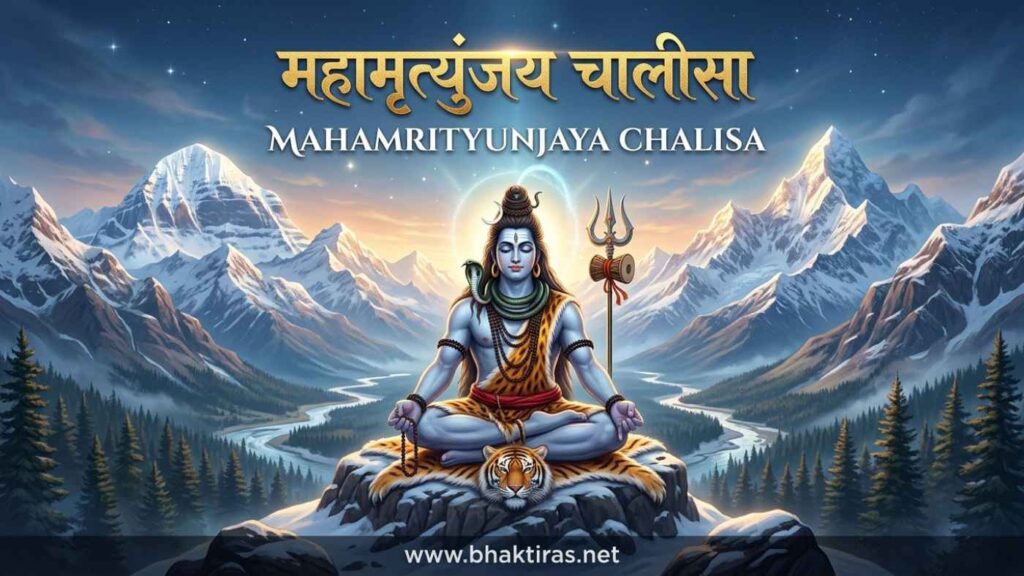
The Mahamrityunjaya Chalisa is a forty-verse devotional hymn to Lord Shiva in his form as Mrityunjaya, the conqueror of death. Devotees recite it for sound health, courage, and protection from untimely death. This page gives the full Roman transliteration of every verse along with a plain-English meaning, so you can both read and understand the prayer.
Mahamrityunjaya Chalisa Lyrics in English (Transliteration)
Roman transliteration for easy chanting. Tap “Meaning” under any verse for the English translation.
Mrityunjay chalisa yah jo hai gunon ki khaan
Alpa mrityu grah dosh sab tan ke kasht mahaan
Chhal va kapat chhod kar jo kare nitya dhyaan
Sahajanand hai kah rahe mite sabhi agyaan
Meaning
This Mrityunjaya Chalisa is a storehouse of good qualities. It eases the fear of early death, the harm of planetary faults, and the body's great troubles. For whoever drops deceit and meditates on it each day, Sahajanand says, all ignorance falls away.
Jay Mrityunjay jag paalan karta
Akal mrityu dukh sabke harta
Meaning
Glory to Mrityunjaya, the one who sustains the whole world. He takes away untimely death and the sorrows of all.
Ashta bhuja tan pyari
Dekh chhavi jag mati bisari
Meaning
His eight-armed form is dear to behold. Seeing that vision, the world loses itself in wonder.
Chaar bhuja abhishek karaye
Do se sabko sudha pilaye
Meaning
With four of his hands he performs the sacred bathing rite, and with two more he offers the nectar of grace to everyone.
Saptam bhuja mrig mudrika sohe
Ashtam bhuja mala man pove
Meaning
His seventh hand bears the sign of the deer, and his eighth holds a rosary that gladdens the heart.
Sarpon ke aabhushan pyare
Baghambar vastra tane dhare
Meaning
Serpents serve as his beloved ornaments, and he wears the tiger-skin as his robe.
Kamalasan ko shobha nyari
Hai aasin bhole bhandari
Meaning
His lotus seat has a beauty all its own, and on it the kind-hearted giver, Bhole, is seated.
Mathe chandrama cham-cham sohe
Baras-baras amrit tan dhoe
Meaning
The crescent moon glitters on his brow, and again and again it bathes his body in nectar.
Trilochana man mohak swami
Ghar-ghar jano antaryami
Meaning
The three-eyed Lord captivates every heart. Know him as the inner witness present in every home.
Vam ang giriraj kumari
Chhavi dekh jae balihari
Meaning
On his left rests Parvati, daughter of the mountain king. Seeing that sight, one gladly surrenders in devotion.
Mrityunjay aisa roop tihara
Shabdon mein na aaye vichara
Meaning
Mrityunjaya, your form is such that words can never fully hold the thought of it.
Ashutosh tum aughad daani
Sant granth yah baat bakhani
Meaning
You are Ashutosh, quickly pleased, and a giver beyond measure. The saints' scriptures declare this plainly.
Rakshas guru Shukra ne dhyaya
Mrit sanjeevani aap se paya
Meaning
Shukra, teacher of the demons, meditated on you and from you gained the art of reviving the dead.
Yahi vidya guru Brahaspati paye
Markandeya ko amar banaye
Meaning
Guru Brihaspati received this same knowledge, and you granted the boy Markandeya deathlessness.
Upamanyu aradhana kini
Anukampa prabhu aap ki leeni
Meaning
The sage Upamanyu worshipped you faithfully and received your compassion and grace.
Andhak yuddh kiya atibhari
Phir bhi kripa kari Tripurari
Meaning
The demon Andhaka waged a fierce war against you, yet even then you showed him mercy, O destroyer of Tripura.
Dev asur sabne tumhen dhyaya
Man vanchhit phal sabne paya
Meaning
Gods and demons alike meditated on you, and each one received the fruit his heart desired.
Asuron ne jab jagat sataya
Devon ne tumhen aan manaya
Meaning
When the demons oppressed the world, the gods came to you and won you over with their prayers.
Tripuron ne jab ki manmani
Dagdh kiye sare abhimani
Meaning
When the three demon cities grew arrogant, you burned all the proud ones to ash.
Devon ne jab dundubhi bajayi
Triloki sari harsai
Meaning
When the gods sounded their victory drums, all three worlds rejoiced together.
Is shakti ka roop hai pyare
Shav ban jaye Shiv se nikare
Meaning
This is the very form of divine power, dear one. Through it the lifeless corpse is lifted into the living truth of Shiva.
Naam anek swaroop bataye
Sab marg aap tak jaye
Meaning
You are spoken of by many names and many forms, and every path in the end leads back to you.
Sabse pyara sabse nyara
Taintis akshar ka mantra tumhara
Meaning
Dearest of all and unlike any other, your sacred mantra is formed of thirty-three syllables.
Taintis seedhi chadh kar jaye
Sahastra kamal mein khud ko paye
Meaning
Climbing the thirty-three steps, the seeker at last finds himself within the thousand-petalled lotus.
Aasuri shakti nasht ho jaye
Satvik shakti god uthaye
Meaning
Demonic forces are undone, while pure and noble powers take the devotee up into their care.
Shraddha se jo dhyan lagaye
Rog dosh wake nikat na aaye
Meaning
Whoever meditates with sincere faith stays untouched, for disease and affliction will not come near.
Aap hi nath sabhi ki dhuri
Tum bin kaise sadhana puri
Meaning
You alone are the Lord and the center of all. Without you, how could any spiritual practice reach its end?
Yam pida na use sataye
Mrityunjay teri sharan jo aaye
Meaning
The pain inflicted by Yama, lord of death, cannot trouble the one who takes shelter in you, Mrityunjaya.
Sab par kripa karo he dayalu
Bhav sagar se taro kripalu
Meaning
Be gracious to all, O merciful one, and carry us across the ocean of worldly life, compassionate Lord.
Mahamrityunjay jag ke adhara
Jape naam so utare para
Meaning
Mahamrityunjaya, support of the world, whoever chants your name is ferried safely to the far shore.
Chaar padarth naam se paye
Dharm arth kaam moksh mil jaye
Meaning
Through your name the four great aims of life are won: righteousness, prosperity, fulfilled desire, and liberation.
Jape naam jo tera prani
Un par kripa karo he daani
Meaning
O bountiful one, pour your grace upon the living soul who repeats your name.
Kaalsarp ka dukh mitave
Jeevan bhar nahin kabhi satave
Meaning
It clears away the distress of the Kaal Sarpa affliction, so that it never torments one for the whole of life.
Nav grah aa jahan shish nivave
Bhakton ko vo nahin satave
Meaning
Where the nine planets come and bow their heads, they no longer bring harm to the devotees.
Jo shraddha vishwas se dhyaye
Us pe kabhi na sankat aaye
Meaning
For the one who meditates with faith and trust, hardship never finds a way in.
Jo jan aapka naam uchare
Nav grah unka kuch na bigade
Meaning
The person who speaks your name aloud is safe, for the nine planets can do them no damage.
Taintis paath kare jo koi
Akal mrityu uski na hoi
Meaning
Whoever recites this thirty-three times is shielded, for untimely death will not reach them.
Mrityunjay jin ke man vasa
Teenon tapon ka hove nasa
Meaning
In whose mind Mrityunjaya dwells, the three kinds of suffering – bodily, worldly, and spiritual – are destroyed.
Nit paath uth kar man lai
Sato guni sukh sampatti pai
Meaning
Rising each day and reciting with an attentive heart, one gains goodness, happiness, and abundance.
Man nirmal Ganga sa hoe
Gyan bade agyan ko khoe
Meaning
The mind grows clear like the waters of the Ganga, and rising wisdom drives ignorance away.
Teri daya us par ho jaye
Jo yah chalisa sune sunaye
Meaning
May your kindness rest upon every person who listens to this Chalisa or recites it for others to hear.
Man chit ek kar jo Mrityunjay dhyaye
Sahaj aanand mile use Sahajanand Nath bataye
Meaning
Whoever fixes mind and heart as one upon Mrityunjaya, says Sahajanand Nath, comes to know an easy, effortless joy.
Benefits of Reciting the Mahamrityunjaya Chalisa
Devotees recite the Mahamrityunjaya Chalisa for healing, courage, and the protection of Lord Shiva. Common reasons people take it up include:
- Health and recovery: It is chanted during illness or for a sick loved one, with a prayer for strength and recovery.
- Protection from untimely death: The hymn is associated with safety from accidents and premature death, a central theme of the Mrityunjaya form.
- Freedom from fear: Regular recitation is said to steady the mind and ease anxiety, including the deep fear of death itself.
- Relief from planetary afflictions: Many turn to it during difficult astrological periods such as Kaal Sarpa Dosha or hard planetary transits.
- Inner peace and clarity: Reciting with attention quiets the mind and supports steadiness and self-confidence.
- Spiritual progress: It is held to clear ignorance and turn the heart toward Shiva and liberation.
When and How to Chant the Mahamrityunjaya Chalisa
The most auspicious time to recite is the Brahma Muhurta before sunrise, with the twilight evening hours also favoured; Mondays and Maha Shivaratri are especially fitting for Shiva worship. Bathe and wear clean clothes, sit on a mat rather than the bare ground, and light a lamp before a Shivling or an image of Lord Shiva. You may offer water, bilva (belpatra) leaves, or dhatura. Recite slowly with correct pronunciation and a calm, attentive mind; a Rudraksha mala helps keep count. Devotion and steady feeling matter more than speed or number.
About the Mahamrityunjaya Chalisa
The Mahamrityunjaya Chalisa is a traditional devotional hymn of forty chaupai verses, framed by an opening and closing doha, composed in the Hindi-Awadhi style of the well-known Chalisa form. It praises Lord Shiva as Mrityunjaya, the conqueror of death, describing his eight-armed form, the moon on his brow, the serpents and tiger-skin, and recalling episodes such as the saving of Markandeya and the burning of the three demon cities. It is important to note that this Chalisa is not the same as the Vedic Mahamrityunjaya Mantra (“Om Tryambakam Yajamahe…”), a single verse of the Rigveda; the Chalisa is a later, longer hymn in the vernacular, and many devotees recite both. The closing doha bears the signature of Sahajanand Nath.
Frequently Asked Questions
What is the Mahamrityunjaya Chalisa?
It is a forty-verse devotional hymn in Hindi-Awadhi praising Lord Shiva as Mrityunjaya, the conqueror of death. Devotees recite it for good health, courage, and protection from untimely death.
Is the Mahamrityunjaya Chalisa the same as the Mahamrityunjaya Mantra?
No. The Mahamrityunjaya Mantra is a single Vedic verse from the Rigveda ("Om Tryambakam Yajamahe…"). The Chalisa is a separate, later devotional hymn of forty verses in the vernacular. Many people chant both, but they are distinct texts.
What are the benefits of reciting the Mahamrityunjaya Chalisa?
It is recited for healing during illness, protection from accidents and premature death, relief from fear and anxiety, steadiness during difficult planetary periods, and inner peace and spiritual focus on Shiva.
Which day is best to recite the Mahamrityunjaya Chalisa?
Monday is traditionally linked with Shiva, and Maha Shivaratri is especially auspicious. The Brahma Muhurta before sunrise is the most favoured time of day, with the evening twilight also suitable.
How many verses are in the Mahamrityunjaya Chalisa?
It has forty chaupai verses, with an opening doha and a concluding doha that frame the hymn.
Can the Mahamrityunjaya Chalisa be recited in English?
Yes. This page provides the full Roman transliteration so anyone can read and recite it, along with an English meaning for each verse. Reciting in the original Hindi sounds is ideal, but devotion matters most.
॥ Mahamrityunjaya Chalisa ॥