
ॐ
Jwala Mata Chalisa
श्री ज्वाला माता चालीसा
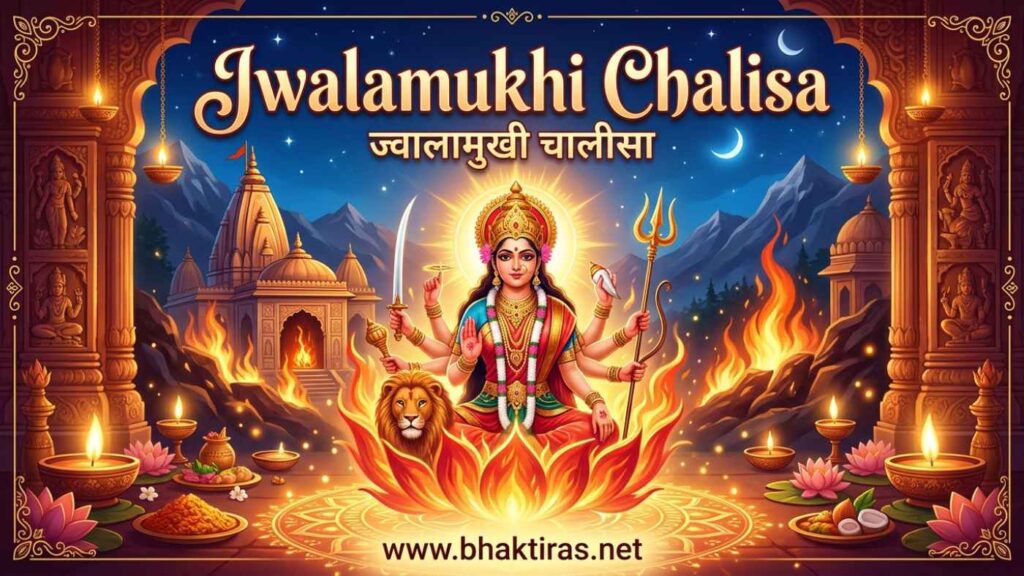
The Jwala Mata Chalisa is a forty-verse hymn to the goddess who is worshipped at Jwalaji in Kangra, Himachal Pradesh, where natural flames burn from the rock with no idol at all. Its verses retell how the Shakti Peeth came to be, name the goddess as Kali, Lakshmi and Saraswati in one form, and recall the devotee Dhianu whose faith the flame answered. This page gives the full Roman transliteration so you can read every line aloud, with an original English meaning for each verse.
Jwala Mata Chalisa Lyrics in English (Transliteration)
Roman transliteration for easy chanting. Tap “Meaning” under any verse for the English translation.
Shakti peeth ma jwalpa dharu tumhara dhyan
Hruday se simaran karu do bhakti vardan
Meaning
O Jwalpa, mother of the Shakti Peeth, I hold you in meditation and remember you from my heart. Grant me the gift of true devotion.
Sukh vaibhav sab dijiye banu tihara das
Daya drushti karo bhagavati aapme hai vishwas
Meaning
Give me every joy and prosperity and let me remain your servant. Turn your merciful gaze on me, Goddess, for all my trust rests in you.
Namskar he jwala mata
Deen dukhi ki bhagya vidhata
Meaning
I bow to you, Mother Jwala. You shape the fortune of the poor and the sorrowful.
Jyoti aapki jagmag jage
Darshan kar andhiyara bhage
Meaning
Your flame burns bright and steady; at the sight of it all darkness runs away.
Nav durga hai rup tihara
Chaudah bhavan me do ujiyara
Meaning
You are the form of all nine Durgas, and you light up every one of the fourteen worlds.
Brahma Vishnu Shankar dvare
Jai maa jai maa sabhi uchhare
Meaning
Brahma, Vishnu and Shiva stand at your door, and all of them call out, 'Victory to the Mother!'
Unche parvat dham tihara
Mandir jag me sabase nyara
Meaning
Your home rests high on the mountains, and your temple is unlike any other in the world.
Kali Lakshmi Sarswati Maa
Ek rup ho Parvati Maa
Meaning
You are Kali, Lakshmi and Saraswati, and in one single form you are Mother Parvati herself.
Riddhi-Siddhi Chanvar Dulave
Aa Ganeshji Mangal Gave
Meaning
Riddhi and Siddhi wave the fans over you, and Lord Ganesha comes to sing songs of blessing.
Gauri Kund Me AAn Nahau
Man ka sara mail hatau
Meaning
I come to bathe in the Gauri Kund so that every stain of my mind may be washed clean.
Gorakh dibbi darshan pau
Baba balak nath manau
Meaning
May I be granted the sight of Gorakh Dibbi, and may I honour Baba Balak Nath.
AApki leela amar kahani
Varnan kaise kare ye prani
Meaning
Your divine play is a story that never dies. How can an ordinary being like me ever describe it?
Raja Daksh ne yadnya rachaya
Kankhal Haridwar Sajaya
Meaning
King Daksha arranged a great fire sacrifice and prepared the grounds at Kankhal in Haridwar.
Shankar ka apaman karaya
Parvati ne krodh dikhaya
Meaning
He insulted Lord Shiva, and Parvati blazed with anger at the offence.
Mere pati ko kyon na bulaya
Sara yadnya vidhvans karaya
Meaning
'Why was my husband not invited?' she cried, and she let the whole sacrifice be undone.
Kud gai maa kund me jakar
Shiv bhole se dhyan lagakar
Meaning
Fixing her mind on innocent Shiva, the Mother leapt into the sacrificial fire.
Gaura ka shav kandhe rakhkar
Chale Nath ji bahut krodh kar
Meaning
Laying Gauri's body across his shoulder, Lord Shiva strode forth in a towering rage.
Vishnuji sab janke maya
Chakra chalakar bojh hataya
Meaning
Understanding the whole play, Lord Vishnu sent his discus and lifted the burden from Shiva.
Ang gire ja parvat upar
Ban gaye maa ke mandir us par
Meaning
Wherever her limbs fell upon the mountains, temples of the Mother rose on those very spots.
Bavan hai shubh darshan maa ke
Jinhe pujate hai ham ja ke
Meaning
Fifty-two are the sacred sites of the Mother, and we travel to each of them to worship.
Jivha giri kangade upar
Amar tej ek pragata aakar
Meaning
Her tongue fell at Kangra, and there an undying radiance took shape as the eternal flame.
Jivha pindi rup me badali
Ansuiya gaiya vaha nikali
Meaning
The tongue turned into the sacred stone form, and the cow Anusuya appeared at that place.
Dudh piya maa rup me aake
Ghabaraya gwala vaha jake
Meaning
The Mother came in her own form and drank the milk, and the cowherd was left bewildered.
Maa ki leela sab pahchana
Paya usane vahi thikana
Meaning
He recognised the Mother's divine play and found his true refuge in that spot.
Sara bhed Raja ko bataya
Jwalaji Mandir Banvaya
Meaning
He told the whole secret to the king, who then had the temple of Jwalaji built.
Chandi Maa ka path karaya
Halwe chane ka bhog lagaya
Meaning
The Chandi Path was recited in her honour, and an offering of halwa and chickpeas was placed before her.
Kalyug vasi pujan kinha
Mukti ka fal sabako dinha
Meaning
The people of this dark age worshipped you, and you gave the fruit of liberation to them all.
Chausath yogini nache dvare
Bavan bhairo hai matvare
Meaning
Sixty-four Yoginis dance at your gate, and fifty-two Bhairavas sway lost in devotion.
Jyoti ko prasad chave
Pede dudh ka bhog lagave
Meaning
The flame receives its offering, and milk and sweets are placed before it as bhog.
Dhol dhapp baje shahnai
Damaru chhaine gaye badhai
Meaning
Drums and the shehnai sound out, damarus and cymbals ring, and songs of celebration are sung.
Tughlak Akbar ne aajamaya
Jyoti koi bujha nahi paya
Meaning
Tughlaq and Akbar both put the flame to the test, yet no one was able to put it out.
Nahar khodakar akbar laya
Jyoti par pani bhi giraya
Meaning
Akbar dug a channel and brought water, and even poured it over the flame.
Lohe ki chadar thi thukvayi
Jyot failkar jagmag aayi
Meaning
An iron sheet was hammered over it, but the flame only spread wider and shone brighter.
Andhkar sab man ka hataya
Chhatra chadhane dar pe aaya
Meaning
With all the darkness of the mind lifted away, he came to your door to offer a golden canopy.
Sharnagat ko maa apanaya
Usaka jeevan dhanya banaya
Meaning
The Mother takes as her own everyone who seeks her shelter, and she makes their life blessed.
Tan man dhan mai karu nyauchhavar
Mangu maa zoli failakar
Meaning
I lay down my body, mind and wealth for you, and with open hands I beg at your feet, Mother.
Muzko maa vipada ne ghera
Kam krodh ne lagaya dera
Meaning
Troubles have closed in around me, Mother, and lust and anger have made their home in me.
Roj bhavan ke darshan pau
Bar-bar mai sheesh Navaau
Meaning
May I see your shrine every single day, and again and again may I bow my head before you.
Jai jai jai Jagdamb Jwalapa
Dhyan rakhegi tu hi balaka
Meaning
Victory, victory, victory to Jagdamba Jwalpa! You alone will watch over this child.
Dhyanu bhagat tumhara yash gaaya
Usaka jeevan dhanya banaya
Meaning
The devotee Dhianu sang your glory, and you made his life truly blessed.
Kalikal me tum vardani
Kshama karo meri naadaani
Meaning
In this age of strife you grant every boon; forgive me for my foolishness.
Sharan pade ko gale lagao
Jwala Mata ki jai jai
Meaning
Take to your heart all who fall at your feet. Victory, victory to Mother Jwala!
Rahun pujta Jwalpa, jab tak hain yeh swans
Daya karo Maa jagdambe, puran ho mere manas
Meaning
Let me keep worshipping Jwalpa for as long as I have breath. Be gracious, Mother of the universe, and let the wishes of my heart be fulfilled.
Benefits of Reciting the Jwala Mata Chalisa
Devotees turn to the Jwala Mata Chalisa for the courage and calm that the goddess of the eternal flame is believed to give.
- Freedom from fear: Regular recitation is said to steady the mind and drive away fear and hostile forces.
- Home and prosperity: The hymn is chanted to invite happiness, comfort and wealth into the household.
- Inner clarity: Just as her flame scatters darkness, the verses are felt to clear confusion and ignorance from the mind.
- Protection for the sheltered: The text repeats that the Mother accepts and guards anyone who seeks her refuge.
- Control over impulses: Verses 34 and 35 are chanted to gain strength over lust, anger and other restless emotions.
- A path toward liberation: The Chalisa recalls that she grants the fruit of mukti to her sincere worshippers.
When and How to Chant the Jwala Mata Chalisa
The Jwala Mata Chalisa is most often recited in the early morning or evening, and during the nine nights of Navratri when devotion to the Goddess is at its height; Tuesdays and Saturdays are also considered especially fitting. Bathe first, wear clean clothes, and light a lamp before an image of Maa Jwala or a picture of the flames of Jwalaji. Sit calmly, fix your attention on the eternal flame, and read the verses aloud or softly with an unhurried, sincere heart. Many devotees repeat the full hymn one, three, seven or eleven times.
About the Jwala Mata Chalisa
The Jwala Mata Chalisa follows the familiar Chalisa form: opening dohas, forty chaupai verses, and a closing doha, composed in Hindi. Rather than praising the goddess in the abstract, its verses tell a story: the sacrifice of Daksha and Sati’s self-immolation, Vishnu’s discus scattering her body, the fall of her tongue at Kangra, the rise of the eternal flame, and the failed attempts of Tughlaq and Akbar to quench it. It closes with the memory of the devotee Dhianu, whose faith the flame answered. On this page every verse appears in Roman transliteration with an original English meaning written for clarity, not copied from any source.
Frequently Asked Questions
What is the Jwala Mata Chalisa?
It is a forty-verse Hindi hymn in praise of Jwala Mata, the goddess worshipped as the eternal natural flame at Jwalaji in Kangra, Himachal Pradesh. Its verses recount the origin of the Shakti Peeth and the goddess's power, mercy and protection.
What are the benefits of reciting the Jwala Mata Chalisa?
Devotees recite it to remove fear, invite happiness and prosperity into the home, clear the mind of confusion, gain control over anger and lust, and seek the Mother's shelter and grace.
Which day is best to recite the Jwala Mata Chalisa?
The nine nights of Navratri are the most auspicious time to recite it. Beyond Navratri, Tuesdays and Saturdays, in the early morning or evening, are also considered ideal.
How many verses are in the Jwala Mata Chalisa?
It has forty chaupai verses, framed by opening dohas and a closing doha, following the standard Chalisa structure.
Where is Jwala Mata worshipped?
At the Jwala Ji temple in Kangra district, Himachal Pradesh, one of the Shakti Peeths, where natural flames burn from the rock and are worshipped in place of any idol.
Can the Jwala Mata Chalisa be recited in English?
Yes. This page provides the complete Roman (English) transliteration so anyone can read and recite every verse aloud, along with an English meaning for each line.
॥ Jwala Mata Chalisa ॥