
ॐ
Chamunda Chalisa
श्री चामुंडा चालीसा
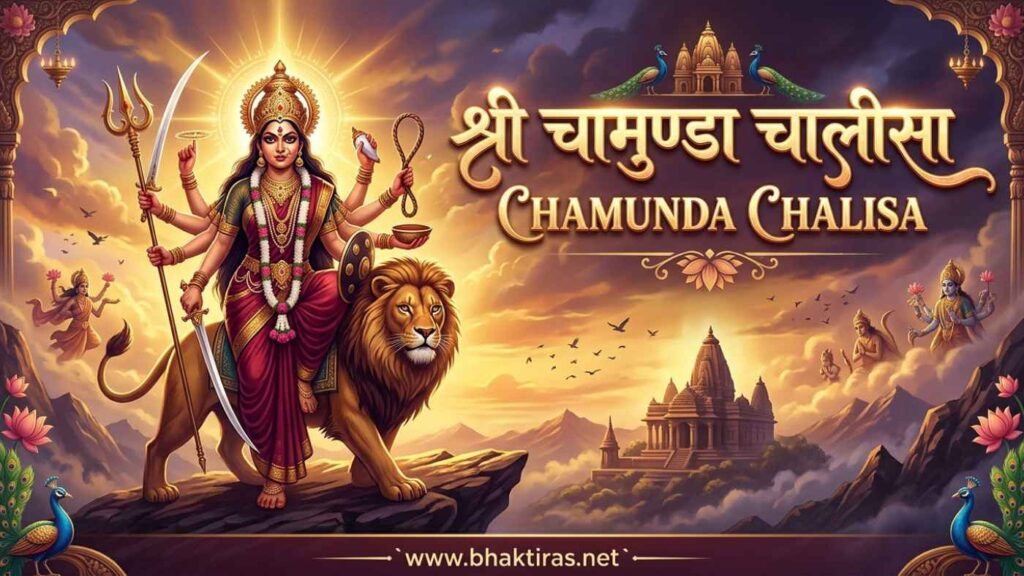
The Chamunda Chalisa is a devotional hymn to Goddess Chamunda, the fierce form of Durga who slew the demons Chanda and Munda and drank the blood of Raktabija. One of the Sapta Matrikas, she is invoked for courage, protection, and the clearing of fear. This page gives the full Roman transliteration of the Chalisa alongside a plain-English meaning for every verse, so you can recite it and understand each line as you go.
Chamunda Chalisa Lyrics in English (Transliteration)
Roman transliteration for easy chanting. Tap “Meaning” under any verse for the English translation.
Neelavaran Maa Kalika, rehti sada prachand
Das hathon mein shastra dhar, deti dusht ko dand
Meaning
The dark-hued Mother Kalika is forever fierce. Bearing weapons in her ten hands, she deals out punishment to the wicked.
Madhu-Kaitabh sanhar kar, kari dharm ki jeet
Meri bhi peeda haro, ho jo karm puneet
Meaning
Having destroyed the demons Madhu and Kaitabha, she secured the triumph of dharma. O Mother, take away my pain too, so that my deeds may be made pure.
Namaskar Chamunda Mata, teeno lok mein tum vikhyata
Himalaya mein pavitra dham hai, Mahashakti tumko pranam hai
Meaning
I bow to you, Mother Chamunda, celebrated across all three worlds. Your holy seat rests in the Himalayas; to you, great Power, I offer my reverence.
Markandeya rishi ne dhyaya, kaise pragati bhed bataya
Shumbh-Nishumbh do daitya balsali, teeno lok jo kar diye khali
Meaning
Sage Markandeya contemplated you and disclosed the secret of how you appear. The two powerful demons Shumbha and Nishumbha had stripped all three worlds bare.
Vayu, Agni ya Kuber sang, Surya, Chandra, Varun hue tang
Apmanit charnon mein aaye, Giriraj Himalaya ko laaye
Meaning
Vayu, Agni, Kubera, Surya, Chandra and Varuna were all in distress. Humbled, they came to your feet and brought the plea to the king of mountains, the Himalaya.
Bhadra-Raudra nitya dhyaya, chetan shakti karke bulaya
Krodhit hokar Kali aayi, jisne apni leela dikhayi
Meaning
In fierce and steady forms they meditated and summoned your awakened power. In wrath, Kali arose and revealed her divine play.
Chand-Mund aur Shumbh pate, kamuk vairee ladne aaye
Pehle Sugreev doot ko maara, bhaga Chand bhi maara maara
Meaning
Chanda, Munda and the forces of Shumbha, lust-driven foes, came to give battle. First the messenger Sugriva was struck down, and Chanda too was routed and beaten back.
Arbo sainik lekar aaya, dhaaran lokanghan krodh dikhaya
Jaise hi dust lalkara, 'Ha-u' sabad gunja ke maara
Meaning
He came leading numberless soldiers, flaunting a fury that overran the worlds. The instant the wicked one challenged her, the syllable 'Ha-u' rang out and cut him down.
Sena ne machayi bhagdar, chadha Singh jo aaya us baad
Hatya karne Chand-Mund aaye, madira peekar ke ghoor aaye
Meaning
The demon army broke into panic, and then came the roar of the lion. Chanda and Munda advanced to kill, glaring, drunk on wine.
Chaturangi sena sang laaye, uche uche seemar giraaye
Tumne krodhit roop nikala, pragati daal gale Mund mala
Meaning
They brought a fourfold army and toppled the tallest ranks. You revealed your enraged form and appeared wearing a garland of severed heads at your neck.
Charm ki sadi cheete wali, haddi dhancha tha balsali
Vikraal mukhi aankhein dikhayi, jise dekh srishti ghabrayi
Meaning
Clad in a leopard-skin robe, your gaunt, bony frame held immense strength. You showed a face and eyes of terror, at whose sight all creation shook.
Chand-Mund ne chakra chalaya, le talwar 'Hu' sabad gunjaya
Papio ka kar diya nistara, Chand-Mund dono ko maara
Meaning
Chanda and Munda hurled discus and drew sword, sounding the war-cry 'Hu.' You made an end of the sinners and slew both Chanda and Munda.
Hath mein mastak le muskayi, paapi sena phir ghabrayi
Saraswati Maa tumhe pukara, pada Chamunda naam tihara
Meaning
Holding their heads in your hand, you smiled, and the sinful army trembled once more. Goddess Saraswati called out to you, and so you came to bear the name Chamunda.
Chand-Mund ki mrityu sunkar, Kaalk-Maurya aaye raaj par
Arab kharab yudh ke path par, jhok diye sab Chamunda par
Meaning
On hearing of Chanda and Munda's death, the demon lords came to the fray. Billions upon billions of warriors were flung along the road of war against Chamunda.
Ugra Chandika pragati aakar, gidron ki vaadi bhar kar
Kaali khatvaang ghuson se maara, Brahmand ne feki jal dhaara
Meaning
Fierce Chandika appeared, and the valleys filled with vultures. Kali struck with the skull-topped staff, and the cosmos poured forth streams of water.
Maheshwari ne trishul chalaya, Maa Vaishnavi chakra ghumaya
Kartikeya ki shakti aayi, Narsinghi daityon pe chhayi
Meaning
Maheshwari drove her trident and Vaishnavi spun her discus. The energy of Kartikeya arrived, and the power of Narasimhi fell upon the demons.
Chun chun Singh sabhi ko khaya, har danav ghayal ghabraya
Raktabeej maya felayi, shakti usne nai dikhayi
Meaning
One by one the lion devoured them all, and every demon was wounded and afraid. Then Raktabija spread his illusion and displayed a strange new power.
Rakt gira jab dharti upar, naya daitya pragata tha wahi par
Chandi Maa ab shool ghumaya, maara usko lahoo choosaya
Meaning
Wherever his blood fell to the ground, a fresh demon sprang up in that very spot. So Mother Chandi turned her lance, struck him, and drank up his blood.
Shumbh-Nishumbh ab daude aaye, saari sena bhar kar laaye
Vajrapat sang shool chalaye, sabhi devta kuch ghabaraye
Meaning
Now Shumbha and Nishumbha themselves rushed in, marshalling their entire host. They loosed thunderbolt and spear together, and even the gods grew uneasy for a moment.
Lalkara phir ghusa maara, le trishool kiya nistara
Shumbh-Nishumbh dharti par soye, daitya sabhi dekh kar roye
Meaning
With a roar you charged and struck, and with your trident finished the work. Shumbha and Nishumbha lay lifeless on the earth, and all the demons wept at the sight.
Chamunda Maa dharm bachaya, apna shubh mandir banwaya
Sabhi devta aake maante, Hanumat Bhairav chavar dolte
Meaning
Mother Chamunda upheld dharma and had her sacred temple raised. All the gods came to honour her, while Hanuman and Bhairava waved the fly-whisks in her service.
Aaswin Chet Navratre aao, dhwaja nariyal bhet chadhao
Vandar nadi snan karao, Chamunda Maa tumko piyau
Meaning
Come in the Navratras of Ashwin and Chaitra; offer flags and coconuts to her. Bathe in the Vandar river and present its water to Mother Chamunda.
Jo yeh chalisa nit gaave, Maa Chamunda usko sukh paave
Bhoot-pret sab bhaag jaaye, jo nar Chamunda dhyaaye
Meaning
Whoever sings this Chalisa daily, Mother Chamunda grants them wellbeing. Ghosts and evil spirits all flee from the one who meditates on Chamunda.
Shatru sangh nash ho jaaye, jo nar Chamunda gaaye
Raj-darbar mein jai ho, karya siddh sab hoi
Meaning
The band of enemies is destroyed for the one who sings her praise. There is victory in the halls of the powerful, and every undertaking comes to fruition.
Jo nar Chamunda se preet, tako kabhu na laage bheet
Din-dukh, daridra mite, sukh-sampatti ghar aave
Meaning
The one who holds love for Chamunda is never touched by fear. Misery and poverty are wiped away, and comfort and prosperity enter the home.
Sharanagat ko shakti do, he jag ki aadhaar
'Om' ye naiya dolati, kar do bhav se paar
Meaning
Give strength to the one who takes refuge in you, O support of the world. This little boat of life is rocking; carry it across the ocean of worldly existence.
Benefits of Reciting the Chamunda Chalisa
Devotees turn to the Chamunda Chalisa when they need protection and inner steadiness. Reciting it with faith is traditionally held to bring the following:
- Freedom from fear: Chamunda is the destroyer of dread, and her Chalisa is chanted to calm anxiety and face difficult situations with a steadier mind.
- Protection from enemies and negativity: The hymn is invoked as a shield against ill-wishers, harmful energies, and unseen disturbances.
- Courage and strength: As the goddess who defeated Shumbha, Nishumbha and Raktabija, she is called upon to build resolve, willpower, and self-confidence.
- Fulfilment of sincere wishes: Regular recitation, especially during Navratri, is offered with heartfelt prayers for the goals a devotee is working toward.
- Peace and prosperity at home: The verses ask that sorrow and want be cleared, and that harmony and sufficiency settle over the household.
- Refuge and grounding: The closing Doha frames the whole recitation as taking shelter in the Mother, which many find steadying in itself.
When and How to Chant the Chamunda Chalisa
Chamunda is most often worshipped on Tuesdays and during Navratri (both Chaitra and Ashwin), and daily recitation is welcome as well. A simple way to recite: bathe, sit on a clean seat facing east or north before an image of the goddess, and light a lamp. Offering red flowers is customary, as red is associated with her. Read the Chalisa slowly and with attention, following the meaning of each verse, and close by repeating ‘Om Chamundayai Namah’ a few times. What matters most is a calm, sincere heart rather than elaborate ritual.
About the Chamunda Chalisa
The Chamunda Chalisa is a traditional devotional composition set in the usual chaupai-and-doha pattern of Hindi Chalisa hymns: opening couplets, a run of narrative verses, and a closing couplet. Its story draws on the Devi Mahatmya, where the goddess slays Chanda and Munda, drinks the blood of Raktabija so no clone can rise, and destroys Shumbha and Nishumbha with the Matrikas at her side. The version here reproduces the attested verses of that narrative through the concluding phalashruti; some circulating copies pad the text with repetitive filler couplets, which we have left out in the interest of an honest, accurate rendering.
Frequently Asked Questions
What is the Chamunda Chalisa?
It is a devotional hymn to Goddess Chamunda, the fierce form of Durga who slew the demons Chanda and Munda and drank the blood of Raktabija. Set in chaupai-and-doha verses, it retells her battles and asks for her protection and grace.
What are the benefits of reciting the Chamunda Chalisa?
Devotees recite it to be freed from fear, to gain protection from enemies and negative influences, and to build courage and confidence. It is also chanted for peace, prosperity, and the fulfilment of sincere wishes.
Which day is best to recite the Chamunda Chalisa?
Tuesdays and the nine nights of Navratri (Chaitra and Ashwin) are considered especially auspicious for Chamunda. Daily recitation, ideally in the morning after bathing, is also encouraged.
How many verses are in the Chamunda Chalisa?
This version presents the attested recension: opening and closing Dohas plus the main chaupais that carry the battle narrative and the phalashruti. Some printed copies inflate the count with repetitive filler lines, which are not part of the standard text.
Who is Goddess Chamunda?
Chamunda is a fierce aspect of the Great Goddess and one of the Sapta Matrikas (seven mother goddesses). Her name comes from the demons Chanda and Munda whom she killed; she is also known as Chamundeshwari or Chamundi.
Can the Chamunda Chalisa be recited in English?
Yes. This page gives the full Roman transliteration so anyone can read and recite it correctly, along with a plain-English meaning for every verse to help you follow along.
॥ Chamunda Chalisa ॥