
ॐ
Batuk Bhairav Chalisa
श्री बटुक भैरव चालीसा
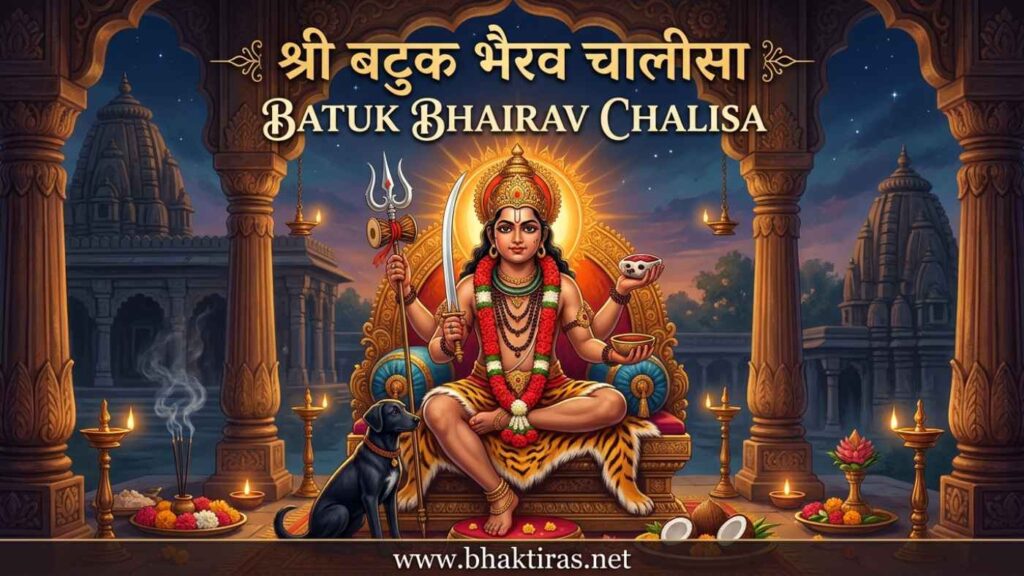
The Batuk Bhairav Chalisa is a forty-verse devotional hymn to Batuk Bhairav, the child or youthful form of Bhairav, who is himself a fierce yet protective manifestation of Lord Shiva. Where Kaal Bhairav is awe-inspiring and severe, Batuk (“the young one”) is approached as a gentle, accessible guardian, often called the beloved son of Goddess Kali. This page gives the full chalisa in easy English transliteration, with an original line-by-line meaning for every couplet so you can both recite it aloud and understand what each verse is saying.
Batuk Bhairav Chalisa Lyrics in English (Transliteration)
Roman transliteration for easy chanting. Tap “Meaning” under any verse for the English translation.
Vishwanath ko sumir man, dhar Ganesh ka dhyan
Bhairav Chalisa rachoon, kripa karahu Bhagwan
Meaning
Holding Lord Vishwanath (Shiva) in mind and meditating on Ganesha, I begin composing this Bhairav Chalisa. May the Lord grant his grace upon this effort.
Batuknath Bhairav bhajoon, Shri Kali ke laal
Chheetarmal par kar kripa, Kashi ke kutwal
Meaning
I sing of Batuknath Bhairav, the dear child of Goddess Kali. O guardian of Kashi, look kindly on this humble devotee.
Jai Jai Shri Kali Ke Lala
Raho Das Par Sada Dayala
Meaning
Hail, hail to you, beloved child of Kali. Stay forever kind and merciful toward this servant of yours.
Bhairav Bhishan Bhim Kapali
Krodhavant Lochan Mein Lali
Meaning
Bhairav is awe-striking and mighty, bearing the skull as his emblem. When roused, his eyes glow red with fierce energy.
Kar Trishool Hai Kathin Karala
Gal Mein Prabhu Mundan Ki Mala
Meaning
In his hand he holds the hard, terrifying trident. Around his neck, O Lord, hangs a garland of skulls.
Krishna Roop Tan Varna Vishala
Peekar Mad Rahta Matwala
Meaning
His form is dark and vast in stature. He stays in a rapturous, intoxicated state, beyond ordinary measure.
Rudra Batuk Bhaktan Ke Sangi
Pret Nath Bhutesh Bhujangi
Meaning
Rudra Batuk stands beside his devotees as their companion. He is the master of spirits and ghosts, adorned with serpents.
Trailatesh Hai Naam Tumhara
Chakra Tund Amaresh Piyara
Meaning
One of your names is Lord of the three worlds. You are dear to Chakra Tunda and to Amaresha.
Shekharchandra Kapal Biraje
Swan Sawari Pe Prabhu Gaje
Meaning
The crescent moon rests in your locks and the skull shines upon you. O Lord, riding the dog as your mount, you move with thundering majesty.
Shiv Nakulesh Chand Ho Swami
Baijnath Prabhu Namo Namami
Meaning
O Shiva, O Nakulesha, O Chanda, you are my Lord. Lord of Baijnath, I bow to you again and again.
Ashwanath Krodhesh Bakhane
Bhairo Kal Jagat Ne Jane
Meaning
You are extolled as Ashwanatha and Krodhesha. The whole world knows you as Bhairo and as Kala, the dark one.
Gayatri Kahain Nimish Digambar
Jagannath Unnat Adambar
Meaning
The Gayatri describes you as the fleeting moment and as the sky-clad one. You are the Lord of all, vast and resplendent.
Kshetrapal Dasapan Kahaye
Manjul Umanand Kahalaye
Meaning
You are called Kshetrapala, the protector of every region. You are also named Manjula and Umananda.
Chakranath Bhaktan Hitkari
Kahain Tryambak Sab Nar Nari
Meaning
As Chakranatha you work for the good of your devotees. All men and women address you as Tryambaka, the three-eyed one.
Samharak Sunand Taw Naama
Karahu Bhakt Ke Purn Kaama
Meaning
Among your names are Samharaka, the dissolver, and Sunanda, the joyful one. Please bring your devotees' sincere wishes to fulfilment.
Nath Pishachan Ke Ho Pyare
Sankat Metahu Sakal Hamare
Meaning
O Lord, even the wild spirits hold you dear. Wipe away all of our troubles and dangers.
Krityayu Sundar Ananda
Bhakt Janan Ke Katahu Phanda
Meaning
O Krityayu, beautiful one, embodiment of bliss, cut away the binding nooses that hold your devotees.
Karan Lamb Aap Bhay Bhanjan
Namonath Jai Janman Ranjan
Meaning
You are the breaker of fear and the source of every cause. I bow to you, O Lord, the one who gladdens the heart of all who are born.
Ho Tum Dev Trilochannatha
Bhakt Charan Mein Navat Matha
Meaning
You are the divine three-eyed Lord. Your devotees lower their heads at your feet in surrender.
Twan Ashtang Rudra Ke Lala
Mahakal Kalon Ke Kala
Meaning
You are the child of the eightfold Rudra. As Mahakala, you are the end of death itself.
Taap Vimochan Ari Dal Nasa
Bhaal Chandrama Karahi Prakasha
Meaning
You free us from suffering and scatter the ranks of enemies. The moon upon your brow shines with clear light.
Shwet Kal Aru Lal Sharira
Mastak Mukut Shish Par Chira
Meaning
Your form appears white, dark and red by turns. A crown sits on your head and a cloth is wound about it.
Kali Ke Lala Baldhari
Kahan Tak Shobha Kahoon Tumhari
Meaning
O strong and mighty child of Kali, how far can words reach in describing your splendour?
Shankar Ke Avtar Kripala
Raho Chakachak Pi Mad Pyala
Meaning
O merciful incarnation of Shankara, you remain radiant and joyful, ever absorbed in divine rapture.
Shankar Ke Avtar Kripala
Batuka Nath Chetaka Dikhlao
Meaning
O merciful incarnation of Shankara, O Lord Batuk, grant me your living vision and presence.
Ravi Ke Din Jana Bhog Lagawen
Dhup Deep Naivedya Chadhawen
Meaning
On Sundays devotees place their offerings before you. They present incense, lamps and consecrated food.
Darshan Karke Bhakt Sihaven
Darud Kida Har Pilaven
Meaning
Beholding you, devotees feel deeply content. With love and devotion they make their offerings to you.
Matha Mein Sundar Latkat Jhawa
Siddh Karya Karo Bhairo Baba
Meaning
Lovely locks fall across your forehead. O Bhairo Baba, bring every undertaking to a successful end.
Nath Apka Yash Nahi Thoda
Karamein Subhag Sushobhit Koda
Meaning
O Lord, your glory is far from small. Your deeds are fortunate and your form is beautifully adorned.
Kati Ghunghra Surile Bajata
Kanchanmay Sinhasan Rajata
Meaning
Sweet-toned bells chime at your waist. You are seated in splendour upon a golden throne.
Nar Nari Sab Tumko Dhyawahin
Manvanchhit Ichhaphala
Meaning
Men and women alike meditate upon you. You grant them the fruit their hearts truly desire.
Bhoot Pishach Sab Tumse Darte
Paap Karma Sab Tumse Sarte
Meaning
Ghosts and wild spirits all tremble before you. Sinful deeds dissolve and fall away in your presence.
Jo Nar Tumko Nit Dhyave
Sankat Mein Kabhu Na Ghabrave
Meaning
Whoever meditates on you each day never panics in times of crisis.
Ripu Jan Ko Darshan Pave
Tum Sang Raksha Karo Sada
Meaning
Even when one meets a foe, you stand by as a constant shield of protection.
Jo Path Kare Chalisa Teri
Sidhi Ho Unki Sab Feri
Meaning
Whoever recites this chalisa of yours finds their efforts crowned with success on every side.
Riddhi Siddhi Ghar Mein Aave
Sukh Sampati Mein Vriddhi Pave
Meaning
Abundance and accomplishment enter their home, and their happiness and prosperity steadily grow.
Jo Nar Batuk Bhairav Dhayave
Sakal Manorath Phal Pave
Meaning
The one who contemplates Batuk Bhairav receives the fruit of all their heartfelt aims.
Bhairav Nath Maha Sukhdata
Jo Chale Uski Raksha Karta
Meaning
Bhairav Nath is the great giver of well-being. Whoever walks his path in faith, he keeps safe.
Jai Jai Shri Kali Ke Lala
Jai Jai Batuk Bhairav Dayala
Meaning
Hail, hail to the beloved child of Kali. Hail, hail to the compassionate Batuk Bhairav.
Jai Jai Bhairav Maha Bhayhari
Jai Jai Kaal Bhairav Balhari
Meaning
Hail, hail to Bhairav, the great remover of fear. Hail, hail to the mighty Kaal Bhairav.
Jai Jai Nath Bhairav Vikhyata
Jai Jai Sarv Bhairav Sukhdata
Meaning
Hail, hail to the celebrated Bhairavnath. Hail, hail to all the Bhairavas, givers of joy.
Bhairav Roop Kiyo Shiv Dharan
Bhav Ke Bhar Utaran Karan
Meaning
Lord Shiva took on the form of Bhairav to lift the heavy burden of worldly existence from his devotees.
Benefits of Reciting the Batuk Bhairav Chalisa
Devotees turn to the Batuk Bhairav Chalisa for the qualities the child form of Bhairav is loved for: fearless protection delivered with a gentler, more approachable spirit. Regular recitation is associated with:
- Freedom from fear: Calling on Bhairav, the breaker of fear, is said to steady the mind during anxiety, crisis or sudden danger.
- Protection and safety: As guardian (Kotwal) of Kashi, Batuk Bhairav is invoked for protection of the home, travel and family from harm and negative influence.
- Courage and confidence: The hymn’s fierce imagery is meant to strengthen resolve and help a devotee face difficult people or situations.
- Removal of obstacles: Several verses ask the Lord to make every undertaking succeed, so the chalisa is recited before important tasks and new beginnings.
- Peace from disturbing forces: Bhairav is the master of spirits, and devotees recite the text seeking relief from fear of unseen or unsettling influences.
- Inner steadiness: Reflecting on the meaning of each verse cultivates devotion, focus and a calm trust that one is watched over.
When and How to Chant the Batuk Bhairav Chalisa
Sunday and Tuesday are considered the most favourable days to recite the Batuk Bhairav Chalisa, since these are traditionally linked with Bhairav worship; the source text itself notes offerings made on Sundays. After bathing, sit before an image or picture of Bhairav, light a lamp or incense, and recite the chalisa slowly and aloud, beginning with the opening dohas. What matters most is sincere attention and a respectful heart rather than ritual perfection, so read at a pace that lets you follow the meaning of each verse.
About the Batuk Bhairav Chalisa
The Batuk Bhairav Chalisa follows the classic chalisa structure: two opening dohas (couplets) followed by forty chaupais (four-line devotional verses), composed in simple Hindi. It is addressed specifically to Batuk Bhairav, the child or youthful form of Bhairav, who is honoured as a son of Goddess Kali and an incarnation of Shiva. The verses move through his many names and titles, his fierce protective imagery, his role as guardian of devotees and master of spirits, and the rewards promised to those who recite it with faith. Like most chalisas, it is traditional and devotional rather than the work of a single named author.
Frequently Asked Questions
What is the Batuk Bhairav Chalisa?
It is a forty-verse Hindi devotional hymn praising Batuk Bhairav, the child or youthful form of Bhairav, who is a protective manifestation of Lord Shiva and honoured as a son of Goddess Kali. The text consists of two opening couplets (dohas) and forty four-line verses (chaupais) describing his names, form and protective grace.
Who is Batuk Bhairav, and how is he different from Kaal Bhairav?
Batuk Bhairav is the young or child form of Bhairav. While Kaal Bhairav is worshipped as fierce, severe and awe-inspiring, Batuk is approached as a gentler, more accessible guardian, which is why many devotees feel especially close to this form even though both are aspects of the same Bhairav.
What are the benefits of reciting the Batuk Bhairav Chalisa?
Devotees recite it seeking protection, courage and freedom from fear, removal of obstacles before important work, and relief from anxiety and disturbing influences. The verses repeatedly describe Bhairav as a protector who keeps his faithful safe and fulfils their sincere wishes.
Which day is best to recite the Batuk Bhairav Chalisa?
Sunday and Tuesday are considered the most auspicious days for reciting it, as these days are traditionally associated with Bhairav worship; the chalisa itself mentions offerings made to Bhairav on Sundays.
How many verses are in the Batuk Bhairav Chalisa?
This text has two opening dohas (couplets) followed by forty chaupais (main verses), matching the standard chalisa form of forty principal verses.
Can the Batuk Bhairav Chalisa be recited in English?
Yes. This page provides the full chalisa in Roman (English) transliteration so it can be read and recited by those who do not read Devanagari, along with an original English meaning for every verse to aid understanding.
॥ Batuk Bhairav Chalisa ॥