
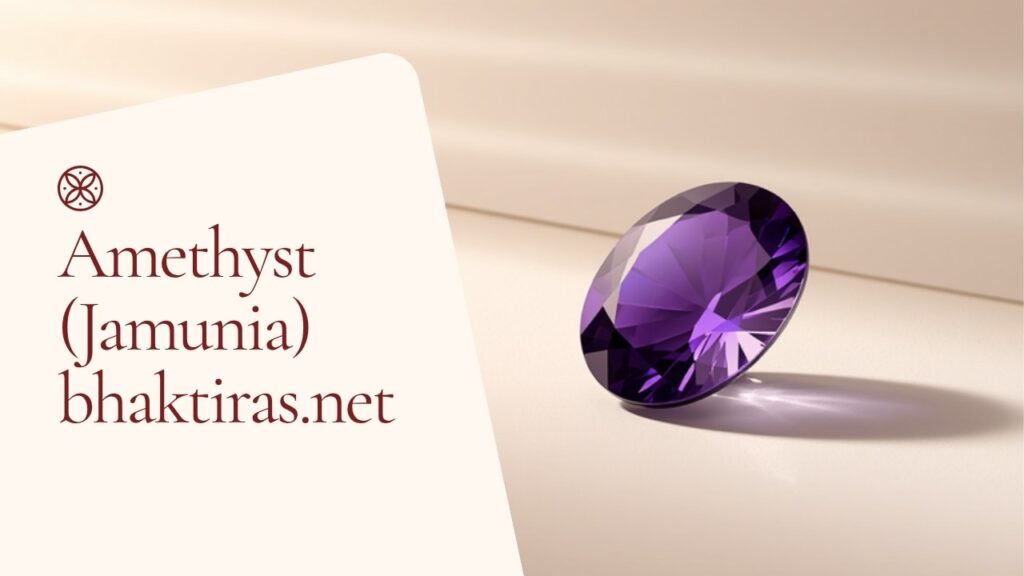
Amethyst (Jamunia)
Saturn's gentle purple trial stone, worn before committing to a neelam.
- Saturn
- Saturday
- Middle finger
- 5-8 ratti
| Ruling planet | Saturn (Shani) |
|---|---|
| Rashi (zodiac) | Capricorn (Makar) and Aquarius (Kumbh) |
| Day to wear | Saturday |
| Finger | Middle finger of the working hand |
| Metal | Silver |
| Weight | 5-8 ratti |
| Mantra | Om Sham Shanicharaya Namah |
| Hardness | 7 on the Mohs scale |
| Colour | Lilac to deep purple |
Who Should Wear Amethyst?
The purple in amethyst comes from trace iron and natural irradiation, and in Vedic gem practice that cool violet tone is read as Saturn’s own colour, so jamunia is prescribed to the same charts that would eventually wear a blue sapphire. Capricorn (Makar) and Aquarius (Kumbh) ascendants get the clearest recommendation, since Saturn rules both signs and a well-placed Shani here rewards support rather than resistance.
It is also suggested during a running Shani mahadasha or antardasha, particularly when Saturn sits weak, combust or under affliction in the birth chart and a full neelam feels too risky to commit to straight away. Some astrologers extend it to charts where Saturn is a functional benefic, but this needs a horoscope check rather than a general rule.
Because Saturn’s placement, strength and the running dasha period all change the reading from chart to chart, treat this as a starting point and confirm the actual recommendation with a practising astrologer. A quick way to see where Saturn sits in your own chart right now is below.
Does Amethyst suit your kundali? The answer is in your birth chart, not your sun sign. Check free in under a minute.
Check My GemstoneBenefits of Wearing Amethyst
Because amethyst is Saturn’s own stone at a gentler intensity, its traditional benefit list reads like a softer echo of what a blue sapphire promises, discipline and patience rather than sudden gain.
- Calmer temperament: wearers report that irritability and impulsive decisions ease, letting Saturn’s slower, more deliberate pace take over daily choices.
- Steadier career discipline: classical texts credit the stone with helping in professions tied to labour, service, land, mining and long-term structured work, areas Saturn governs.
- Reduced Shani-related restlessness: some wearers notice fewer of the delays, anxiety and low-grade worry associated with an unsettled Saturn, particularly during a Shani dasha.
- Better focus and self-control: the cool purple tone is traditionally linked to a quieter mind, useful for meditation, study and repetitive disciplined practice.
- A gentler trial before neelam: because it channels the same planet at lower intensity, wearers use it to gauge how their system responds to Saturn before committing to blue sapphire.
How to Wear Amethyst (Jamunia)
Amethyst is a 7 on the Mohs scale, hard enough for daily wear without much scratching, which is one reason it survives well as an everyday trial ring.
- Day and time: start wearing on a Saturday, ideally during the Shani hora or early morning after sunrise.
- Metal and finger: set in silver and worn on the middle finger, the finger traditionally assigned to Saturn.
- Weight: 5 to 8 ratti is the usual range for a wearable stone, sized to the finger without the setting overwhelming it.
- Purification: before the first wear, soak the stone in raw cow’s milk for a few minutes, then rinse with Gangajal or clean water and pat dry.
- Mantra: chant “Om Sham Shanicharaya Namah” 108 times while holding the ring, ideally using a mala to count.
- Replacement: replace the stone if it cracks, chips or visibly dulls in colour, or after a few years of regular wear, whichever comes first.
Who Should Not Wear Amethyst
Saturn and the Sun, Moon and Mars are classical enemies, so charts leaning heavily on those three should be cautious rather than assume the stone is automatically safe just because it is inexpensive.
- Leo and Aries ascendants: where Saturn typically functions as a malefic, wearing jamunia without a chart check can aggravate rather than calm Saturn-related troubles.
- Strong Sun or Mars charts: if Surya or Mangal already sits strongly and well placed, adding Saturn’s influence through the stone can create friction rather than support.
- Active Sade Sati or a harsh Shani dasha with a weak birth chart: some astrologers prefer to strengthen the chart first rather than add more Saturn energy immediately.
The trial custom exists for exactly this reason, wear it for a few weeks and watch for excessive lethargy, isolation, unexplained delays or a heavier, gloomier mood before deciding to continue, move to a neelam, or stop. If anything feels distinctly worse, remove the ring and consult an astrologer rather than pushing through.
Amethyst Price in India
Amethyst is priced nowhere near a neelam, which is precisely the point, fine deep-purple material runs roughly Rs 100 to Rs 1,000 per ratti, a range wide enough to fit a first trial ring on almost any budget.
Colour depth drives most of the price difference within that range, a saturated, even deep purple with good clarity sits at the top, while paler lilac or heavily included stones sit lower. Most of what reaches Indian jewellers today is Brazilian or Zambian rough, both perfectly acceptable sources for this purpose since the astrological reading depends on colour and authenticity, not country of origin.
Because the stone is affordable, the temptation to skip certification is common, but it is worth asking for a gemmological lab report confirming natural, untreated amethyst before paying even the lower end of that range, since the low price also makes it an easy target for glass and synthetic substitutes.
How to Identify a Real Amethyst
Natural amethyst almost always shows colour banding, streaks of deeper and lighter purple running in straight zones rather than a flat, uniform tint, a good first check before anything else.
- Loupe inclusions: look for natural fingerprint-like fractures, needle inclusions or faint colour zoning under 10x magnification, glass and synthetic material is usually too clean and even.
- Hardness test: genuine amethyst is 7 on the Mohs scale, it will scratch ordinary glass but should not be scratched by a steel blade, a quick field check jewellers still use.
- Colour behaviour in light: real amethyst can show a faint reddish flash from certain angles, glass and dyed quartz simulants usually stay one flat purple regardless of angle.
- Weight and feel: amethyst has a density close to 2.65, so a stone that feels notably lighter or heavier for its size than expected is worth questioning.
- Common substitutes to watch for: purple glass, lab-grown synthetic amethyst, dyed quartz and purple cubic zirconia are all sold in the market at amethyst prices.
None of these home checks replace an actual gemmological lab report, ask for one confirming natural, untreated amethyst before you pay for the ring.
FAQs About Amethyst
Who should wear Jamunia (amethyst) stone?
Amethyst suits Capricorn and Aquarius ascendants, since Saturn rules both signs, and anyone running a Shani mahadasha or antardasha with a weak or afflicted Saturn. It is often used as a first step before a blue sapphire. Confirm with an astrologer since Saturn's actual placement varies by chart.
How does amethyst work astrologically and what results does it give?
Amethyst is believed to channel Saturn's qualities, discipline, patience and steady effort, at a gentler intensity than a neelam. Wearers report calmer moods and steadier focus rather than dramatic change. Classical texts describe it as strengthening a well-placed Saturn, not as a guaranteed fix for problems.
Which finger, metal and day are correct for wearing jamunia?
Wear jamunia set in silver on the middle finger, Saturn's designated finger. Start on a Saturday, ideally in the early morning or during Shani hora, after purifying the stone in raw milk and Gangajal and chanting the Shani mantra 108 times.
What weight or ratti of amethyst should I wear?
A weight of 5 to 8 ratti is the usual range prescribed for jamunia in a wearable ring. The exact weight within that range depends on finger size and the setting, so a jeweller or astrologer can help fit it correctly rather than guessing.
What stone combinations should be avoided with amethyst?
Avoid pairing jamunia with stones for Saturn's classical enemies, the Sun, Moon and Mars, such as ruby, pearl or red coral, without an astrologer's guidance. Leo and Aries ascendants, or charts where Sun or Mars sits strong, should get a chart check before wearing it.
What is the price of natural amethyst (jamunia) in India?
Fine deep-purple amethyst typically costs Rs 100 to Rs 1,000 per ratti in India, mostly sourced from Brazil and Zambia. Its low price compared to a blue sapphire is exactly why it is recommended as an affordable trial stone before committing to a neelam.
Can amethyst be worn instead of blue sapphire (neelam)?
Yes, amethyst is commonly used as a low-cost substitute or trial for blue sapphire, since both represent Saturn. It lets a wearer gauge Saturn's effect before spending on a neelam. It is not listed as having its own separate substitute stones.