
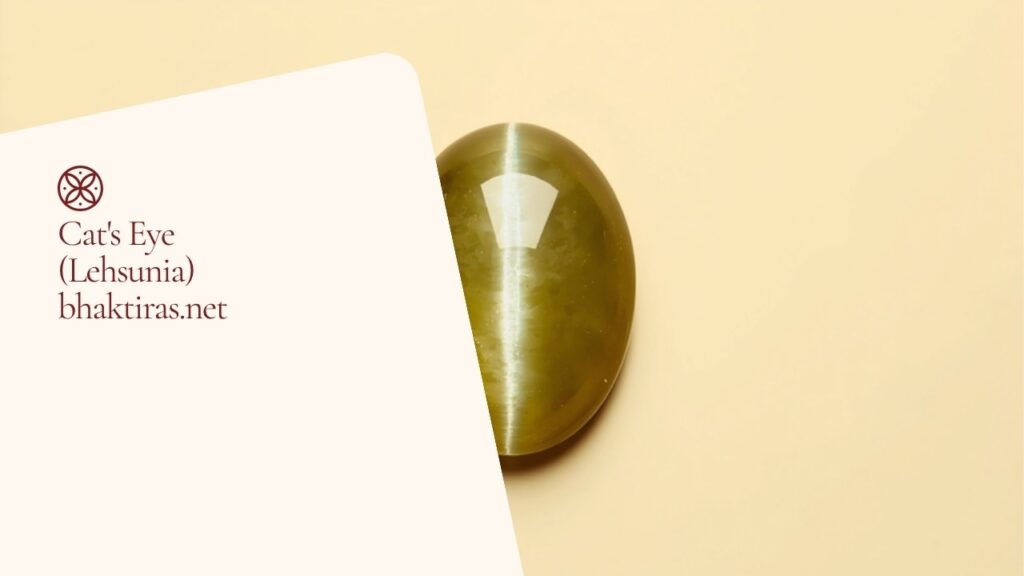
Cat's Eye (Lehsunia)
Ketu's stone: worn not by moon sign but by the shadow planet's grip on your chart, for the sharp-eyed and the steady-nerved.
- Ketu
- Tuesday
- Middle finger
- 3-6 ratti
| Ruling planet | Ketu (south lunar node) |
|---|---|
| Rashi (zodiac) | Worn on Ketu indications in the chart, not by rashi |
| Day to wear | Tuesday (some traditions prefer Thursday) |
| Finger | Middle finger of the working hand |
| Metal | Silver or panchdhatu |
| Weight | 3-6 ratti |
| Mantra | Om Kem Ketave Namah |
| Hardness | 8.5 on the Mohs scale |
| Colour | Greenish-grey to honey with a sharp moving band of light (chatoyance) |
Who Should Wear Cat's Eye?
Cat’s eye is the one navratna that ignores your moon sign entirely. Where a ruby or pearl gets matched to your rashi, lehsunia is matched to Ketu’s actual position, strength and current dasha in your birth chart, so two people born under the same moon sign can get opposite advice on this stone.
It is most often recommended when a person is running Ketu mahadasha or antardasha and the planet is weak, debilitated or afflicted by malefics, or when the chart shows Ketu behind recurring sudden accidents, unexplained fears, restlessness, skin or nerve complaints, or a pull toward renunciation and spiritual practice that the person cannot quite explain. Some astrologers also prescribe it where Ketu sits favourably but needs support to deliver its better side, intuition, detachment and moksha-oriented growth.
Because Ketu’s placement and dasha timing are the whole basis for this stone, guessing is not advisable, and a qualified astrologer should confirm both before you buy. If you want to check where Ketu sits in your own chart and whether its dasha is currently active, that is worth calculating first.
Does Cat's Eye suit your kundali? The answer is in your birth chart, not your sun sign. Check free in under a minute.
Check My GemstoneBenefits of Wearing Cat's Eye
Ketu governs the areas classical astrology treats as hidden or sudden, so cat’s eye’s reported benefits sit in that territory rather than in everyday material gain.
- Protection from sudden loss: classical texts credit cat’s eye with cushioning the abrupt accidents, falls and unexpected setbacks associated with a troubled Ketu.
- Sharper intuition: wearers report clearer gut instinct and quicker decision-making, particularly in situations where facts alone are not enough.
- Relief from mysterious ailments: the stone is traditionally linked to easing chronic complaints that resist diagnosis, especially nerve and skin related issues.
- Shielding from hidden hostility: older texts associate it with reducing the effect of secret enemies, black magic and similar unseen threats.
- Support for spiritual detachment: Ketu rules moksha and renunciation, and cat’s eye is worn to steady the restlessness that a strong Ketu period can bring, easing the pull toward introspection rather than fighting it.
How to Wear Cat's Eye (Lehsunia)
Lehsunia’s chatoyant band is at its sharpest under direct light, and traditional practice asks you to bring that same directness to how the stone is prepared and worn.
- Day: start wearing it on a Tuesday, though some traditions prefer Thursday instead.
- Metal and finger: set it in silver or panchdhatu and wear it on the middle finger.
- Weight: 3 to 6 ratti, chosen with your astrologer based on your build and chart.
- Purification: soak the set stone briefly in raw milk, then rinse it clean with Gangajal before the first wear.
- Activation: chant Om Kem Ketave Namah 108 times while holding the ring, ideally at dawn on the chosen day.
- Replacement: once the eye’s band loses its sharpness, the stone develops a crack, or it feels persistently uncomfortable to wear, it has served its purpose and should be replaced.
Who Should Not Wear Cat's Eye
Ketu does not get along with the Sun and the Moon in classical planetary friendships, so cat’s eye is usually kept away from ruby and pearl unless an astrologer has specifically checked the combination for your chart.
Ascendants where Ketu functions as a malefic for that particular lagna are generally advised against wearing it, and the same caution applies to anyone whose Ketu is already well placed and strong, since boosting an already strong Ketu can tip its effects toward excess detachment or isolation rather than balance. This stone is not a general-purpose good luck charm to try out of curiosity.
The traditional trial custom exists for exactly this reason: wear it for three to seven days first and watch for disturbed sleep, unusual anxiety or physical discomfort. If any of these appear, remove the stone and consult your astrologer before continuing rather than pushing through.
Cat's Eye Price in India
A sharp, straight eye is what separates a Rs 2,000 stone from one priced well past Rs 50,000 a ratti, since that single moving band of light is the entire point of chrysoberyl cat’s eye.
Within that range, price moves with how tight and centred the band is, how clean the stone is under a loupe, and whether the honey to greenish-grey colour is even across the surface. A larger stone with a dull, off-centre band is worth less than a smaller one with a crisp, well-defined eye, so size alone should never set the price in your mind.
Buy only against a certificate from a reputed gem testing lab that confirms the stone is natural chrysoberyl, and treat any price far below the going range as a signal to check the stone more carefully rather than a bargain.
How to Identify a Real Cat's Eye
The chatoyant band that gives cat’s eye its name comes from parallel, silk-like inclusions inside the stone, and that same feature is what a loupe should be used to check first.
- Loupe inclusion check: look for fine, parallel needle-like inclusions running beneath the surface, these are what cause the moving band and are hard to fake convincingly.
- Hardness test: genuine chrysoberyl cat’s eye rates 8.5 on the Mohs scale and will scratch quartz, a simple comparison that separates it from quartz cat’s eye.
- Density check: chrysoberyl feels noticeably heavier than quartz of the same size when weighed, since its specific gravity is meaningfully higher.
- Band sharpness: the genuine stone shows one crisp, well-defined line of light that moves cleanly as the stone is turned, glass and quartz versions tend to show a duller, wider or less mobile band.
- Common substitutes to watch for: quartz cat’s eye and fibre-optic glass are both sold at a fraction of the price and are easy to mistake for the real stone without testing.
None of these checks replace a proper lab report, so before you commit to a stone at any real price, get it certified by a recognised gem testing laboratory.
FAQs About Cat's Eye
Who should wear Cat's Eye (Lehsunia)?
Cat's eye is prescribed for Ketu, not for a rashi. People running a weak, afflicted or unclear Ketu mahadasha or antardasha, or facing sudden accidents, phobias, chronic undiagnosed illness or spiritual restlessness linked to Ketu, are typical candidates. Always confirm Ketu's actual placement and strength with an astrologer before wearing it.
Kya Lehsunia pehenne se fayda hota hai, aur kitne din mein asar dikhta hai?
Classical texts credit cat's eye with steadying Ketu's unpredictable influence, sharpening intuition and reducing sudden setbacks. Most astrologers ask you to trial it for a few weeks before committing, since Ketu's effects vary by chart; some report a shift within a month, others take longer. It supports, not replaces, remedial measures.
Which finger, metal and day for wearing Cat's Eye?
Cat's eye is worn on the middle finger, set in silver or panchdhatu, on a Tuesday, though some traditions prefer Thursday. It should be purified in raw milk and Gangajal, then energised by chanting Om Kem Ketave Namah 108 times before the first wearing.
Cat's eye ka weight kitna hona chahiye, kitne ratti?
The standard weight range for cat's eye is 3 to 6 ratti, chosen according to the wearer's build and the astrologer's reading of the chart. A heavier stone is not automatically better; a clean, well-cut stone with a sharp central eye in the right weight range matters more than size alone.
Cat's eye ke saath kaunsa stone nahi pehenna chahiye?
Ketu's traditional enemies are the Sun and the Moon, so cat's eye is usually not combined with ruby or pearl without an astrologer's clearance. Ascendants where Ketu sits as a functional malefic should also avoid it. A short trial period is recommended before committing to it permanently.
Cat's eye stone price kya hai?
Genuine chrysoberyl cat's eye ranges from about Rs 2,000 to Rs 50,000 or more per ratti, with the sharpest, straightest eye commanding the highest prices. Colour, clarity and the tightness of the light band all affect cost, so always buy against a lab certificate rather than price alone.
Cat's eye ka substitute kya hai, kya tiger eye chalega?
Tiger eye is the accepted budget substitute for cat's eye when the genuine chrysoberyl stone is out of reach. Quartz cat's eye, though visually similar and cheap, is not considered a valid substitute in traditional practice, so it should not be worn expecting Ketu's remedial effect.