
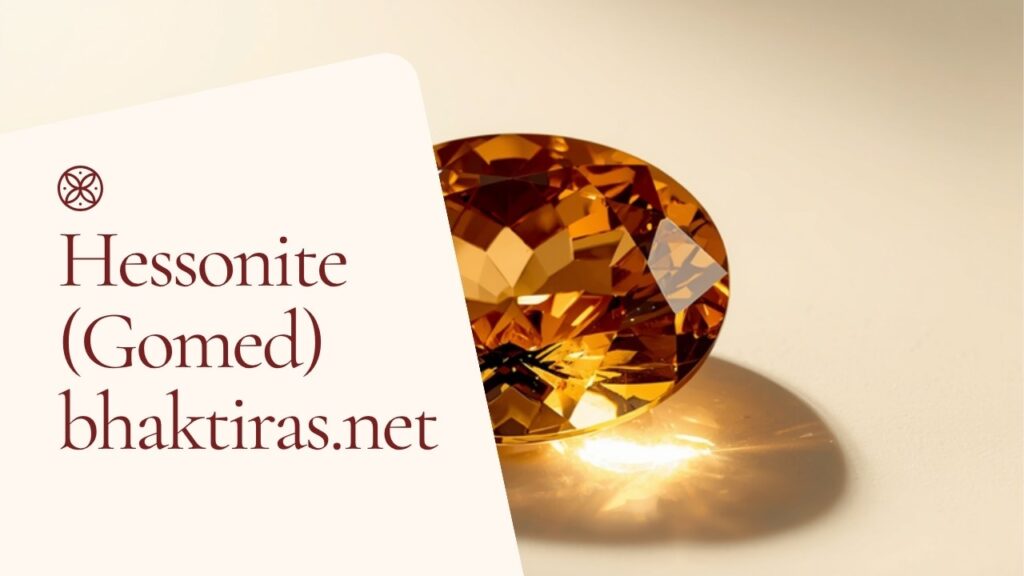
Hessonite (Gomed)
Gomed, the honey-brown stone for Rahu – for sudden gains, foreign success and breaking through invisible blocks, worn with care.
- Rahu
- Saturday
- Middle finger
- 5-8 ratti
| Ruling planet | Rahu (north lunar node) |
|---|---|
| Rashi (zodiac) | Worn on Rahu indications in the chart, not by rashi |
| Day to wear | Saturday |
| Finger | Middle finger of the working hand |
| Metal | Silver or panchdhatu |
| Weight | 5-8 ratti |
| Mantra | Om Ram Rahave Namah |
| Hardness | 6.5-7.5 on the Mohs scale |
| Colour | Honey brown to deep cinnamon (a fine gomed glows like cow urine held to light, per the classical test) |
Who Should Wear Hessonite?
Gomed does not follow the rashi (moon sign) rule that governs most navratnas – it is prescribed on Rahu’s placement and condition in the birth chart, not on which sign you were born under. An astrologer typically recommends it when Rahu sits poorly placed, conjunct or aspected by malefics, or when the person is running Rahu mahadasha or antardasha and facing confusion, sudden setbacks, addiction patterns, or unexplained anxiety that classical texts trace to an unsettled Rahu.
Because Rahu’s effect depends entirely on its house, sign and the planets it touches, this is not a stone to pick up because a friend wore one and felt good. A proper reading of your birth chart tells you whether Rahu needs strengthening or pacifying in your case, and for how long.
Does Hessonite suit your kundali? The answer is in your birth chart, not your sun sign. Check free in under a minute.
Check My GemstoneBenefits of Wearing Hessonite
Rahu governs the unconventional side of life, foreign lands, sudden windfalls, technology and ambition that does not follow a straight line, so gomed’s reported benefits sit in that territory.
- Clarity during Rahu mahadasha – wearers report fewer episodes of the confusion and restlessness classical texts associate with an unsettled Rahu period.
- Foreign opportunities – astrologers who prescribe gomed often link it to smoother visa processes, overseas postings and cross-border business, Rahu’s traditional domain.
- Protection from hidden threats – classical texts credit gomed with guarding against black magic, the evil eye and unseen rivals, Rahu being the planet of things not immediately visible.
- Steadier decision-making – some wearers report less impulsiveness in speculation, trading and high-risk ventures, areas an unchecked Rahu tends to push too far.
- Relief from unexplained fear – the stone is traditionally worn to calm the sudden anxiety and disturbed sleep Vedic texts attribute to Rahu’s shadow influence.
How to Wear Hessonite (Gomed)
Gomed is put on for the first time on a Saturday, Rahu’s own day, ideally in the evening or during a window your astrologer specifies.
- Metal and finger: set in silver or panchdhatu and worn on the middle finger of the working hand.
- Weight: 5 to 8 ratti is the standard range for a first-time gomed.
- Purification: soak the stone in raw milk and Gangajal for a few hours the night before, then rinse in clean water before setting it.
- Mantra: chant “Om Ram Rahave Namah” 108 times with a mala while putting the ring on for the first time.
- Replacement: a hessonite that develops a crack, turns cloudy or loses its honey glow should be replaced, and most wearers change the stone once the Rahu period it was prescribed for has passed.
Who Should Not Wear Hessonite
Gomed is not a gentle stone to experiment with, and honest jewellers will say so before selling one. Traditional practice treats Sun, Moon and Mars as opposed to Rahu, so wearing gomed alongside ruby (Sun), pearl (Moon) or red coral (Mars) is generally avoided unless an astrologer has specifically balanced the combination for your chart.
People with a strong, well-placed Rahu, or those already running a difficult Ketu period, are usually told to skip it. As with any navagraha stone, the trial custom applies here too – wear it for three to seven days first and watch for restlessness, skin irritation, disturbed sleep or a run of bad luck before committing to it permanently. If any of that shows up, take it off and consult your astrologer rather than pushing through.
Hessonite Price in India
Gomed is one of the more forgiving navratnas on the wallet, which is exactly why buyers get careless with it. Ceylon (Sri Lankan) hessonite runs Rs 500 to Rs 5,000 per ratti, while African material sells for less across the board.
Within that range, colour consistency does most of the work – an even honey to cinnamon tone without black flecks or cloudy patches sits at the top of the price band, while stones with visible spotting or a muddy tint sell for less regardless of origin. Because the stone is affordable to begin with, there is little excuse to skip a lab certificate confirming it is natural, untreated hessonite garnet rather than a dyed or synthetic substitute – ask for one before you pay, not after.
How to Identify a Real Hessonite
- Loupe check: genuine hessonite often shows soft, swirling “treacle” or heat-wave-like inclusions under 10x magnification, a natural marker that is hard to fake convincingly.
- Hardness test: at 6.5 to 7.5 on the Mohs scale, a real gomed will scratch glass and resist a steel blade; if a knife marks it easily, be suspicious.
- Colour behaviour: classical texts describe a fine gomed glowing like cow urine held to light – an even honey to cinnamon transparency, not a flat, uniform orange-brown that looks painted on.
- Common substitutes to watch for: dyed quartz, glass imitations and synthetic garnet are regularly sold as gomed, especially at the cheaper end of the market where the price difference is hard to spot by eye.
- Weight check: a genuine stone feels noticeably heavier than glass of the same size when held loose in the palm, though this is a rough indicator, not a substitute for proper testing.
None of these home tests replace a certificate from a recognised gem testing lab, which is the only reliable way to confirm a hessonite is natural and untreated before you commit to wearing it.
FAQs About Hessonite
Who should wear Gomed stone?
Gomed suits people whose birth chart shows a weak, afflicted or poorly placed Rahu, or who are going through Rahu mahadasha or antardasha with symptoms like confusion, sudden setbacks or unexplained anxiety. Unlike most navratnas it is not assigned by moon sign, so get your chart checked by an astrologer before wearing one.
How does Gomed stone actually work?
Gomed is believed to strengthen or calm Rahu's influence in your chart, the planet linked to ambition, foreign connections and sudden change. Classical texts credit it with steadier decisions, fewer setbacks during Rahu periods and protection from hidden threats, though results vary by chart and are never guaranteed.
Which finger and metal for Gomed, and which day to wear it?
Wear Gomed on the middle finger, set in silver or panchdhatu, not gold. The stone is first put on a Saturday, Rahu's own day, after purifying it in raw milk and Gangajal and chanting Om Ram Rahave Namah 108 times.
Gomed stone kitne ratti ka pehnna chahiye?
A first-time Gomed is usually worn between 5 and 8 ratti, chosen by your astrologer based on Rahu's strength in your chart. Heavier stones are not automatically better, the correct weight depends on the horoscope, not personal preference or budget alone.
Which stones should not be worn with Gomed?
Avoid combining Gomed with pearl (Moon), ruby (Sun) or red coral (Mars) unless an astrologer has specifically balanced the pairing for your chart, since these planets are traditionally considered opposed to Rahu. Wearing enemy-planet stones together can work against each other rather than help.
Gomed stone ki price kitni hoti hai?
Genuine Ceylon Gomed typically costs Rs 500 to Rs 5,000 per ratti, with African material priced lower. Cost depends mainly on colour evenness, an honey to cinnamon tone without black spots, and clarity. Always ask for a lab certificate, since the low price makes this stone a common target for fakes.
Is there a substitute for Gomed stone?
Gomed has no widely recognised substitute in navratna tradition since it represents Rahu specifically and no other gem stands in for it. If Gomed does not suit you after a trial period, astrologers usually suggest a Rahu yantra or mantra remedy instead of switching to another stone.