
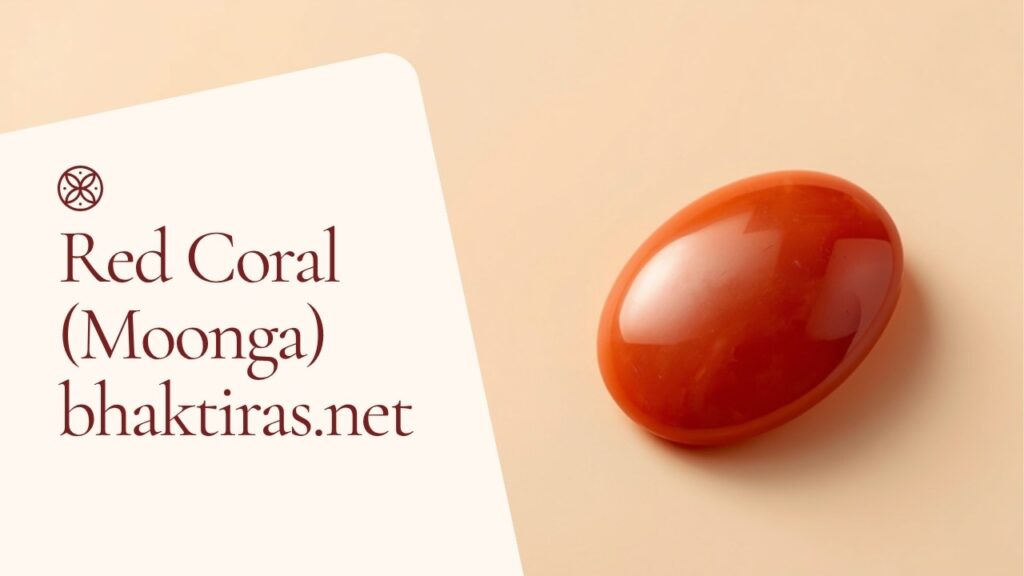
Red Coral (Moonga)
Mars's own stone: a fiery orange-red coral worn for courage, land gains and physical strength, best suited to Aries and Scorpio charts.
- Mars
- Tuesday
- Ring finger
- 5-8 ratti
| Ruling planet | Mars (Mangal) |
|---|---|
| Rashi (zodiac) | Aries (Mesha) and Scorpio (Vrishchik) |
| Day to wear | Tuesday |
| Finger | Ring finger of the working hand |
| Metal | Gold or copper |
| Weight | 5-8 ratti |
| Mantra | Om Ang Angarakaya Namah |
| Hardness | 3.5-4 on the Mohs scale |
| Colour | Vermilion red to deep orange-red |
Who Should Wear Red Coral?
Mars owns Aries (Mesha) and Scorpio (Vrishchik) as its home signs, so ascendants born under these two rashis are the most natural candidates for red coral, especially if Mars sits weak, debilitated or afflicted by malefics in the birth chart. It is also the classic stone recommended during Mars mahadasha or antardasha, when a person needs extra courage, decisiveness or physical stamina to get through that period cleanly.
Coral is not a stone to pick because a friend wore it and felt more confident. Mars behaves differently across the twelve ascendants: it can be a powerful yogakaraka for some and a source of accidents, anger or blood pressure trouble for others if pushed further with a stone. A qualified astrologer should check Mars’s placement, strength and relationship with your ascendant lord before you commit to wearing it. Once you know where Mars actually stands in your own chart, the next step is working out its exact strength and timing.
Does Red Coral suit your kundali? The answer is in your birth chart, not your sun sign. Check free in under a minute.
Check My GemstoneBenefits of Wearing Red Coral
Mars governs blood, muscle, land and raw willpower in Vedic astrology, and red coral’s traditional benefits track those domains closely rather than promising vague good luck.
- Courage and decisiveness: classical texts credit a well-placed coral with sharpening resolve, useful for anyone in the armed forces, sports, surgery or any field that rewards quick, bold action.
- Property and land dealings: Mars is the karaka for real estate, and wearers report smoother outcomes in land disputes, construction projects and property purchases.
- Physical vitality: coral is linked to blood health and stamina, and is traditionally worn to support recovery from low physical energy or anaemia-type weakness.
- Sibling relationships: Mars rules younger siblings, and the stone is said to ease strained relationships with brothers and sisters.
- Leadership and competitive drive: wearers report an edge in careers built on competition, negotiation or command, from business to athletics.
How to Wear Red Coral (Moonga)
Tuesday, Mars’s own day, is when red coral should first go on, ideally in Shukla Paksha during the early morning hours after sunrise. The stone is set in gold or copper, both metals that carry Mars’s heat well without clashing with it, and worn on the ring finger of the right hand.
- Weight: 5 to 8 ratti is the standard range for a visible astrological effect; smaller pieces are mostly decorative.
- Purification: soak the coral in raw milk for a few minutes, then rinse it in Gangajal before the first wear.
- Mantra: chant Om Ang Angarakaya Namah 108 times while holding the ring, ideally with a red or coral-coloured mala.
- Ongoing care: coral is soft and porous, so keep it away from perfume, soap and chemical cleaners, and remove it before swimming or heavy manual work.
- Replacement: once the surface turns dull, develops a whitish film, or cracks, the stone has done its work and should be replaced rather than repaired.
Who Should Not Wear Red Coral
Mercury is Mars’s enemy in classical astrology, so anyone leaning on Mercury for career or wellbeing, particularly Gemini and Virgo ascendants or people running a strong Mercury dasha, should be cautious about adding coral on top of it. Mars can also act as a functional malefic for several other ascendants depending on which houses it owns in that chart, so this is genuinely not a stone to self-prescribe from a generic list.
The traditional trial custom exists for exactly this reason: wear a borrowed or inexpensive coral piece for three to seven days and watch for restlessness, unusual anger, headaches, skin irritation where the stone touches, or disturbed sleep. If any of that shows up, stop and consult an astrologer before buying a proper piece. People with high blood pressure, active skin inflammation near the ring finger, or a chart where Mars sits in the sixth, eighth or twelfth house from the ascendant should get a chart reading first rather than wear coral on a hunch.
Red Coral Price in India
Genuine Italian, or Mediterranean, red coral runs from about Rs 1,500 to Rs 15,000 or more per ratti, with Japanese coral priced in a similar band. The gap within that range comes down to colour depth, an even vermilion to deep orange-red tone without patchiness, and how well the piece is cut and polished; a uniformly saturated, unblemished piece at the top of a size range costs noticeably more than a pale or mottled one at the same weight.
Dyed or reconstituted coral is sold cheaply, sometimes passed off as premium Italian coral at a fraction of the honest price, and it carries no astrological value at all since it is not the natural, untreated material the tradition calls for. Buy only from a dealer who provides a gem testing lab certificate confirming natural, untreated coral, and be wary of any online listing offering large, deeply coloured pieces at bargain prices.
How to Identify a Real Red Coral
- Loupe check: natural red coral shows fine, irregular growth lines and a slightly granular, striped structure under 10x magnification; a perfectly uniform, glassy surface is a warning sign.
- Hardness test: coral sits at 3.5 to 4 on the Mohs scale, soft enough that a steel pin leaves a faint mark; genuine glass or plastic imitations are noticeably harder and will not scratch.
- Acetone swab: gently rub a cotton swab dipped in nail polish remover on an inconspicuous spot; dyed coral often bleeds colour onto the swab, while natural coral does not.
- Weight and feel: natural coral feels cool and slightly heavier than plastic imitations of the same size, and lacks the perfectly smooth, uniform texture of moulded fakes.
- Common fakes to watch for: dyed bamboo coral, red-dyed limestone or aragonite, glass, and reconstituted coral made from powdered fragments pressed and dyed to look solid.
None of these home checks replace a proper gem testing lab report, so always ask for a certificate from a recognised Indian gem lab before paying for a piece above a few thousand rupees.
FAQs About Red Coral
Who should wear Red Coral (Moonga)?
Aries and Scorpio ascendants, and anyone running a Mars mahadasha or antardasha with a weak or afflicted Mars, are the usual candidates. It is not a stone to wear casually; get your birth chart checked by an astrologer to confirm Mars actually needs strengthening before you buy one.
How does Moonga work and when will I see results?
Coral is believed to channel Mars's energy through the wearer, sharpening courage, decisiveness and physical stamina once the stone is purified and activated with mantra. Effects are gradual, often noticed over weeks to a few months, and vary with how strong or weak Mars already is in your chart.
Which finger, metal and day are correct for Red Coral?
Wear red coral set in gold or copper on the ring finger of the right hand. The correct day to first wear it is Tuesday, Mars's own day, ideally in the early morning after purifying the stone in raw milk and Gangajal and chanting the Mars mantra 108 times.
What weight of coral in ratti should I buy?
5 to 8 ratti is the standard weight range used for a genuine astrological effect. Anything much smaller tends to be decorative rather than functional, while very large stones should only be worn on an astrologer's specific advice based on your chart's strength.
Which stones or planets clash with Moonga?
Mercury is Mars's classical enemy, so coral is generally avoided alongside strong Mercury stones like emerald, and by ascendants who depend heavily on Mercury, such as Gemini and Virgo. Always get your chart reviewed, since Mars can be a functional malefic for several ascendants regardless of enemy-planet rules.
How much does genuine Red Coral cost?
Natural Italian or Japanese red coral costs roughly Rs 1,500 to Rs 15,000 or more per ratti, depending on colour depth and finish. Cheap dyed or reconstituted coral is common in the market and has no astrological value, so always insist on a gem testing lab certificate before buying.
Is there a substitute for Moonga if I cannot afford it?
There is no widely accepted low-cost substitute for red coral in classical practice, unlike some other navratnas. If budget is the concern, a smaller genuine stone within the 5 to 8 ratti range is preferable to a larger dyed or reconstituted piece; ask an astrologer about timing instead.