
Harihara
हरिहर
Harihara is a single deity who joins Vishnu (Hari) and Shiva (Hara) into one body, split down the middle so that one half carries Vishnu's emblems and the other Shiva's. He expresses the idea that these two great gods, and the paths devoted to them, point to the same Supreme reality.
Who Is Harihara?
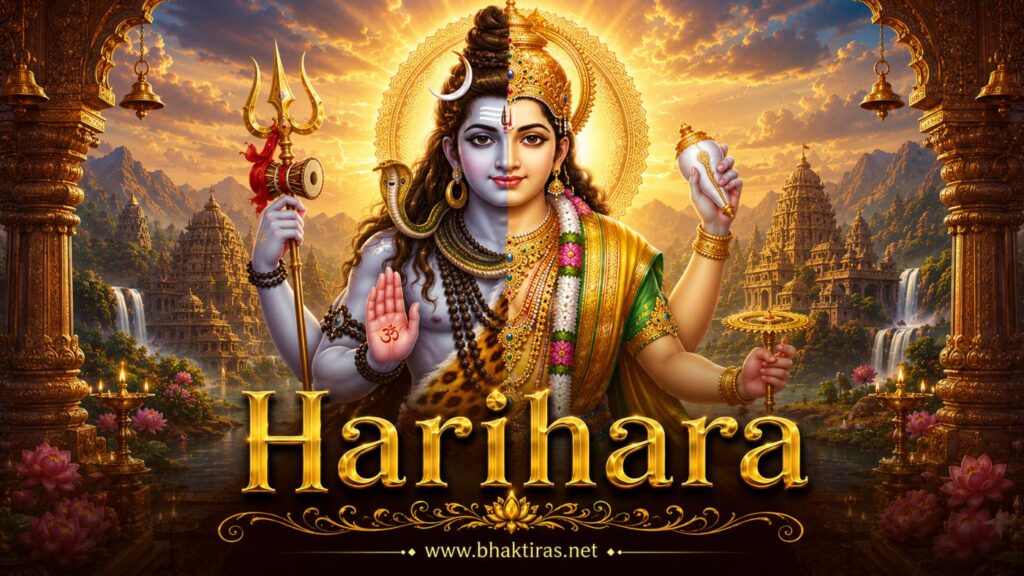
Harihara is one god shown as two gods sharing a single body. Split cleanly down a vertical line, the right side is Vishnu, whom devotees call Hari, and the left side is Shiva, whom they call Hara. Put the two names together and you get Harihara, a form that says the god of the Vaishnavas and the god of the Shaivas are not rivals but two faces of one truth.
The image grew out of a very old debate in Hindu life. Some communities held Vishnu as the highest, others held Shiva, and the argument could turn sharp. Harihara answered it in a way words could not. By fusing both gods into one figure, sculptors and poets made a quiet point: the Supreme is beyond any single name, and the quarrel over which god ranks first misses that larger point.
He is also called Shankaranarayana, a name that stitches together Shankara (a title of Shiva) and Narayana (a title of Vishnu). Under either name, the meaning holds steady – the divine is one, even when we approach it through different traditions.
The Two Halves – Iconography
Reading a Harihara image is a matter of looking left and right. Each half keeps its own gods emblems, and the join at the centre is the whole point.
Vishnu Half (Hari)
The right side belongs to Vishnu. This half wears a tall crown, the kirita mukuta, and holds the spinning discus (chakra) and the conch (shankha). The skin is often shown in a deep blue or dark tone, and the ornaments are those of a royal preserver – smooth, regal, calm. Everything here signals order, protection and the god who steadies the world.
Shiva Half (Hara)
The left side belongs to Shiva. Matted locks (jata) pile up in place of a crown, a crescent moon rests in the hair, and the hand grips a trident (trishula). A tiger skin, a coil of serpent and a smear of ash mark this half. Where the Vishnu side is polished and courtly, the Shiva side is that of the ascetic on the mountain, master of time and dissolution.
One Body, One Truth
The two halves meet along a single spine, sharing one chest, one gaze, one stance. Nothing about the figure looks stitched or awkward – it reads as a whole being who simply happens to carry two sets of signs. That seamless centre is the message: preserver and destroyer, discus and trident, are held together in one undivided source.
The Meaning of the Union
Harihara is a piece of theology carved in stone. For centuries the followers of Vishnu and the followers of Shiva ran separate temples, separate mantras and separate claims about which god sat at the top. Harihara sets that competition aside. If both gods live in one body, then choosing between them is like arguing over which half of a face is the real one.
At a deeper level the form points to a single Supreme that takes many shapes. The preserving warmth of Vishnu and the transforming fire of Shiva are two movements of the same reality – the world is kept, and the world is remade, and one power does both. Philosophers who leaned toward non-dual thought found Harihara a natural symbol for their view that all names of god finally dissolve into one. For an ordinary worshipper, the takeaway is gentler and just as clear: worship offered to either god reaches the same divine heart.
Worship, Temples and Mantra
The town of Harihar in Karnataka takes its very name from this deity, and its Harihareshwara temple, with roots in the Hoysala period, is the best known centre of the cult. The Tungabhadra river runs close by, and the shrine has drawn pilgrims from both Vaishnava and Shaiva backgrounds who see their own god in the shared image. Across South India other temples carry Harihara or Shankaranarayana shrines, and the form appears again and again in Chalukya and Hoysala sculpture.
The reach went far beyond India. In the Khmer empire, Harihara was among the earliest state gods, and some of the finest early sculptures of the form survive from Cambodia, where kings used the fused deity to bind their people under a single divine banner. Worship today follows familiar rhythms – Ekadashi days tied to Vishnu and Mondays tied to Shiva both suit him. Devotees offer tulsi and bilva together, since one leaf is dear to Hari and the other to Hara, and chant his composite name to honour both gods at once.
Stories and Legends
The quarrel that ended in one form
A well loved tradition tells of devotees who fell into bitter dispute over whether Vishnu or Shiva was the greater god. Each camp praised its own lord and belittled the other, and the argument threatened to split the community. To settle it, the divine appeared as a single body – Vishnu on the right, Shiva on the left – so that neither side could claim victory over the other. Faced with one god wearing both sets of emblems, the quarrellers understood that they had been fighting over two names for the same reality, and the dispute quietly fell away.
Guha and the demon of Harihar
Local lore around Harihar town speaks of a demon named Guha who had won a boon that made him almost impossible to kill – no god acting alone could end him. Vishnu could not defeat him, nor could Shiva, because the boon protected the demon from each of them separately. So the two gods joined into a single form, Harihara, combining the strengths of both, and in that united shape they overcame the demon that neither could face apart. The town is said to remember the victory in its very name.
Frequently Asked Questions
Who is Harihara?
Harihara is a composite Hindu deity who combines Vishnu (Hari) and Shiva (Hara) in a single body, with the right half showing Vishnu's emblems and the left half showing Shiva's. He symbolises the unity of the two gods and the traditions built around them.
What is the difference between Harihara and Ardhanarishvara?
Both are half-and-half deities, but they join different pairs. Harihara fuses two male gods, Vishnu and Shiva, to show the oneness of those two traditions. Ardhanarishvara fuses Shiva with his consort Parvati to show the union of the masculine and the feminine. They should not be confused with each other.
Why is Harihara also called Shankaranarayana?
Shankaranarayana blends Shankara, a name of Shiva, with Narayana, a name of Vishnu. It is simply another title for the same fused deity and carries the identical message – that Shiva and Vishnu are one at the highest level.
How do you tell which half is Vishnu and which is Shiva?
The right half is Vishnu: a tall crown, the discus and the conch. The left half is Shiva: matted hair with a crescent moon, a trident, a tiger skin and ash. The vertical line down the centre marks where the two gods meet.
Where is Harihara worshipped?
The main centre is the Harihareshwara temple in Harihar, Karnataka, and the form appears widely across South Indian temple sculpture. Historically Harihara was also a major deity in the Khmer empire, and some of the earliest fine images of the form come from Cambodia.
Harihara reminds worshippers that behind different names, the divine is one.