
Tarnetar Mela 2026 – Gujarat's Fair of Umbrellas and Swayamvar
તરણેતરનો મેળો
When is Tarnetar Mela in 2026?
Tarnetar Mela 2026 runs from Monday 14 September to Wednesday 16 September, held over the three days of Bhadarva Sud (Bhadrapada Shukla) Chaturthi to Shashti. It is a three-day folk fair at the Trinetreshwar Mahadev temple near Thangadh in Surendranagar district, Saurashtra, Gujarat, famous for its match-making tradition and embroidered courtship umbrellas.
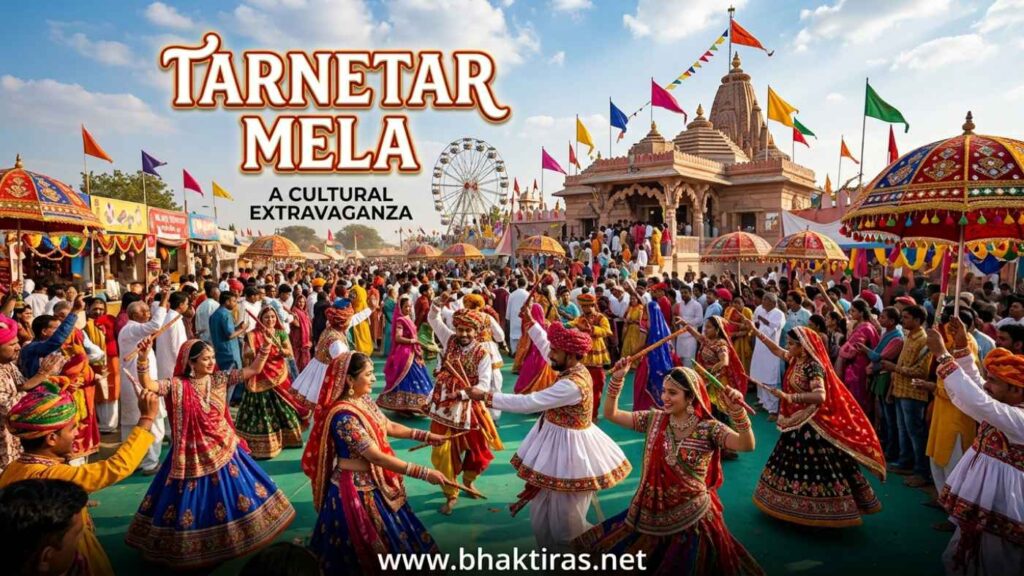
Tarnetar Mela is a three-day folk fair held every Bhadarva (September) at the Trinetreshwar Mahadev temple, about 8 km from Thangadh in Surendranagar district of Saurashtra, Gujarat. Pilgrims come to bathe in the temple kund and worship Shiva as Trinetreshwar, the three-eyed lord, but the fair is best known as a living marriage market where young men and women of the Koli, Bharwad, Rabari and Kathi communities meet future partners. Hand-embroidered umbrellas, Hudo dancing and rural sports fill the grounds.
Tarnetar Mela 2026-2028: Dates & Calendar
The next Tarnetar Mela falls on 14-16 September 2026. Because it follows the Hindu lunar calendar (Bhadarva Sud 4 to 6, beginning on Ganesh Chaturthi), the Gregorian dates shift by around ten days each year.
| Year | Dates | Days | Tithi |
|---|---|---|---|
| 2026 | 14-16 September | Mon-Wed | Bhadarva Sud 4-6 (next) |
| 2027 | 4-6 September | Sat-Mon | Bhadarva Sud 4-6 |
| 2028 | 23-25 August | Wed-Fri | Bhadarva Sud 4-6 |
The opening day always coincides with Ganesh Chaturthi. The main crowds gather on the middle and closing days, when the umbrella procession, folk dance and match-making reach their peak.
Why Tarnetar Mela Is Celebrated
Tarnetar Mela is celebrated to honour Shiva at the Trinetreshwar Mahadev temple and to continue an old Saurashtra custom in which unmarried men and women of the pastoral and tribal communities meet to choose life partners.
The three-eyed lord
The temple enshrines Shiva as Trinetreshwar, meaning the three-eyed one – the name Tarnetar is a local contraction of Trinetra. Devotees offer worship here first, and the fair grows around this act of darshan during the sacred Bhadarva days.
The Draupadi swayamvar
Local tradition links the site to the Mahabharata swayamvar where Arjuna won Draupadi by the Matsyavedh – piercing the eye of a revolving fish while aiming only at its reflection in the water below. The fair is seen as a folk echo of that contest of choosing a spouse.
A holy kund
The temple has a kund, or step-tank, that villagers believe was once touched by the Ganga. A dip here during the fair is treated as being as purifying as bathing in the Ganga itself, so pilgrims bathe before darshan.
A living marriage fair
For generations the mela has worked as a swayamvar of the common people. Families bring eligible sons and daughters, elders make introductions, and matches settled at the fair are often confirmed with marriages later in the year.
Deities & Figures Worshipped
The presiding deity is Shiva in his Trinetreshwar form, worshipped at the Tarnetar temple. The Mahabharata heroes Arjuna and Draupadi are honoured in the fair’s founding legend.
Shiva (Trinetreshwar)
Shiva is worshipped here as Trinetreshwar Mahadev, the three-eyed great god whose third eye represents inner vision and the power to burn away illusion. The Shivalinga in the temple is the focus of prayer and abhishek through the three fair days.
Arjuna & Draupadi
The Pandava prince Arjuna and princess Draupadi are remembered as the archetypal couple of the site. Their swayamvar story, in which merit and skill win a marriage, gives the fair its identity as a meeting ground for prospective couples.
What Happens at Tarnetar Mela, Step by Step
The fair blends temple worship with folk dance, courtship and rural sport across three days.
- Darshan and holy dip. Visitors first take a bath in the temple kund, believed to carry the grace of the Ganga, then enter the Trinetreshwar Mahadev temple to offer prayers to Shiva.
- The umbrella procession. Eligible young men carry the famous Tarnetar chhatris – tall umbrellas covered in mirror-work, beadwork and embroidery they may spend a year making. A raised, decorated umbrella is a quiet signal that a bachelor is seeking a bride.
- Match-making and introductions. Families and elders move through the crowds arranging meetings between unmarried men and women, especially among the Koli, Bharwad, Rabari and Kathi communities. Rabari women in red skirts traditionally signal that they are unmarried.
- Ras-Garba and Hudo dance. Circles of dancers perform raas with wooden sticks and the vigorous Hudo, a clapping dance of the Bharwad shepherds, to the beat of the dhol and the shehnai.
- Rural sports and contests. The grounds host horse and camel displays, tug-of-war, wrestling and other village games that let young men show their strength and skill.
- Craft and food stalls. Rows of stalls sell embroidery, beadwork, silver jewellery, umbrellas and Kathiawadi fair food, turning the fairground into a marketplace of Saurashtra folk craft.
- Closing day. On Bhadarva Sud 6 the dancing and courtship peak before the crowds disperse, with many matches carried home to be finalised as weddings.
Special Foods of Tarnetar Mela
Fair food is hearty Kathiawadi and Gujarati fare, cooked at stalls and eaten on the go.
Ganthiya
Crisp, thick gram-flour ganthiya fried fresh at the stalls is the signature snack of any Saurashtra mela, usually eaten with fried green chillies and a squeeze of sev.
Jalebi
Coils of hot jalebi soaked in syrup are a fairground favourite, often paired with ganthiya for the classic Gujarati fafda-jalebi style breakfast.
Rotla & shaak
Thick millet rotla served with a spiced vegetable shaak, chaas and jaggery is the everyday village meal of the region, sold at food tents for hungry fairgoers.
Chaas & sweets
Cool, salted buttermilk (chaas) refreshes visitors in the late-monsoon heat, alongside boondi, penda and other milk sweets from the pastoral Rabari and Bharwad households.
Where It Is Celebrated
Tarnetar Mela is a single-site fair rooted in the Saurashtra countryside, drawing communities from across the region.
Tarnetar & Thangadh
The fair is held at the Trinetreshwar Mahadev temple at Tarnetar village, about 8 km from the ceramics town of Thangadh in Surendranagar district. Thangadh is the nearest base for food, transport and stay.
Surendranagar & Saurashtra
It sits in the Saurashtra peninsula of Gujarat, a dry pastoral belt whose folk dress, embroidery and cattle-herding culture shape the whole event.
The communities
Kolis, Bharwads, Rabaris, Kathis, Kanbis, Khants and Charans travel from surrounding villages, bringing their distinctive costume, jewellery and dance to what remains one of Gujarat’s most colourful tribal gatherings.
Tarnetar Mela Do's and Don'ts
A few simple courtesies help visitors enjoy the fair and respect the communities who make it.
Do
- Take a respectful dip in the kund and visit the temple before exploring the fairground.
- Ask permission before photographing people, their umbrellas or their costumes.
- Carry cash in small notes, sun protection and water for the September heat.
- Support local artisans by buying genuine Tarnetar embroidery and beadwork.
- Reach early on the middle or closing day to catch the umbrella procession and Hudo dance.
Avoid
- Do not treat the match-making as a spectacle or intrude on family discussions.
- Do not touch or handle the embroidered umbrellas without the owner’s consent.
- Do not litter the temple kund or fairground with plastic and food waste.
- Do not drive into the crowded fair core; park at the edge and walk in.
- Do not haggle disrespectfully over craft that took months of hand-work to make.
Frequently Asked Questions
When is Tarnetar Mela in 2026?
Tarnetar Mela 2026 is held from Monday 14 September to Wednesday 16 September. The three days match Bhadarva Sud (Bhadrapada Shukla) Chaturthi to Shashti, opening on Ganesh Chaturthi, at the Trinetreshwar Mahadev temple near Thangadh in Gujarat.
When is Tarnetar Mela in 2027 and 2028?
Tarnetar Mela falls on 4-6 September in 2027 and on 23-25 August in 2028. The dates move each year because the fair follows the Hindu lunar month of Bhadarva, always beginning on Sud 4 and running for three days.
Why is Tarnetar Mela celebrated?
Tarnetar Mela is celebrated to worship Shiva as Trinetreshwar and to continue an old Saurashtra tradition of match-making among tribal and pastoral communities. It is linked to the Mahabharata legend in which Arjuna won Draupadi in a swayamvar, so the fair is seen as a folk swayamvar for common people.
Which god is worshipped at Tarnetar Mela?
The god worshipped at Tarnetar Mela is Shiva in his Trinetreshwar form, the three-eyed lord, at the Trinetreshwar Mahadev temple. The name Tarnetar itself comes from Trinetra, meaning three eyes. Pilgrims first bathe in the temple kund and then offer prayers at the Shivalinga.
What are the Tarnetar umbrellas?
The Tarnetar umbrellas, or chhatris, are large hand-embroidered parasols decorated with mirror-work, beadwork and colourful patches. Young unmarried men craft them over many months and carry them raised at the fair as a courtship signal that they are looking for a bride.
Where is Tarnetar Mela held?
Tarnetar Mela is held at the Trinetreshwar Mahadev temple in Tarnetar village, about 8 km from Thangadh in Surendranagar district of Saurashtra, Gujarat. Thangadh and the wider Surendranagar area serve as the nearest towns for transport and stay.
What happens at the Tarnetar fair?
At the Tarnetar fair, pilgrims bathe in the temple kund and worship Shiva, bachelors display embroidered umbrellas, and communities perform Ras-Garba and the Hudo dance. There are rural sports, craft and food stalls, and above all informal match-making between unmarried men and women.
Which communities attend Tarnetar Mela?
Tarnetar Mela draws pastoral and tribal communities of Saurashtra, chiefly the Kolis, Bharwads, Rabaris, Kathis, Kanbis, Khants and Charans. They arrive in traditional dress and jewellery, and the fair is one of Gujarat’s largest gatherings of these folk cultures.
May the three-eyed lord of Tarnetar bless every seeker who comes to his fair. Jai Trinetreshwar Mahadev.