
Charak Puja 2027 – Bengal's Fierce Year-End Festival of Shiva
চড়ক পূজা
When is Charak Puja in 2027?
Charak Puja falls on Wednesday, 14 April 2027, on Chaitra Sankranti, the last day of the Bengali month of Chaitra and the day before Poila Boishakh. It marks the close of the month-long Gajan of Shiva, when devotees called charak sannyasis complete their austerities in honour of Shiva (worshipped here as Neel).
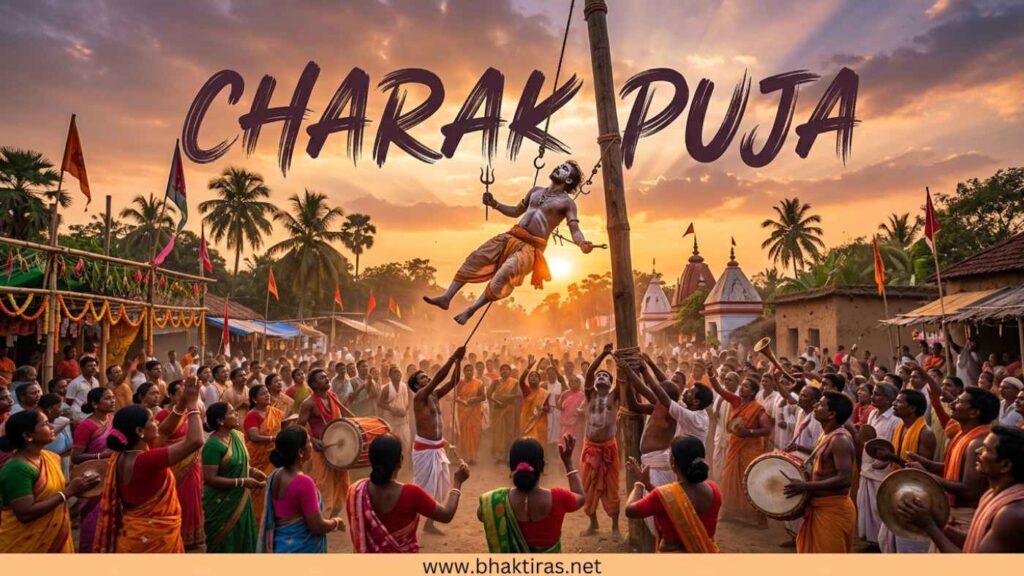
Charak Puja is a folk Shaiva festival of Bengal held on Chaitra Sankranti, the final day of the Bengali year, just before Poila Boishakh. It is the loud, physical climax of the month-long Gajan of Shiva, who is worshipped in this tradition as Neel (and as Dharmaraj in some districts). Devotees who have kept a vow of renunciation, the charak sannyasis, perform demanding austerities as offerings to the god, asking for a good harvest, health and protection from misfortune in the year to come. The festival is strongest in rural West Bengal, Bangladesh, Tripura and the Barak Valley of Assam.
Charak Puja 2026-2028: Dates & Calendar
The next Charak Puja falls on 14 April 2027. The date moves each year with the solar calendar because it is tied to Chaitra Sankranti, the moment the sun leaves the sign of Pisces and Chaitra ends.
| Year | Date | Day | Notes |
|---|---|---|---|
| 2026 | 14 April | Tuesday | Chaitra Sankranti; Poila Boishakh on 15 April |
| 2027 | 14 April | Wednesday | Next occurrence; Poila Boishakh on 15 April |
| 2028 | 13 April | Thursday | Chaitra Sankranti; Poila Boishakh on 14 April |
Neel Puja is observed on the evening before Charak Puja, so in 2027 many households keep the Neel fast on the night of 13 April. In Bangladesh the state fixes Poila Boishakh to 14 April, so local dates can differ slightly from West Bengal.
Why Charak Puja Is Celebrated
Charak Puja is celebrated to worship Shiva at the turn of the Bengali year, closing the Gajan season with acts of devotion and thanksgiving before the new year begins.
The festival grew out of village agricultural life. Farmers reaching the end of the dry Chaitra heat looked to Shiva, the lord of the wild and of fertility, to send timely rain, a strong harvest and freedom from disease and calamity in the coming year. Charak Puja gathers those hopes into one intense day of worship.
Close of the Gajan
Charak is the final rite of the Gajan of Shiva, a roughly month-long period of fasting and service kept in Chaitra. After weeks of restraint, the sannyasis complete their vows on Charak day, which gives the festival its charged, celebratory mood.
A vow and its fulfilment
Devotees take a temporary vow of renunciation, living apart from the household and keeping strict rules of purity and diet. The austerities of Charak day are seen as the fulfilment of that vow, offered to Shiva in place of ordinary temple worship.
Harvest, health and the new year
The prayers ask for rain, fertile fields and protection from illness and misfortune. Held on the last day of the year, Charak Puja works as a rite of cleansing and renewal, clearing the old year before Poila Boishakh.
A festival of the villages
Historically Charak was kept most strongly by farming and labouring communities rather than temple priesthoods. For those days a devotee of any background could stand close to the god, which is part of why the festival has held such a strong place in rural Bengali life.
Deities & Figures Worshipped
Charak Puja is dedicated to Shiva, worshipped in this folk tradition under the name Neel, and in some districts identified with Dharmaraj.
Shiva as Neel
Shiva is the focus of the festival, honoured here as Neel (Nil). The name recalls Shiva as Neelkanth, the blue-throated one who swallowed the poison churned from the cosmic ocean to save the world, a story of self-sacrifice that fits the festival’s mood of offering and endurance.
Dharmaraj / Dharmathakur
In parts of Bengal the Gajan and Charak are addressed to Dharmaraj (Dharmathakur), a folk deity closely merged with Shiva in village worship. The two identities sit side by side depending on the local temple and community.
Parvati and Neel Sasthi
The evening Neel Puja is linked with Neel Sasthi, when mothers fast and pour milk over the Shiva lingam praying for the health and long life of their children, drawing in the household and the goddess alongside Shiva.
Key Rituals, Step by Step
The observance unfolds over the month of Gajan and reaches its peak on Chaitra Sankranti. The extreme austerities are performed by trained sannyasis, and in many places today they are symbolic or restricted.
- The month of Gajan. Through Chaitra, the sannyasis take their vow, wear simple cloth, keep a restricted diet and go from house to house singing and collecting offerings for Shiva. Weeks of fasting and service prepare them for the final day.
- Neel Puja on the eve. On the night before Charak, households keep Neel Puja: women fast through the day and, at dusk, pour milk over the Shiva lingam and offer bel leaves, flowers, fruit and lamps, praying for the family’s wellbeing.
- Raising the charak tree. A tall pole, the charak gachh, is set up in the village ground with a horizontal beam that can turn at the top. It is worshipped and readied as the centre of the day’s rite.
- The swinging rite. In the traditional form a sannyasi is fastened to a rope from the beam and swung round in wide circles high above the crowd, in the older practice through iron hooks set in the back. It is performed as a hard offering to Shiva; today it is often symbolic, done with a harness, or restricted on safety grounds.
- Fire-walking and other feats. Devotees walk across a bed of hot coals, pierce the tongue or skin with thin rods, or lie on thorns and blades, each act understood as penance and self-offering rather than spectacle.
- Community worship and the fair. Alongside the austerities there is puja before the deity, singing, and a Charak mela (fair) that draws whole villages, turning the day into a shared gathering.
- Breaking the fast. Once the rites are complete the sannyasis end their long fast and formally give up the vow, returning to ordinary household life as the old year closes and Poila Boishakh begins the next day.
Special Foods of Charak Puja
Food follows the rhythm of the vow: plain vegetarian fare while the fast holds, ritual offerings at the shrine, and a fuller meal once the fast is broken.
Bhog and prasad
Simple cooked offerings of rice, fruit and sweets are placed before Shiva and shared afterwards as prasad. Sweets made from rice flour and jaggery are common, in keeping with the plain, sattvic character of the vow.
Cold rice and panta bhat
In the Chaitra heat, cooling foods suit the season. Panta bhat, cooked rice soaked in water overnight, and other cold-rice dishes are eaten and, in some places, offered, marking the end of the hot dry month.
Shol fish and ritual foods
In parts of Bengal the midnight offerings connected with the rite include fish such as shol (snakehead) along with rice, reflecting the older village character of the worship. Devotees generally keep to vegetarian food during the vow and return to fish and other dishes once the fast is broken.
Fruits and non-cereal food
Those keeping the Neel fast avoid rice and cereals through the day, taking only fruit or non-grain items before offering milk and bel leaves at the Shiva temple in the evening.
Regional Names & Variations
Charak Puja is a Bengali folk festival, and its form shifts across the districts and communities that keep it.
Rural West Bengal
The heartland of the festival, especially districts such as Purulia, Bankura, Birbhum, Nadia and the North and South 24 Parganas, where the charak gachh, the fair and the sannyasis’ austerities are still a fixture of Chaitra Sankranti.
Bangladesh
Charak Puja (often written Chadak) is kept by Hindu communities across Bangladesh, with well-known observances drawing large crowds to old temple grounds and tanks in the countryside.
Tripura
The Bengali Hindu communities of Tripura observe Charak Puja as part of the same Gajan tradition, with village-level worship and fairs at the close of Chaitra.
Barak Valley, Assam
In the Barak Valley of southern Assam, home to a large Bengali Hindu population, the Gajan and Charak are held alongside Neel Puja in much the same folk form as in Bengal.
Charak Puja Do's and Don'ts
A short guide for observing the festival with respect and care.
Do
- Treat the sannyasis and their vow with respect; the austerities are acts of devotion, not entertainment.
- Join the temple worship, the singing and the Charak fair, which are open to all.
- If you keep the Neel fast, follow the rice-free rule and offer milk, bel leaves and fruit at the Shiva temple in the evening.
- Offer simple, clean vegetarian bhog while the vow is being kept.
- Support and follow any local safety measures and restrictions around the swinging and piercing rites.
Avoid
- Do not attempt hook-swinging, piercing or fire-walking yourself; these are performed only by trained, vowed sannyasis.
- Do not treat the piercing rites as a photo spectacle or crowd around in a way that endangers the devotee.
- Do not eat rice or cereals during the day if you are keeping the Neel fast.
- Do not break the vow’s rules of purity and diet before the fast is formally ended.
- Do not ignore local rules; several places now limit or bar the harshest austerities on safety grounds.
Frequently Asked Questions
When is Charak Puja in 2027?
Charak Puja falls on Wednesday, 14 April 2027. It is observed on Chaitra Sankranti, the last day of the Bengali month of Chaitra, with Poila Boishakh (Bengali New Year) following on 15 April 2027.
When is Charak Puja in 2026 and 2028?
Charak Puja was on 14 April 2026 (Tuesday) and will be on 13 April 2028 (Thursday). The date shifts by a day or so each year because it is fixed by Chaitra Sankranti in the Bengali solar calendar rather than a set English date.
Why is Charak Puja celebrated?
Charak Puja is celebrated to worship Shiva at the very end of the Bengali year and to close the month-long Gajan season. Devotees ask for rain, a good harvest, health and protection from misfortune before the new year, offering their austerities to the god as an act of thanksgiving and renewal.
Which god is worshipped in Charak Puja?
Charak Puja is dedicated to Shiva, worshipped in this folk tradition as Neel (Nil), and identified with the folk deity Dharmaraj in some Bengal districts. The name Neel recalls Shiva as Neelkanth, who swallowed the ocean’s poison to save the world.
How is Charak Puja related to the Gajan festival?
Charak Puja is the final rite of the Gajan of Shiva. The Gajan runs through the month of Chaitra as a period of fasting, service and vow-keeping by the sannyasis, and Charak, held on Chaitra Sankranti, is its climax and last day.
What is the charak tree and the swinging ritual?
The charak gachh is a tall pole raised in the village with a turning beam at the top. In the traditional rite a vowed sannyasi is tied to a rope and swung in wide circles high above the ground as an offering to Shiva. In the older form this involved iron hooks in the back; today it is often performed symbolically, with harnesses, or restricted for safety.
How is Charak Puja connected to Poila Boishakh?
Charak Puja falls on the last day of the Bengali year, and Poila Boishakh, the Bengali New Year, begins the very next day. Charak works as a rite of cleansing and renewal that closes the old year, leading straight into the new-year celebrations.
Are the extreme austerities of Charak Puja still practised?
The extreme austerities such as hook-swinging, body-piercing and fire-walking are still performed in many villages of West Bengal and Bangladesh, but only by trained, vowed sannyasis. In urban and reformed communities they are now often symbolic, done with harnesses, or limited by local rules on safety grounds.
May Shiva’s blessings clear the old year and light the way into the new. Subho Charak, and Subho Noboborsho.