
Govatsa Dwadashi 2026 – The Day Cows and Calves Are Honoured
गोवत्स द्वादशी
When is Govatsa Dwadashi in 2026?
Govatsa Dwadashi 2026 falls on Thursday, 5 November. It is observed on the Dwadashi (twelfth day) of the waning fortnight before Diwali, one day before Dhanteras. In Maharashtra the day is known as Vasu Baras and opens the Diwali festivities, with families worshipping a cow together with her calf and thanking them for the milk and nourishment they give.
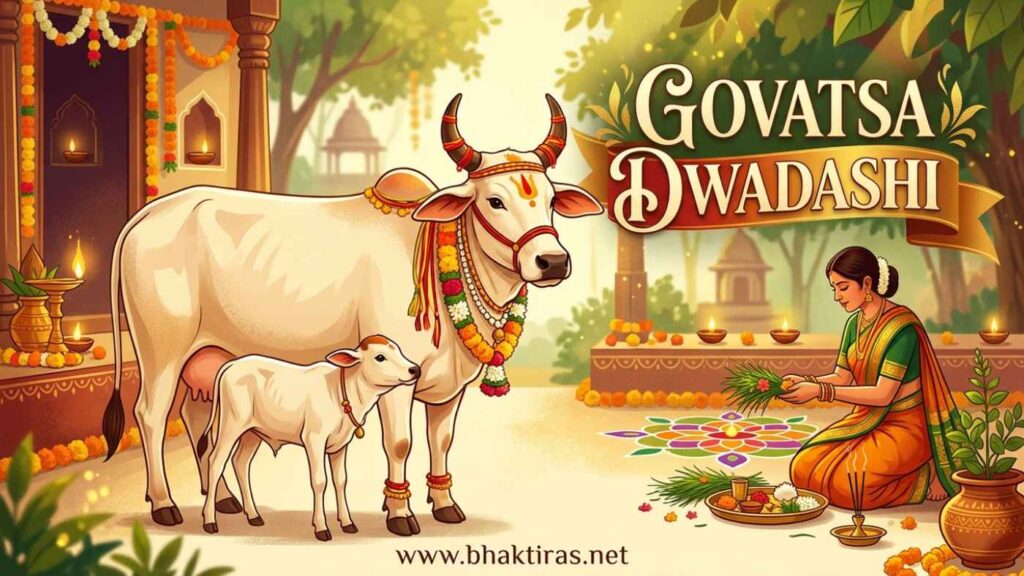
Govatsa Dwadashi is a quiet, tender festival that turns a whole household’s attention to the cow and her calf. Falling on the twelfth day of the dark fortnight of Kartik, the day before Dhanteras, it is the moment many families pause before the noise of Diwali to say thank you to the animal that has fed generations. In Maharashtra it is called Vasu Baras and marks the real start of the Diwali season. Mothers keep a vrat and pray for their children’s long life and good health.
Govatsa Dwadashi 2026-2028: Dates & Calendar
Govatsa Dwadashi next falls on Thursday, 5 November 2026. Because it follows the lunar Hindu calendar, the English date shifts every year, usually landing in late October or early November, always one day before Dhanteras.
| Year | Date | Day | Notes |
|---|---|---|---|
| 2025 | 17 October | Friday | Vasu Baras, before Diwali |
| 2026 | 5 November | Thursday | Next occurrence; opens Diwali in Maharashtra |
| 2027 | 25 October | Monday | One day before Dhanteras |
| 2028 | 14 October | Saturday | Start of the Diwali sequence |
The Dwadashi tithi does not always fill a full sunrise-to-sunrise day, so some panchangs fix the observance to the morning or evening when the tithi is current. When in doubt, follow the date given by your local temple or family panchang.
Why Govatsa Dwadashi Is Celebrated
Govatsa Dwadashi is celebrated to thank the cow and her calf, seen in Hindu tradition as living symbols of motherhood, patience and unearned giving. The festival honours the animal that provides milk, ghee and curd, and asks for the wellbeing of one’s own children in return.
Gratitude to the cow and calf
The word govatsa means calf. On this day the calf is worshipped alongside its mother, because it is the calf’s suckling that makes a cow give milk freely. Families feel that a household which has drunk a cow’s milk all year owes it a day of thanks, and this is that day.
Nandini and Kamadhenu
The cow is revered as Nandini, daughter of the wish-granting cow Kamadhenu who rose from the churning of the ocean. Worshipping the cow and calf is understood as honouring Kamadhenu herself, the source of abundance, and by extension the earth that sustains all life.
A mother's vrat for her children
Many women keep a vrat on Govatsa Dwadashi for the long life and health of their children, drawing a parallel between the cow’s care for her calf and a mother’s care for her child. The abstention from cow-milk products for the day is part of this fast.
The opening of Diwali
In Maharashtra, Govatsa Dwadashi is called Vasu Baras and is treated as the first day of the Diwali festival, coming just before Dhanteras. Cleaning the home, lighting the first lamps and honouring the cow together set a grateful tone for the days of light that follow.
Deities & Figures Worshipped
Govatsa Dwadashi centres on the cow and her calf as sacred figures, with Lord Krishna honoured as the cowherd god who is inseparable from cattle.
The cow and calf (Gau Mata)
The living cow with her calf is the heart of the day. She is addressed as Gau Mata, the mother cow, and worshipped with a lamp, kumkum, turmeric, a garland and offerings of green fodder. Where no cow is available, an image or a clay figure of a cow and calf is used.
Nandini / Kamadhenu
The cow honoured on this day is invoked as Nandini, a form of the divine cow Kamadhenu who fulfils every wish. Prayers acknowledge her as the wellspring of milk, health and prosperity for the family and the land.
Lord Krishna
Krishna, who grew up in Gokul among cows and is loved as Govinda and Gopala, the protector of cattle, is remembered on this day. His fondness for cows makes the worship of the cow and calf a way of honouring him too.
Key Rituals, Step by Step
The observance is simple and heartfelt, centred on the cow and calf rather than on elaborate ceremony. Here is how families usually keep the day.
- Rise early and clean. Bathe in the morning and tidy the home and the cattle shed. Those keeping the vrat begin their fast, resolving to avoid cow-milk products for the day.
- Bring the cow and calf together. A cow accompanied by her calf is brought to the courtyard or gate. If you have no cattle at home, visit a gaushala or a neighbour’s cow, or set up a clay image of a cow and calf.
- Bathe and adorn them. Wash the cow’s feet, apply haldi and kumkum to her forehead, drape a garland and, in many homes, tie a decorative cloth or bells on her.
- Perform the aarti. Light a lamp and incense and offer aarti to the cow and calf, circling the flame before them while reciting simple prayers of thanks.
- Offer sprouted grains. Feed germinated moong and gram, along with bajra rotis and green fodder, first to the calf and then to the cow. Sprouted pulses are the customary offering of the day.
- Listen to the katha. Gather to hear the Govatsa Dwadashi vrat katha, the traditional story that explains why the cow and calf are honoured and how the vrat protects one’s children.
- Pray for the family. Mothers pray for the long life and health of their children, and the household seeks the blessing of prosperity that the cow represents.
- Break the fast mindfully. Those fasting eat once, keeping to foods that contain no cow’s milk or wheat, and share the day’s simple prasad.
Special Foods of Govatsa Dwadashi
The food customs of the day follow one clear rule: nothing made from cow’s milk, and in many families nothing made from wheat either. Bajra and pulses take the place of the usual grains.
Bajra bhakri
Flatbread made from pearl millet (bajra) is the staple of the day, standing in for wheat rotis. It is eaten with a simple vegetable, often paired with buttermilk made from buffalo milk rather than cow’s milk where the rule is kept strictly.
Sprouted moong and gram
Germinated green gram and Bengal gram are both offered to the cow and calf and eaten by the family. Lightly cooked as a usal or eaten plain, sprouts suit the light, milk-free spirit of the vrat.
Moong preparations
Whole and split moong appear as khichdi, usal or a simple curry. Prepared without cow-milk ghee, they make a filling meal for those who fast until evening.
Milk-free prasad
Since cow’s milk, curd and ghee are set aside, the day’s prasad and sweets are made with jaggery, coconut and other non-dairy ingredients so that everyone can partake without breaking the day’s custom.
Regional Names & Variations
The same twelfth-day observance carries different names and shades of meaning across states, though the cow and calf stay at the centre everywhere.
Maharashtra (Vasu Baras)
Here it is Vasu Baras and is counted as the opening day of Diwali. Families clean the home, light the first lamps and worship a cow with her calf, treating the day as a grateful start to the festival of lights.
Gujarat (Vagh Baras)
In parts of Gujarat the twelfth-day observance is linked to Vagh Baras, marked by traders as the day to close and settle old account books before starting fresh for the new year, alongside reverence for the cow.
North India (Bach Baras / Nandini Vrat)
In several northern regions the day is called Bach Baras or observed as Nandini Vrat. Mothers keep the fast for their children and avoid wheat and cow-milk foods, worshipping the cow and calf for the family’s wellbeing.
Govatsa Dwadashi Do's and Don'ts
A few simple customs keep the spirit of the day intact.
Do
- Worship the cow together with her calf, never the cow alone.
- Offer sprouted moong, gram and green fodder to the animals.
- Feed and care for the calf first, as a gesture of tenderness.
- Keep the fast simply if you observe it, eating light, milk-free food.
- Support a local gaushala if you have no cow at home.
Avoid
- Do not consume cow’s milk, curd, ghee or buttermilk that day.
- Avoid wheat-based foods; use bajra and pulses instead.
- Do not use a knife or fried preparations made in cow-milk ghee for the puja meal in strict households.
- Do not treat the cattle roughly or turn the calf away.
- Avoid buying or gifting cow-milk sweets as the day’s prasad.
Frequently Asked Questions
When is Govatsa Dwadashi in 2026?
Govatsa Dwadashi 2026 is on Thursday, 5 November. It falls on the Dwadashi tithi of the waning fortnight before Diwali, one day before Dhanteras, and in Maharashtra opens the Diwali season as Vasu Baras.
When is Govatsa Dwadashi in 2027 and 2028?
Govatsa Dwadashi falls on Monday, 25 October 2027 and on Saturday, 14 October 2028. The date moves each year with the lunar calendar but always lands in late October or early November, just before Dhanteras.
Why is Govatsa Dwadashi celebrated?
Govatsa Dwadashi is celebrated to thank the cow and her calf for the milk and nourishment they give, honouring them as symbols of motherhood and abundance. Mothers also keep a vrat on this day and pray for the long life and health of their children.
Which god is worshipped on Govatsa Dwadashi?
On Govatsa Dwadashi the cow and calf are worshipped as Gau Mata and as Nandini, a form of the wish-granting divine cow Kamadhenu. Lord Krishna, the cowherd god raised among cattle, is also honoured because of his lifelong bond with cows.
What is Vasu Baras?
Vasu Baras is the Marathi name for Govatsa Dwadashi and is regarded in Maharashtra as the first day of Diwali. Families clean the home, light the first lamps and worship a cow with her calf, thanking them before the main days of the festival.
Why do people avoid milk and wheat on Govatsa Dwadashi?
On Govatsa Dwadashi many families avoid cow’s milk, curd and ghee out of respect, since the day is dedicated to the cow, and they also skip wheat, eating bajra and pulses instead. Setting these foods aside is part of the vrat kept for the family’s wellbeing.
How is Govatsa Dwadashi different from Gopashtami?
Both festivals honour the cow, but Gopashtami comes on the eighth day of the bright fortnight of Kartik and celebrates Krishna’s first day of taking the cows to graze. Govatsa Dwadashi falls on the twelfth day of the dark fortnight, just before Diwali, and focuses on the cow together with her calf and on a mother’s prayers for her children.
How is Govatsa Dwadashi connected to Diwali?
Govatsa Dwadashi comes one day before Dhanteras and, in Maharashtra as Vasu Baras, is treated as the opening day of the Diwali festival. It sets a grateful tone before Dhanteras, Naraka Chaturdashi, Lakshmi Puja and the days of light that follow.
May the blessing of Gau Mata bring health to your children and quiet abundance to your home. Happy Govatsa Dwadashi and a joyful start to Diwali.