
Gopashtami 2026 – The Day Krishna Became a Cowherd
गोपाष्टमी
When is Gopashtami in 2026?
Gopashtami falls on Tuesday, 17 November 2026. It is observed on the Ashtami (eighth day) of the bright fortnight of the Kartik month, marking the day young Krishna first took the cows of Vrindavan out to graze and became a Gopa, a cowherd. Cows and cowherds are bathed, decorated and worshipped, especially across the Braj region.
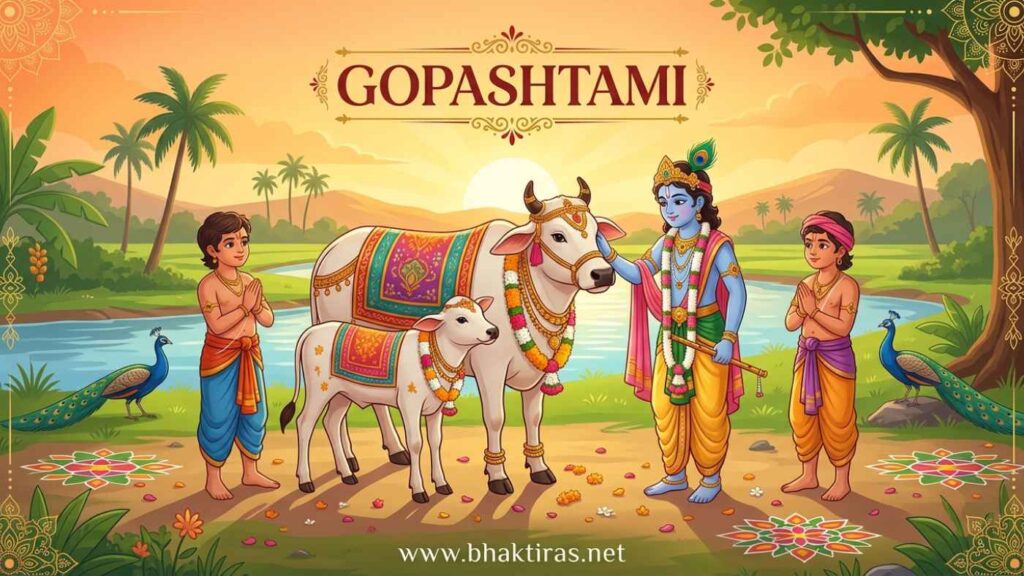
Gopashtami is a one-day Vaishnava festival that honours the day Krishna graduated from tending calves to leading the full herd of cows out to pasture, earning the name Gopa, or cowherd. Celebrated on the eighth day of the bright fortnight of Kartik, it centres on the worship of cows and cowherds and the deep reverence Hindu tradition holds for the cow as Gau Mata. It is dearest to the Braj region around Mathura and Vrindavan, and to Gujarati and North Indian devotees of Krishna.
Gopashtami 2026-2028: Dates & Calendar
Gopashtami 2026 falls on 17 November. Because it follows the Hindu lunar calendar, the date shifts each year against the Gregorian calendar, landing anywhere from late October to mid-November.
| Year | Date | Day | Notes |
|---|---|---|---|
| 2025 | 29 October | Wednesday | Past occurrence |
| 2026 | 17 November | Tuesday | Next occurrence |
| 2027 | 6 November | Saturday | Kartik Shukla Ashtami |
| 2028 | 25 October | Wednesday | Falls earlier in the season |
Gopashtami always comes a week after Govardhan Puja and Govatsa Dwadashi, forming a short cluster of festivals in Kartik that celebrate cows, cowherds and Krishna’s life in Vrindavan.
Why Gopashtami Is Celebrated
Gopashtami celebrates the day Nanda Baba first entrusted the young Krishna with the family’s cows, marking his passage from a child who watched calves to a true Gopa who led the herd. It is also a day of gratitude to the cow, revered in Hindu dharma as Gau Mata.
Krishna becomes a Gopa
Until this day the boy Krishna and his brother Balaram were allowed only to mind the calves near home. On Kartik Shukla Ashtami, Nanda Baba judged Krishna old enough to take the cows out to the forests of Vrindavan. Walking barefoot behind the herd, calling each cow by name, he formally became a cowherd, and the festival takes its name from that moment.
The cow as Gau Mata
Hindu tradition treats the cow as a mother figure whose milk sustains the household and whose care teaches gentleness and duty. Gopashtami is the year’s clearest expression of that respect: the cow is bathed, fed and honoured as a giver, not merely as livestock. Kamadhenu, the wish-fulfilling cow of the scriptures, is remembered as the source of this sanctity.
Krishna the protector of Braj
By taking on the cows, Krishna took on the life of the cowherds of Vrindavan whom he would go on to shelter, most famously by lifting Govardhan hill. Gopashtami quietly opens that chapter of his life, and Braj devotees see the day as the beginning of his role as protector and companion of the herding community.
A festival of duty and care
Beyond the story, the day carries a plain lesson about responsibility. Handing a child the herd was an act of trust, and worshipping the animals that feed a family is an act of thanks. Many gaushalas (cow shelters) hold their busiest day of the year on Gopashtami, when devotees come to feed and serve the cows.
Deities & Figures Worshipped
Gopashtami is dedicated to Krishna in his cowherd form and to the cow herself as Gau Mata. In Braj, Balaram is often honoured alongside his brother.
Krishna as Gopala
Krishna is worshipped as Gopala and Govinda, names that both mean protector or keeper of cows. Temples dress the deity as a young cowherd, sometimes with a peacock feather and a herding staff, and offer him butter, milk and sweets. The names Gopal and Govind are said to have come to him through his love for the cows.
Gau Mata (the cow)
The cow is the co-recipient of worship on Gopashtami. Cows are bathed, marked with tilak and haldi-kumkum, garlanded, and fed jaggery, grass and grains. Families and gaushalas circle the cows in parikrama and perform aarti, treating the animal as a living form of the sacred.
Balaram
In many Braj accounts Krishna’s elder brother Balaram took the cows out on the same day, and Vrindavan temples remember the pair together. Their joint role as young cowherds is part of what makes the festival so beloved in the region.
Key Rituals, Step by Step
Gopashtami worship moves outward from the home to the cow shelter and the temple. Families who keep cows begin at dawn; others visit a gaushala or a Krishna temple.
- Bathe and clean the cows. Early in the morning the cows and calves are washed and their sheds cleaned, so the animals are fresh before worship begins.
- Decorate the cows. The cows are marked with tilak and haldi-kumkum, given a mark on the forehead, draped with garlands and coloured cloth, and sometimes have their horns painted.
- Worship the cow and cowherd. A short puja is offered to the cow as Gau Mata, and to the gopas who tend the herd; lamps are lit and aarti is performed before them.
- Feed the cows. Devotees offer jaggery, fresh grass, grain, rotis and green fodder by hand, an act seen as feeding Gau Mata directly.
- Perform parikrama. Worshippers walk clockwise around the cows, and in some places let the touch of the passing herd’s dust fall on them as a blessing.
- Visit a gaushala. Those without cows of their own go to a cow shelter to feed and serve the animals, a central part of the day’s charity.
- Take Krishna’s darshan. Families visit Krishna temples, especially across Braj and at Nathdwara, where the deity is shown as Gopala and offered butter, milk and sweets.
Special Foods of Gopashtami
Because the day honours the cow, the food is built around milk and its products, offered first to Krishna and the cows and then shared.
Milk, curd and makhan
Fresh milk, thick curd and hand-churned white butter (makhan) are the heart of the day’s offerings, echoing the butter that the child Krishna is loved for stealing. They are placed before the deity and the cows before being shared.
Kheer
A slow-cooked rice and milk pudding, sweetened with sugar or jaggery and flavoured with cardamom, kheer is a common gau-bhog and prasad, prepared using the cow’s own milk wherever possible.
Panchamrit
A mix of milk, curd, ghee, honey and sugar, panchamrit is offered during the cow and Krishna puja and later given to devotees as a blessed sip.
Jaggery and grains for the cows
Alongside human food, the cows themselves are fed lumps of gur (jaggery), soaked grains, fresh grass and green fodder, offered by hand as the animal’s share of the festival.
Peda and milk sweets
Mathura’s famous milk pedas and other khoya sweets are offered at temples and distributed as prasad, tying the day’s sweetness back to the cow’s milk.
Regional Names & Variations
Gopashtami is felt most strongly in the Braj heartland but is kept by Krishna devotees across the north and west, each place adding its own colour.
Mathura & Vrindavan
The Braj towns hold the largest celebrations. Cows are decorated and paraded, temples such as Banke Bihari and the many Krishna shrines hold special darshan, and gaushalas fill with visitors. The day is seen here as part of Krishna’s own life story unfolding on home ground.
Nathdwara & Rajasthan
At the Shrinathji temple in Nathdwara, Krishna is worshipped in his cowherd child form, and Gopashtami is marked with special sringar (dressing) and offerings. The Pushtimarg tradition gives the cow and the young Gopala a central place.
Gujarat
In Gujarat’s Vaishnava haveli tradition, Gopashtami is observed with cow worship and rich milk offerings, and families connected to Pushtimarg havelis take part in the deity’s darshan and gau-seva.
North India
Across the wider north, temples and homes that keep cows perform go-puja, feed the animals and offer kheer and sweets, often continuing the run of cow-centred observances that began with Govatsa Dwadashi and Govardhan Puja.
Gopashtami Do's and Don'ts
A few simple customs keep the spirit of the day, which is care and gratitude, at its centre.
Do
- Bathe, decorate and feed cows with clean hands and a calm manner
- Visit a gaushala to serve or donate towards the care of cows
- Offer milk, curd, makhan and kheer to Krishna as Gopala
- Take darshan at a Krishna temple, especially in Braj if you can
- Involve children so they learn the day’s lesson of duty and care
Avoid
- Do not frighten, strike or overwork the cows on this day
- Avoid serving beef or any harm to the animal being honoured
- Do not treat the puja as a photo occasion at the animal’s expense
- Avoid feeding cows plastic-wrapped or unsuitable food
- Do not neglect the gaushala after the festival; the care is meant to continue
Frequently Asked Questions
When is Gopashtami in 2026?
Gopashtami in 2026 falls on Tuesday, 17 November. It is observed on the Ashtami tithi of the bright fortnight of the Kartik month, which places it about a week after Govardhan Puja and Diwali.
When is Gopashtami in 2027 and 2028?
Gopashtami will be on Saturday, 6 November 2027 and on Wednesday, 25 October 2028. The date moves each year because it is fixed to the Kartik Shukla Ashtami tithi in the Hindu lunar calendar rather than to a Gregorian date.
Why is Gopashtami celebrated?
Gopashtami is celebrated because it marks the day Krishna first took the cows of Vrindavan out to graze and became a Gopa, or cowherd. Nanda Baba judged him old enough to lead the herd, and the day also honours the cow as Gau Mata, revered in Hindu dharma as a mother and giver.
What does the word Gopashtami mean?
Gopashtami combines ‘Gopa’, meaning cowherd, and ‘Ashtami’, the eighth day of the lunar fortnight. Together the name marks the eighth day of Kartik’s bright half on which Krishna took up the life of a cowherd.
Which god is worshipped on Gopashtami?
Krishna is worshipped on Gopashtami in his cowherd form as Gopala and Govinda, names that mean keeper of cows. The cow herself is worshipped alongside him as Gau Mata, and in Braj his brother Balaram is often honoured too.
How is Gopashtami celebrated?
On Gopashtami cows are bathed, decorated with tilak and garlands, worshipped and fed jaggery, grass and grain, and circled in parikrama. Devotees visit gaushalas to serve cows, offer milk and kheer to Krishna, and take darshan at Krishna temples, most vividly in Mathura and Vrindavan.
Where is Gopashtami mainly celebrated?
Gopashtami is celebrated most intensely in the Braj region around Mathura and Vrindavan, where it is tied to Krishna’s own life. It is also widely observed at Nathdwara, in Gujarat’s Vaishnava haveli tradition, and across North India by Krishna devotees and families who keep cows.
What is the link between Gopashtami and Govardhan Puja?
Both festivals fall in Kartik and both centre on Krishna’s life as a cowherd in Braj. Govardhan Puja, a week earlier, recalls Krishna lifting Govardhan hill to shelter the cows and cowherds, while Gopashtami marks the day he first took on the cows himself, opening that chapter of his life.
May Gopala’s blessings and the grace of Gau Mata fill your home this Gopashtami. Jai Shri Krishna.