
Tiruvathira / Arudra Darshan 2026 – Shiva's Cosmic Dance
திருவாதிரை · തിരുവാതിര
When is Tiruvathira / Arudra Darshan in 2026?
Arudra Darshan (Tiruvathira) falls on Thursday, 24 December 2026. It is observed on the Ardra (Thiruvathirai) nakshatra of the Tamil month Margazhi, which matches the Malayalam month Dhanu. The day honours Lord Shiva as Nataraja, the cosmic dancer, and in Kerala it is kept as a women’s vratam for marital happiness.
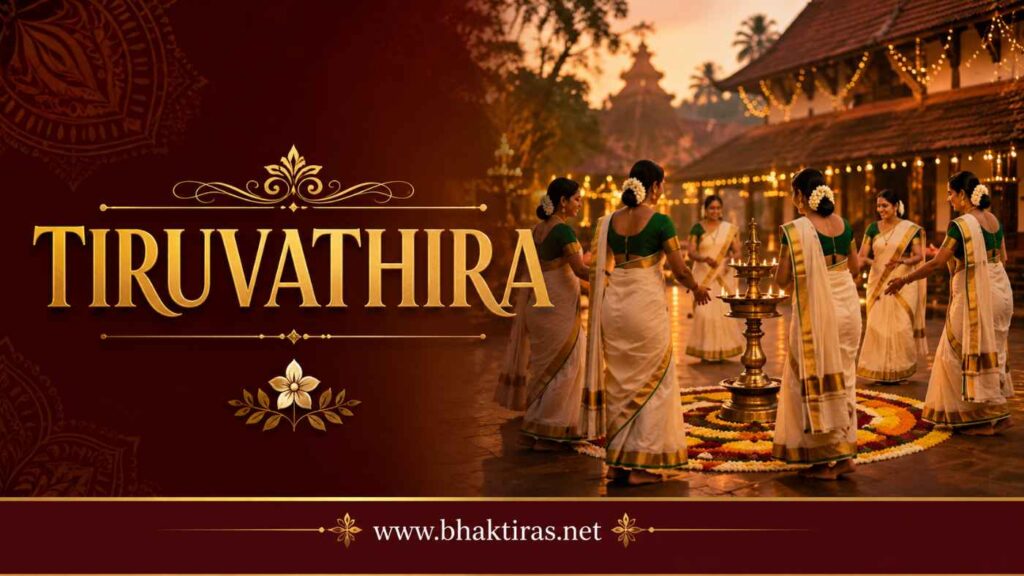
Tiruvathira, or Arudra Darshan, is the night the sky lets you glimpse Shiva as Nataraja, the dancer whose rhythm keeps the universe turning. It arrives on the Ardra nakshatra of the Tamil month Margazhi (the Malayalam month Dhanu), and in 2026 that falls on 24 December. In Tamil Nadu, temples such as Chidambaram hold a night-long abhishekam and bring the bronze Nataraja out in procession. In Kerala the same star is Thiruvathira, a fast kept mostly by women who dance the kaikottikali and pray for their households.
Arudra Darshan / Tiruvathira 2025-2028: Dates
The next Arudra Darshan is Thursday, 24 December 2026. Because it tracks the Ardra star in the lunar month of Margazhi against the solar calendar, the Gregorian date drifts and can even skip a calendar year.
| Year | Date | Day | Notes |
|---|---|---|---|
| 2025 | 13 January | Monday | Previous Margazhi observance |
| 2026 | 3 January | Saturday | Early-year observance (already passed) |
| 2026 | 24 December | Thursday | Next occurrence |
| 2027 | – | – | No Ardra-Margazhi date falls within 2027 |
| 2028 | 11 January | Tuesday | Next Margazhi observance |
The two dates in 2026 are not a mistake. The observance early in January 2026 belonged to the previous Margazhi, while the 24 December 2026 date opens the following cycle. That shift is also why 2027 has no separate calendar date of its own.
Why Arudra Darshan Is Celebrated
Arudra Darshan celebrates the moment devotees are allowed to behold Shiva’s Ananda Tandava, the dance of bliss through which he creates, sustains and dissolves the cosmos. It falls on the Ardra star of Margazhi, held to be Shiva’s own asterism.
The dance that runs the universe
Nataraja’s five acts (creation, preservation, dissolution, veiling and grace) are read into every part of the icon: the drum that sounds the first pulse of time, the fire that dissolves it, the raised foot that promises release. Arudra Darshan is the night this dance is formally revealed and worshipped.
Chidambaram and the space within
At the Nataraja temple in Chidambaram the sanctum holds the Chidambara Rahasya, an empty curtained space symbolising the formless divine. On Arudra Darshan the golden hall hosts a grand abhishekam, and the darshan of Nataraja on this star is considered especially fruitful.
Parvati's penance and Kamadeva
In the Kerala tradition the day is tied to Parvati’s long tapas to win Shiva, and to Kamadeva, the love-god burnt to ash by Shiva’s third eye and later restored. Women keep the vratam so their own marriages carry the same devotion and endurance.
The longest night
Arudra Darshan sits close to the winter solstice, among the longest nights of the year. Staying awake through it, singing and dancing before the lamp, turns the darkness into a vigil for Shiva rather than a thing to fear.
Deities & Figures Worshipped
The festival centres on Shiva in his dancing form as Nataraja, worshipped alongside Parvati (Sivakami). Kamadeva features in the Kerala legend behind the women’s fast.
Shiva as Nataraja
Nataraja is Shiva caught mid-dance, one foot planted on the dwarf of ignorance, the other lifted in grace, ringed by a halo of fire. Arudra Darshan is his night, and the bronze Nataraja is bathed and processed with special honour.
Parvati / Sivakami
Parvati, worshipped as Sivakami beside Nataraja, is the reason Kerala keeps the day as a women’s vratam. Her penance to marry Shiva models the devotion wives pray to carry into their own homes.
Kamadeva
Kamadeva, the god of love, was reduced to ash when he tried to rouse Shiva from meditation, then revived as a bodiless presence. His story threads the Thiruvathira fast that women keep for a happy married life.
Key Rituals, Step by Step
The observance splits along two lines: a temple-led night of worship in Tamil Nadu, and a home-and-community vratam led by women in Kerala.
- Pre-dawn bath. In Kerala, women rise well before sunrise for the thudichu kuli, a communal bathe in a pond or river, often singing traditional songs as they go in.
- The fast begins. Devotees keep a rice-free fast through the day. Unmarried girls fast to be blessed with a good husband; married women fast for their husbands’ long life and the welfare of the household.
- Dashapushpam and lamp. Ten sacred herbs (dashapushpam) are gathered and worn or kept, and a nilavilakku lamp is lit as the focus for the day’s songs and dance.
- Thiruvathirakali (kaikottikali). Women circle the lamp in a graceful clapping dance, singing songs about Shiva and Parvati. The circle stands for the turning cycle of creation the festival honours.
- Oonjal and songs. A decorated swing (oonjal) is hung, and women take turns swinging and singing devotional and folk verses through the evening.
- Temple abhishekam (Tamil Nadu). At Chidambaram and other Shiva temples, priests perform a long, layered abhishekam to Nataraja through the night, offering milk, curd, honey, sandal and more.
- Ananda Tandava darshan and procession. The high point is the darshan of Nataraja in his dance pose, followed by a procession of Nataraja and Sivakami around the temple, watched by large crowds.
Special Foods of Tiruvathira
The vratam keeps rice off the plate, so the festival food leans on tubers, wheat and roasted grains. The dishes differ between Kerala homes and Tamil temples.
Thiruvathira puzhukku
A thick stew of tubers and vegetables such as yam, colocasia, raw banana and pumpkin, seasoned with coconut and jeera. It is the defining dish of the Kerala vratam, cooked without rice.
Koova payasam
A gentle pudding made from koova (arrowroot) with jaggery and coconut milk. Being rice-free, it fits the fasting rule while still marking the day as a celebration.
Ettangadi
A roast of eight tubers and pulses, ettangadi is prepared for pathirappoochoodal on the eve of Thiruvathira and shared warm. It gives the fast its earthy, smoky character.
Sweet Pongal
In Tamil homes and temples, a sweet pongal of moong dal and jaggery is offered on Arudra Darshan and shared as prasadam.
Kali
Kali is a rich sweet made from rice flour or wheat with jaggery, and Thiruvathirai kali is a traditional Margazhi offering associated with this very star.
Regional Names & Variations
The same nakshatra carries two quite different observances, one temple-centred and one home-centred.
Tamil Nadu (Arudra Darshan)
Here it is a temple festival. Chidambaram is the epicentre, its golden hall hosting a night-long abhishekam and the darshan of Nataraja’s Ananda Tandava, echoed at Shiva temples across the state during Margazhi.
Kerala (Thiruvathira)
In Kerala it is a household and community day led by women, built around fasting, the kaikottikali dance, the oonjal swing and dishes like puzhukku. It is sometimes called Dhanu masam Thiruvathira after the Malayalam month.
Diaspora and other Shiva temples
Tamil and Malayali communities abroad keep the day with temple abhishekam and Thiruvathirakali gatherings, and many Shaiva temples outside these two states mark the Ardra star with special worship of Nataraja.
Tiruvathira Do's and Don'ts
A few simple customs guide the vratam and the temple observance.
Do
- Take the pre-dawn bath and begin the fast with a calm, prayerful mind
- Light the nilavilakku and gather for Thiruvathirakali and songs
- Prepare rice-free vratam food such as puzhukku, ettangadi and koova payasam
- Attend the temple abhishekam and Nataraja darshan where you can
- Include unmarried girls and elders in the dance and the swing
Avoid
- Do not eat rice during the fast; keep to wheat, tubers and roasted grains
- Do not break the vratam before the Thiruvathira star and worship are complete
- Do not treat the night as ordinary; the vigil and songs are part of the observance
- Do not turn the dance into mere display; keep its devotional focus on Shiva and Parvati
- Do not invent muhurat timings; follow your local temple’s panchangam for the star
Frequently Asked Questions
When is Arudra Darshan / Tiruvathira in 2026?
Arudra Darshan (Tiruvathira) is on Thursday, 24 December 2026. It follows the Ardra nakshatra in the Tamil month Margazhi, which is the Malayalam month Dhanu. Note that an earlier observance on 3 January 2026 belonged to the previous Margazhi cycle.
When is Arudra Darshan in 2027 and 2028?
There is no separate Arudra Darshan date within the 2027 calendar year, because the 24 December 2026 observance opens that lunar cycle. The next Margazhi observance falls on Tuesday, 11 January 2028, with a further date on 31 December 2028.
Why is Arudra Darshan celebrated?
Arudra Darshan celebrates the revealing of Shiva’s Ananda Tandava, the cosmic dance through which he creates, sustains and dissolves the universe. It falls on the Ardra star of Margazhi, held to be Shiva’s own asterism, making the darshan of Nataraja especially auspicious that night.
Which god is worshipped on Tiruvathira?
The festival is dedicated to Lord Shiva in his dancing form as Nataraja, worshipped together with Parvati (Sivakami). In Kerala the women’s fast is also linked to Kamadeva, the love-god restored by Shiva.
What is the difference between Arudra Darshan and Thiruvathira?
They are the same star observed in two ways. In Tamil Nadu, Arudra Darshan is a temple festival with a night-long abhishekam and Nataraja procession, centred on Chidambaram. In Kerala, Thiruvathira is a women’s vratam at home with fasting, the kaikottikali dance and the oonjal swing.
How do women observe the Thiruvathira vratam?
Women take a pre-dawn bath, keep a rice-free fast through the day, and light a nilavilakku lamp. They perform the Thiruvathirakali (kaikottikali) circle dance, swing on the oonjal and sing devotional songs, praying for marital happiness and the wellbeing of their families.
What food is eaten on Tiruvathira?
Because the fast excludes rice, the day is built around tubers, wheat and roasted grains. Kerala homes make thiruvathira puzhukku, ettangadi and koova (arrowroot) payasam, while Tamil kitchens and temples offer sweet pongal and kali.
Where is Arudra Darshan celebrated most grandly?
The grandest Arudra Darshan is at the Nataraja temple in Chidambaram, Tamil Nadu, whose golden hall enshrines Shiva’s dance. The night brings an elaborate abhishekam and a procession of Nataraja and Sivakami before large crowds.
May Nataraja’s dance keep your home in rhythm this Margazhi. Arudra Darshan valthukkal, Thiruvathira aashamsakal.