
Sitarama Kalyanam 2027 – Rama and Sita's Celestial Wedding
सीताराम कल्याणम्
When is Sitarama Kalyanam in 2027?
Sitarama Kalyanam falls on Thursday, 15 April 2027, held on Sri Rama Navami (Chaitra Shukla Navami). It is the ceremonial wedding of Lord Rama and Goddess Sita, performed most famously at the Bhadrachalam Sri Sita Ramachandraswamy temple in Telangana around the midday Abhijit muhurat.
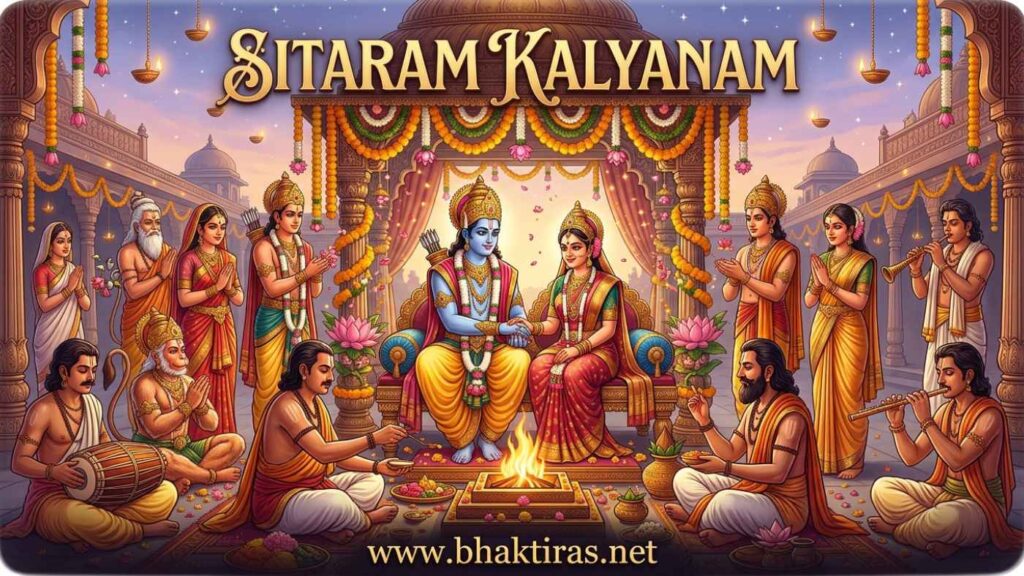
Sitarama Kalyanam is the ceremonial re-enactment of the wedding of Lord Rama and Goddess Sita, staged on Sri Rama Navami in the month of Chaitra (March or April). While northern India marks the day chiefly as Rama’s birth, the South treats the divine marriage as the emotional heart of the festival. The most celebrated Kalyanam takes place at the Bhadrachalam Sri Sita Ramachandraswamy temple on the banks of the Godavari in Telangana, drawing lakhs of devotees. In 2027 it falls on Thursday, 15 April.
Sitarama Kalyanam 2026-2028: Dates & Calendar
Sitarama Kalyanam is held on Sri Rama Navami, the ninth day of the bright fortnight of Chaitra, so the Gregorian date shifts each year with the lunar calendar. The next occurrence is 15 April 2027.
| Year | Kalyanam Date | Day | Notes |
|---|---|---|---|
| 2026 | 27 March | Friday | Vaishnava Rama Navami; Bhadrachalam Kalyanam (smarta date 26 March) |
| 2027 | 15 April | Thursday | Next occurrence |
| 2028 | 3 April | Monday | Chaitra Shukla Navami |
At Bhadrachalam the marriage is conducted during the midday muhurat, traditionally around the Abhijit or Madhyahna period near noon, when the Kalyanam mandapam is at its fullest.
Why Sitarama Kalyanam Is Celebrated
Sitarama Kalyanam celebrates the marriage of Rama and Sita as the model of an ideal, dharmic union. In the South, re-enacting their wedding on Rama Navami turns the god’s birthday into a joyous family occasion the whole town shares in.
For Telugu and wider South Indian devotees, the Kalyanam is not a symbolic add-on but the main event of Rama Navami. Householders host smaller Kalyanams in their own homes and neighbourhoods, echoing the grand temple ceremony and inviting Rama and Sita to bless every family the way the couple blesses the cosmos.
The ideal couple
Rama and Sita are held up as the perfect husband and wife, bound by loyalty, patience and shared duty. Witnessing their wedding is believed to bring harmony to marriages and to households, which is why unmarried devotees and newlyweds attend in large numbers.
Bhadrachalam and Bhakta Ramadasu
The Bhadrachalam temple owes its fame to the 17th-century devotee Kancharla Gopanna, known as Bhadrachala Ramadasu. A revenue officer under the Golconda Sultanate, he used state funds to build the shrine and was jailed for twelve years, composing hundreds of Rama kirtanas in prison that are still sung at the Kalyanam.
The government's pearl-and-silk tradition
After releasing Ramadasu, the ruler began sending pearls and silk robes to Rama and Sita for the wedding. The custom survived every later regime; to this day the Telangana government formally presents mutyala talambralu (rice mixed with pearls) and pattu vastralu (silk garments) at the Bhadrachalam Kalyanam each year.
A wedding, not just a birth
The Kalyanam distinguishes South Indian Rama Navami from the northern observance. Where the north focuses on Rama’s janma (birth) with jhankis and processions, the South stages the full marriage rite, complete with mangalsutra, saptapadi and talambralu, as the day’s centrepiece.
Deities & Figures Worshipped
The ceremony centres on the divine bride and groom, Sita and Rama, worshipped together as Sitarama. Their close companions are honoured alongside them in the temple tableau.
Lord Rama
The seventh avatar of Vishnu and prince of Ayodhya, Rama is worshipped as the groom (varudu). At Bhadrachalam he is enshrined as Sri Sita Ramachandra Swamy, and his marriage is performed with full Vedic honours.
Goddess Sita
Daughter of King Janaka and an incarnation of Lakshmi, Sita is the bride (vadhuvu). Her hand is formally offered to Rama in the Kanyadanam, and she receives the mangalsutra as the marriage is sealed.
Lakshmana
Rama’s devoted younger brother stands beside him throughout the exile and the wedding tableau. He is present in the Bhadrachalam sanctum, worshipped as the ever-loyal companion who never left Rama’s side.
Hanuman
The greatest devotee of Rama, Hanuman is invoked at every Rama celebration. He is honoured as the protector of the couple and the ideal bhakta whose devotion the Kalyanam crowd aspires to.
Key Rituals, Step by Step
At Bhadrachalam the Kalyanam is conducted on a decorated mandapam following the Pancharatra Agama tradition, with the wedding rites mirroring a human Telugu marriage. The sequence below is the typical order on the day.
- Decoration and procession. The utsava murtis of Rama and Sita are bathed, adorned in fresh silks and jewellery, and brought to the flower-decked Kalyanam mandapam as Vedic chanting and Ramadasu kirtanas fill the temple.
- Snatakam and Gauri puja. Preliminary rites are performed for the groom and bride, including the traditional Gauri puja for Sita, preparing the couple for the marriage in the manner of a mortal wedding.
- Kanyadanam. Sita’s hand is formally offered to Rama, the sacred giving-away that marks the parents’ consent and the purity of the union.
- Mangalsutra Dharana. At the auspicious midday muhurat, Rama ties the mangalsutra (sacred nuptial thread) around Sita’s neck, the moment the vast crowd waits for, greeted with conches, nadaswaram and cheers.
- Talambralu. The couple shower each other with talambralu, rice tinted with turmeric, kumkum and, at Bhadrachalam, mixed with pearls (mutyala talambralu); the same blessed rice is then shared among devotees.
- Saptapadi. The divine pair take the seven symbolic steps together, each step a vow of companionship, trust and shared dharma that completes the marriage.
- Government offering. Representatives of the state present pattu vastralu and mutyala talambralu on behalf of the government, continuing the centuries-old pearl-and-silk tradition begun after Ramadasu.
- Distribution of prasadam. Panakam, vadapappu and other cooling offerings are distributed to all present, closing the celebration on a sweet, community note.
Special Foods of Sitarama Kalyanam
Because Rama Navami falls at the start of the hot season, the prasadam is deliberately cooling and simple. These dishes are offered at the temple and prepared in homes across Andhra, Telangana and Karnataka.
Panakam
A jaggery drink flavoured with cardamom, dry ginger and a pinch of pepper, sometimes edible camphor. Light and thirst-quenching, it is the signature Rama Navami offering and is handed out to every visitor.
Vadapappu
Simply soaked and drained yellow moong dal, kept plain and cooling. It accompanies panakam as the classic paired naivedyam for the day.
Kosambari
The Karnataka cousin of vadapappu, this fresh salad of soaked moong dal with cucumber, grated coconut and a light tempering is offered in Kannada homes and Rama temples.
Chalimidi
A soft sweet of raw rice flour kneaded with jaggery, cardamom and a little water. It needs no cooking and is a traditional Rama Navami prasadam in Telugu households.
Jeelakarra-bellam
A paste of cumin (jeelakarra) and jaggery (bellam) that the bride and groom place on each other’s heads at the muhurat in Telugu weddings, symbolising an inseparable bond; the same ritual is enacted in the Kalyanam.
Where Sitarama Kalyanam Is Celebrated
The Kalyanam is a distinctly South Indian expression of Rama Navami, strongest in the Telugu-speaking states but observed across the Deccan and the Tamil country.
Bhadrachalam, Telangana
The grandest Kalyanam of all, on the Godavari at the Sri Sita Ramachandraswamy temple. Lakhs attend the midday wedding, the state presents mutyala talambralu and pattu vastralu, and Ramadasu’s kirtanas are sung through the day.
Andhra Pradesh
Temple and street Kalyanams are held town by town, with One Town Rama temples, Ontimitta (near Kadapa) and countless neighbourhood pandals staging their own weddings, often with the same jeelakarra-bellam and talambralu rites as a family marriage.
Karnataka
Rama temples across the state hold Sitakalyana, with kosambari and panaka distributed as prasadam. Ramanavami music festivals, especially in Bengaluru, run alongside the temple observance.
Tamil Nadu
Sri Rama temples mark Sri Rama Navami with the Kalyana Utsavam of Rama and Sita, and the nine-day Ramayana recitation culminating in the wedding is a widespread custom in Vaishnava shrines.
How it differs from northern Rama Navami
In North India the day centres on Ramlalla’s birth with fasting, jhankis and Ramayana path; the wedding is not the main rite. In the South, staging the Sitarama Kalyanam itself is the defining act of the festival.
Sitarama Kalyanam Do's and Don'ts
A few simple observances help you take part respectfully in the Kalyanam, at the temple or at home.
Do
- Attend or watch the Kalyanam at the midday muhurat, when the mangalsutra is tied.
- Offer or accept panakam, vadapappu and talambralu as blessed prasadam.
- Chant Rama’s name or sing Ramadasu kirtanas and bhajans through the day.
- Keep a light, sattvic diet; many devotees fast until the wedding is over.
- Dress modestly and reach the temple early, as crowds at Bhadrachalam are very large.
Avoid
- Do not consume onion, garlic, meat or alcohol on the day.
- Do not treat the talambralu or panakam casually; they are consecrated offerings.
- Avoid arriving after the muhurat and missing the central marriage rite.
- Do not push or jostle in the crowd; move calmly in the queue lines.
- Do not confuse the Kalyanam with the plain birth observance; the wedding is the point of the day.
Frequently Asked Questions
When is Sitarama Kalyanam in 2027?
Sitarama Kalyanam in 2027 is on Thursday, 15 April, held on Sri Rama Navami (Chaitra Shukla Navami). The wedding of Rama and Sita is performed at the midday muhurat, with the grandest ceremony at Bhadrachalam in Telangana.
When is Sitarama Kalyanam in 2026 and 2028?
Sitarama Kalyanam is on Friday, 27 March 2026 (the Vaishnava Rama Navami observed at Bhadrachalam; the smarta date is 26 March) and on Monday, 3 April 2028. The date shifts each year because it follows the Hindu lunar calendar.
How is Sitarama Kalyanam different from Rama Navami?
Sitarama Kalyanam is the wedding ceremony of Rama and Sita, celebrated on the day of Rama Navami. Rama Navami itself marks Rama’s birth, and in North India that birth is the focus; in South India the day’s centrepiece is instead the re-enactment of the divine marriage, complete with mangalsutra, talambralu and saptapadi.
Why is Sitarama Kalyanam celebrated?
Sitarama Kalyanam is celebrated to honour Rama and Sita as the ideal couple and to invite their blessing on families and marriages. Re-enacting their wedding turns Rama Navami into a shared celebration, and at Bhadrachalam it also continues a tradition of devotion begun by the saint Bhadrachala Ramadasu.
Where is the most famous Sitarama Kalyanam held?
The most famous Sitarama Kalyanam is held at the Sri Sita Ramachandraswamy temple in Bhadrachalam, Telangana, on the banks of the Godavari. Lakhs of devotees attend, and the state government formally presents mutyala talambralu (rice mixed with pearls) and silk garments for the wedding.
What is talambralu at the Kalyanam?
Talambralu is rice coloured with turmeric and kumkum that the bride and groom shower over each other during the wedding. At Bhadrachalam it is enriched with pearls, called mutyala talambralu, and after being poured over Rama and Sita it is distributed to devotees as prasadam symbolising prosperity and blessings.
What foods are offered on Sitarama Kalyanam?
The classic offerings are panakam (a cooling jaggery drink with cardamom and pepper) and vadapappu (soaked moong dal), along with chalimidi (a rice-flour and jaggery sweet) and kosambari in Karnataka. These simple, cooling foods suit the start of the hot season and are shared as prasadam.
Who was Bhadrachala Ramadasu?
Bhadrachala Ramadasu was the 17th-century devotee Kancharla Gopanna, a revenue officer under the Golconda Sultanate who built the Bhadrachalam temple. Jailed for twelve years for using state funds, he composed hundreds of Rama kirtanas that are still sung at the Kalyanam, and his story gave rise to the government’s annual pearl-and-silk offering.
May the wedding of Sita and Rama bring harmony to your home. Sri Sita Ramachandra Parabrahmane Namah.