
Kadalekai Parishe 2026 – Bengaluru's Groundnut Fair at the Bull Temple
ಕಡಲೆಕಾಯಿ ಪರಿಷೆ
When is Kadalekai Parishe in 2026?
Kadalekai Parishe 2026 peaks on Monday, 7 December, with stalls spread around the Dodda Basavana Gudi (Bull Temple) in Basavanagudi, Bengaluru, from about 5 to 8 December. The groundnut fair always falls on the last Monday of the Kannada month of Karthika, so the Gregorian date shifts each year.
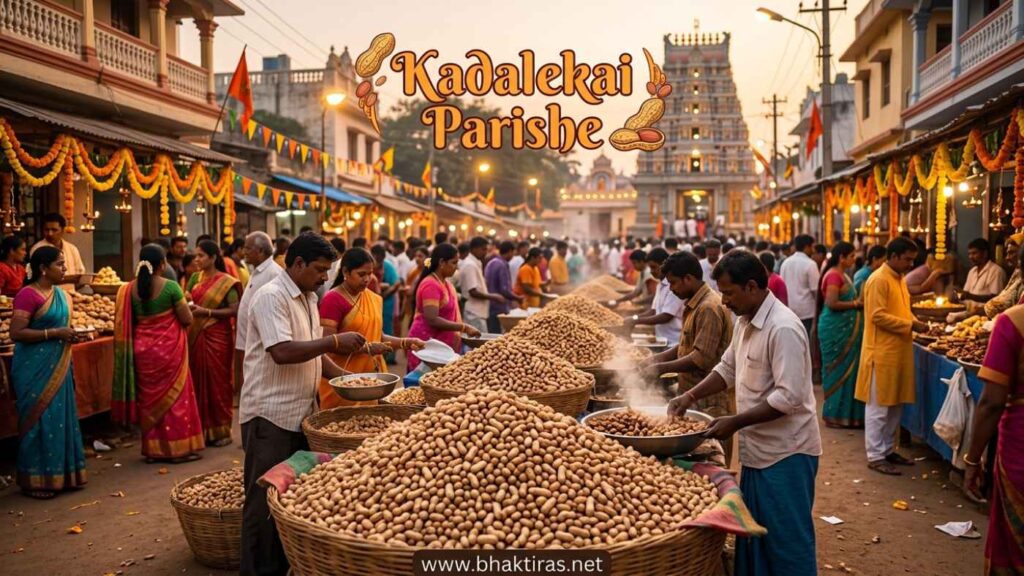
Kadalekai Parishe, the Groundnut Fair, is one of Bengaluru’s oldest street festivals, held each year around the Dodda Basavana Gudi (Bull Temple) and Bugle Rock in Basavanagudi. On the last Monday of the Kannada month of Karthika, farmers bring the season’s first groundnut harvest to offer to Basava, the sacred bull who is the mount of Shiva. What begins as a temple offering spills into a kilometre-long fair of roasted and boiled groundnut, toys, bangles and street food. In 2026 the peak day is Monday, 7 December.
Kadalekai Parishe 2026-2028: Dates & Calendar
Kadalekai Parishe 2026 peaks on Monday, 7 December. The fair follows the Kannada lunar calendar, landing on the last Monday of Karthika masa, so it moves between mid-November and early December each year.
| Year | Main day | Day | Fair window |
|---|---|---|---|
| 2026 | 7 December | Monday | Approx. 5-8 December (peak on the 7th) |
| 2027 | 22 November | Monday | Around 20-23 November |
| 2028 | 13 November | Monday | Around 11-14 November |
The one-day peak falls on the last Monday of Karthika, but stalls usually open a day or two earlier and stay through the following evening, when tradition says Basava himself comes to eat the leftover groundnut shells on the streets.
Why Kadalekai Parishe Is Celebrated
Kadalekai Parishe marks the offering of the season’s first groundnut harvest to Basava, the sacred bull, in thanks for protecting the crop. It is both a religious rite and one of Bengaluru’s oldest community fairs, tracing back several centuries.
The first harvest, offered
Groundnut has long grown in the fields around Basavanagudi and the villages that once ringed old Bangalore. Farmers bring the very first pods of the new crop to the Bull Temple and lay them before Nandi, asking for a good yield and safe fields. The fair grew out of this simple act of gratitude.
The legend of the hungry bull
Folk memory tells of a bull that came on moonlit nights and ate the groundnut crop, ruining farmers season after season. When villagers chased it up the rocky hill one night, it turned to stone as a Nandi idol that kept growing until an iron peg was driven in to hold it. Reading this as a sign, farmers pledged the first of every harvest to Basava, and the offering became a yearly fair.
One of Bengaluru's oldest fairs
The parishe has been held around the Bull Temple for centuries, with local accounts placing its roots in the 1530s. As the city grew around Basavanagudi and Bugle Rock, the fair kept its place, making it a rare living link between old agrarian Bangalore and the modern metropolis.
Agriculture meets the city
For a day the streets of a busy tech city fill with farmers, cart-loads of groundnut and the smell of roasting nuts. Kadalekai Parishe keeps a farming ritual alive in the middle of urban Bengaluru, drawing families, students and traders together in one crowded, cheerful stretch of road.
Deity Worshipped: Basava (Nandi)
The fair centres on Basava, or Nandi, the sacred bull who serves as the mount and gatekeeper of Lord Shiva. He is worshipped at the Dodda Basavana Gudi, the Bull Temple, home to one of India’s largest monolithic Nandi carvings.
Basava / Nandi
Nandi is the bull companion of Shiva, a symbol of strength, patience and devotion. As guardian of the fields and of Shiva’s abode, he is the natural recipient of a farmer’s first harvest. During the parishe, groundnut is offered to him with coconuts, flowers and lamps.
The giant monolithic Nandi
The Dodda Basavana Gudi enshrines a single-stone Nandi about 15 feet tall and 20 feet long, one of the biggest in the country. Built in the Dravidian style during the Vijayanagara period, the temple is the anchor of the whole fair, and long queues form for darshan through the day.
Shiva in the background
Because Nandi faces and serves Shiva, the fair carries a quiet Shaiva devotion. Many worshippers visit the nearby Dodda Ganapathi (large Ganesha) shrine and other temples in Basavanagudi on the same trip, weaving the parishe into a small local pilgrimage.
How Kadalekai Parishe Unfolds, Step by Step
The day moves from a quiet temple offering to a roaring street fair. Here is how it usually plays out.
- Farmers arrive with the harvest. From villages around Bengaluru and further across Karnataka, growers reach Basavanagudi with sacks and cartloads of freshly dug groundnut, the first of the season.
- The offering to Nandi. Devotees carry groundnut, coconuts, flowers and lamps to the Dodda Basavana Gudi and place them before the giant Nandi, seeking blessings for their crops and homes.
- Darshan and puja. Priests perform aarti to Basava through the day; worshippers queue for darshan and receive a little of the offered groundnut back as prasada.
- The stalls take over the streets. Along Bull Temple Road and the lanes around Bugle Rock, hundreds of vendors set up, and the road turns into a nearly kilometre-long market of groundnut in every form.
- Buying by the measure. Groundnut is sold by the seru or small heaps, boiled, roasted and raw, alongside chikki, jaggery and colourful sweets that families carry home in paper bags.
- The fair beyond groundnut. Toys, bangles, kitchen tools, balloons and street food such as bajji and bonda draw children and shoppers well into the evening.
- The night belief. On the closing night, tradition holds that Basava himself roams the streets to eat the groundnut shells left behind, so the fair ends with the bull symbolically taking his share.
What to Eat at Kadalekai Parishe
Groundnut is the star in every possible form, but the fair also serves up classic Bengaluru street snacks.
Boiled groundnut
Fresh green pods boiled in salted water, sold steaming hot in paper cones. Soft and mild, this is the first thing most visitors buy and eat while walking the fair.
Roasted groundnut
Dry-roasted in giant iron pans over open flame until the shells crackle. The smoky, crisp nuts are the sound and smell of the parishe and travel well as a take-home snack.
Kadalekai chikki
Brittle made from groundnut set in molten jaggery or sugar, snapped into slabs. A sweet, sticky favourite that families stock up on by the bagful.
Jaggery & sweets
Blocks of jaggery, sesame sweets and brightly coloured sugar candies line the stalls, a nod to the harvest and to children’s tastes alike.
Bajji, bonda & mirchi
Hot fritters straight from bubbling oil, from onion and potato bondas to chilli bajjis, keep the crowd fed through a long day of shopping.
Filter coffee & sugarcane juice
Basavanagudi’s tiffin culture is close by; a strong South Indian filter coffee or a glass of fresh sugarcane juice rounds off the fair-day snacking.
Where It Happens: Basavanagudi & Around
Kadalekai Parishe is a distinctly Bengaluru event, tied to a specific cluster of old-city landmarks.
Dodda Basavana Gudi (Bull Temple)
The heart of the fair, this 16th-century temple houses a huge monolithic Nandi and gives Basavanagudi its name. Every offering and much of the crowd flows through here.
Bugle Rock
A cluster of ancient granite outcrops beside the temple, now a shaded park. The fair spreads along the roads around it, and families climb the rocks for a view over the crowd.
Basavanagudi neighbourhood
One of Bengaluru’s oldest planned localities, full of temples, tiffin rooms and tree-lined roads. Bull Temple Road becomes a pedestrian sea of stalls on fair day.
Malleshwaram edition
In recent years a companion groundnut fair has been held in Malleshwaram in North Bengaluru around the same season, letting the city celebrate the harvest in two neighbourhoods.
Kadalekai Parishe Do's and Don'ts
A few practical tips to enjoy the fair and respect the temple.
Do
- Reach early or in the cooler evening to avoid the thickest crush of the crowd.
- Use public transport or a metro-plus-walk plan; parking near the Bull Temple is very tight on fair day.
- Buy groundnut by the small measure first and taste before stocking up.
- Dress modestly and remove footwear before entering the temple for darshan.
- Keep an eye on children and belongings in the dense crowd.
Avoid
- Do not drive right up to the temple expecting to park; roads are closed or jammed.
- Do not litter groundnut shells everywhere; use the bins, as recent editions push for a plastic-free, cleaner fair.
- Do not bring large bags or valuables you cannot watch in the crush.
- Do not haggle aggressively with small farmer-vendors; prices are already modest.
- Do not block the temple queue for photos; step aside for those seeking darshan.
Frequently Asked Questions
When is Kadalekai Parishe in 2026?
Kadalekai Parishe 2026 peaks on Monday, 7 December, at the Dodda Basavana Gudi (Bull Temple) in Basavanagudi, Bengaluru. The fair usually runs for two to three days, roughly 5 to 8 December, with the main offering and biggest crowds on the 7th.
When is Kadalekai Parishe in 2027 and 2028?
Kadalekai Parishe falls on the last Monday of Karthika masa each year, so it moves. It is expected on Monday, 22 November 2027 and Monday, 13 November 2028, with the fair spread over a couple of days around each main Monday.
Why is Kadalekai Parishe celebrated?
Kadalekai Parishe celebrates the offering of the season’s first groundnut harvest to Basava, the sacred bull, in thanks for protecting the crop. It grew from a farmers’ ritual at the Bull Temple into one of Bengaluru’s oldest street fairs, blending harvest gratitude with community festivity.
Which god is worshipped at Kadalekai Parishe?
The fair honours Basava, or Nandi, the sacred bull who is the mount and gatekeeper of Lord Shiva. He is worshipped at the Dodda Basavana Gudi in Basavanagudi, which enshrines one of India’s largest monolithic Nandi carvings.
Where is Kadalekai Parishe held?
Kadalekai Parishe is held around the Dodda Basavana Gudi (Bull Temple) and Bugle Rock in Basavanagudi, in South Bengaluru, Karnataka. Stalls stretch nearly a kilometre along Bull Temple Road and the surrounding lanes.
What is the story behind Kadalekai Parishe?
Local legend says a bull kept eating the groundnut crop at night until villagers chased it up a hill, where it turned to a stone Nandi that grew until an iron peg held it in place. Taking this as divine, farmers vowed to offer their first harvest to Basava every year, and that vow became the fair.
What food is sold at Kadalekai Parishe?
Groundnut leads the fair in every form: boiled, roasted, raw and made into chikki brittle. Stalls also sell jaggery, colourful sweets, and Bengaluru street snacks such as bajji, bonda and hot fritters, along with toys, bangles and household goods.
How old is Kadalekai Parishe?
Kadalekai Parishe has been held at the Bull Temple for centuries, with local tradition tracing it to the 1530s. That makes it one of the oldest continuously celebrated fairs in Bengaluru, a living link to the city’s farming past.
Whether you come for the darshan of Nandi or simply for a warm cone of boiled groundnut, Kadalekai Parishe is Bengaluru at its most rooted. Kadalekai koḷḷi, harasi hōgi – take some groundnut and go blessed.